
The Collapsing Minds of the ‘Collapsing Climate’ Cult: Part II – Science vs The Consensus Manufacturing Machine

Understanding the difference between a scientific consensus and a consensus of scientists.
Originally published on A Plague on Both Houses substack.
“Madness does not come by breaking out, but by giving in; by settling down in some dirty, little, self-repeating circle of ideas; by being tamed.” – G.K. Chesterton, Manalive
What science is and what science isn’t
Science is a method or process that seeks to explain phenomena in the natural world. Prefacing science’s objective with the word “seeks” implies that real science very rarely claims to arrive at The Truth for all time on any particular subject of investigation, particularly more complex matters such as the Earth’s climate.
Scientific investigation has been largely confined to the “natural world” because it cannot apply to things that are not observable and therefore not subject to objective experience and experimentation – things such as faith in God. However, the scientific method need not be exclusively confined to the natural world provided that the subject of inquiry can be measured by reference to observable phenomena and empirical testing. Hence the ability to obtain a science degree in psychology. Human behaviour is an observable phenomenon, and subject to theoretical explanations.
Scientific knowledge encompasses theories about how observable phenomena work, laws that explain mechanisms and patterns of action, and empirical data to support both the theories and the laws. This knowledge is accumulated in an iterative process of experimentation, and/or observation of the phenomena under investigation. Any claims made must be based on reliable observations, data, and experimental design.
Claims made must be testable and falsifiable, and, crucially, the results of any experimentation or observation must be repeatable or replicable. The inability to independently replicate the results of experiments or observations points to potential flaws in the hypothesis, the empirical evidence, or both.
Scientific knowledge is not absolute. It advances when better theories and/or better evidence emerge. This is why scepticism is fundamental to the scientific method. A well-designed experiment, or a truly scientific approach to natural-world observations, entails trying to prove that the hypothesis is wrong, not that it is right. Trying to prove that a theory is wrong is the correct mindset for approaching a hypothesis since, if the hypothesis survives rigorous and repeated scepticism, it is more likely to be true than false.
Real scientists rarely claim they’ve reached the end-point of knowledge on any subject, and they rarely claim a degree of certainty about their findings that rules out further surprises down the road. Real science and real scientists therefore welcome challenges to their theories and observations because admitting dissent is absolutely fundamental to advancing truth. Herr Kommandant Packham, please take note.
All of the above exposes the dictum of ‘following the science’ to be a childish absurdity, since, as Judith Curry points out, ‘following the science’ is not supposed to lead anywhere other than to more questions and more discovery. Science is a process of ongoing discovery. There is no end point other than the expectation and production of more surprises about previous findings. To quote climate scientist Tamsin Edwards[1]:
“Science is always sold as facts, and it’s not; it’s process. And that process is mainly arguing.”
As I will attempt to show in this and the next essay, what has actually happened is that an institution – the IPCC – which is not a scientific body, has capitalised on a general ignorance of how science is supposed to work. The only way you could buy into the idea that the science on an issue as complex as the Earth’s climate system was all ‘settled’ is if you believed that scientists were a group of people who regularly met around a table in order to agree on everything, and then issued statements of agreement to the general public. It’s quite the opposite. Scientists – at least genuine ones – are the sort of people who love to disagree with each other, and to prove each other wrong. They’re a lot like the chap in the Monty Python sketch who enjoys arguing so much that he seeks out a service offering arguments for a fee.
None of this is actually controversial or surprising to rational people. But these basic markers must be laid down because I am going to argue in this piece that the self-appointed body for advancing scientific truth about climate change is not doing science. Furthermore, given the certainty that it is trying to promote about a fiendishly complex area of science fraught with deep uncertainty, it is staggering to see educated people making claims, with absolute certainty, about the primary cause of global warming and what needs to be done about it. One such person wrote: “i [sic] fail to see how we can make it to 2030, barring some drastic changes in what we do and how we live.”
The apocalyptic climate cult has been announcing that The End is coming within five or ten years since 1988. This amounts to making a ridiculous bet, and then doubling down every time you lose in the firm belief that the event you’re betting on will eventually crystallise within your lifetime. And if you die before the event occurs, well so what; you’re dead. Who’s going to hold you to account?
But let’s be clear – this bet is not based on science. It’s based on a fundamental and irrational belief that the world is actually coming to an end within the gambler’s lifetime. In other words, the fundamental belief underlying the bet is not science; it’s an apocalyptic cult belief. Not only that, but it’s a belief that the apocalypse will happen in their lifetime. Now, it could happen; it is possible. But, given how long we’ve been surviving on this planet, it’s not something to be certain about, and the golden rule of betting on uncertain events with short timeframes is that the past is the best indicator of the future.
It would also be a little harder to ridicule them if they were hanging their apocalyptic hats on nuclear war, a comet, or even AI. But choosing something as fickle as the weather is not a great strategic move. Sensible Brits will know this better than anyone else.
What appears to be stratospheric idiocy is actually mental illness induced by decades of relentless climate alarmism. That’s not me being mean-spirited. I’m just reporting what the BBC is saying. Dust off your old copy of the Diagnostic and Statistical Manual of Mental Disorders because we’ve got a new entry: heatwave anxiety is now a proper thing. Human-caused climate change is the culprit, but its equally evil accomplices are… drum roll… rotten stinking climate deniers.
If you want to understand schadenfreude in the context of media reporting, then look no further than this BBC article titled: “Heatwave anxiety can make you feel ‘incredibly helpless’ – here’s how to manage it.” The BBC, as the nation’s rescuer and moral nanny needs victims to fulfil its role. It needs climate alarmism as grist for its rescuing and moralising mill. It’s therefore actually pleased to report that poor “Lizzie Ellen was ‘terrified’ when she first learned about The Climate Change in school, although at the time it felt as though it was ‘quite far off’ “.
I empathise completely with Lizzie on that. I remember everything that really mattered to me always seemed far off when I was in school. For me, the end of school could not have come too soon. But once school’s over, beastly Father Time cruelly changes his whole character and starts to march on relentlessly. And before you know it, you’re being thrust into the limelight of Aunty Beeb’s climate propaganda, solemnly testifying that this latest heatwave is the definitive sign that The End really is nigh this time. Or at least nigher than it was last time.
It’s not a drill any longer! Forget about all the other 27 false alarms. This one’s The One. I imagine they must be relieved after all this waiting. After all, keeping a climate apocalypse Advent Calendar and counting down the days to eternal combustion in climate hell is its own torture. At long last, this summer has brought them … what’s the word I’m looking for… certainty. That’s right – certainty! It’s really happening this time. According to my newfound climate alarmist pal who “fail[s] to see how we can make it to 2030”, you’ve got three years left. Use them wisely. The only advice I can give to the cult comes from a wonderful Confucian-style card one of my sisters gave me years ago:
“Don’t worry, it’ll be alright in the end. If it’s not alright, it’s not yet the end.”
The meaning of a scientific consensus and why it’s important in this debate
If we aren’t experts in a field, does that mean we have to shut up and accept whatever policies the experts dictate to us on the basis of ‘settled science’? Absolutely not. As I’ve been arguing, real science hardly ever claims certainty and, in any case scientists, as a narrow section of society, should not be trusted to dictate what kind of world we live in. They aren’t infallible and, even if they were, why would we assume that their value system, which should be the basis of important decisions, is any better than ours?
Collectively, we have a responsibility to incorporate as much or as little as we see fit from science into decisions about governing our relationships in society. But a crucial point is that if we decide that a particular issue warrants more scientific input than another, we don’t have to be experts to assess how much scientific uncertainty exists around the issue, and therefore how much risk might be attached to a particular policy. An open and transparent debate between the experts will inform the degree of uncertainty. It is for us to decide what that uncertainty means and what risks we are willing to take. But the open and transparent debate about climate science hasn’t happened because it has been deliberately blocked.
The IPCC consensus is a manufactured consensus, and that has been a deliberate ploy to remove policy-making responsibility from politicians in order to transfer it to a small group of scientists supposedly endowed with super-human qualities and intellect. Science is being used, or more accurately abused, to advance the agenda of a corrupt political ruling class. The general population’s ignorance of both science and their own responsibility for making decisions has resulted in the acceptance of the position that effectively says: “We have no choice – we’re following the science.” The reality is we do have a choice, and we’re not ‘following the science’.
Consensus has served as a psychological lasso that the Establishment narrative controllers wield to herd the sheep. But what is consensus from a scientific perspective?
First, there is no scientific consensus about the key issues that are driving current IPCC global climate policy. Judith Curry’s distinction between a scientific consensus and a consensus of scientists[2] is essential to illuminating what is going on:
- “A scientific consensus is a relatively stable paradigm that structures and organises scientific knowledge.” [emphasis added] Notice the judicious use of “relatively stable” – a nod to the possibility that even the most stable paradigms can be shaken in time.
- “By contrast, a consensus of scientists represents a deliberate expression of collective judgement by a scientific institution or a group of scientists, often at the official request of a government or other organisation.”
A scientific theory becomes unassailable when:
- first, all challenges to it are admitted
and
- second, all challenges are successfully refuted.
This is what produces a scientific consensus – a relatively stable paradigm that goes on to structure scientific knowledge. This has not happened in the case of the pillars propping up the human-caused CO₂ climate change hypothesis. We will come to the uncertainty surrounding those pillars, but let’s first deal with the IPCC consensus machine.
Over the past 40 years, the IPCC has tried, and failed, to establish a scientific consensus on human-caused climate change. The IPCC consensus is a manufactured consensus rooted in its intentional consensus-building process. This is not mere opinion: the IPCC has actually codified consensus building into its assessment procedures. Quoting the IPCC itself[3]:
“In taking decisions, drawing conclusions, and adopting reports, the IPCC Plenary and Working Groups shall use all best endeavours to reach consensus.”
The consensus they are constructing is a manufactured consensus of scientists, not a genuine scientific consensus. If it were seeking the latter, it would publish and encourage dissenting opinions in order to advance the debate in the direction of truth. Indeed, it would fund or encourage research on a wide range of different hypotheses. It does not do that. It decided the direction of travel at its inception, and has attempted to build consensus around its preconceived hypothesis.
The process by which the IPCC launders data with high uncertainty into clear and compelling conclusions, and the criticism of this process by IPCC insiders, is well documented by Curry in Chapter Two of her book: Climate Uncertainty and Risk: Rethinking Our Response.
While it should go without saying that “the existence of a consensus is not itself the evidence”[4], the IPCC manufactured consensus is certainly not the evidence. So the IPCC is not doing science; it’s doing politics.
Let’s now establish that the IPCC has been attempting to manufacture a bogus consensus of scientists from its very inception. The IPCC settled on the Catastrophic Anthropogenic Global Warming (CAGW) hypothesis when it opened its shop doors, before there was even a consensus of scientists, let alone a scientific consensus.
Before we move on, I want to make sure we’re all on the same page as to what the CAGW hypothesis encapsulates. It is not scientifically disputed that CO₂ is a greenhouse gas that has some warming effect on climate. However, CAGW posits that human-made (anthropogenic) carbon emissions are the primary driver of global warming, and that this warming is catastrophic. The scientific point of contention is around how much warming is attributable to human emissions, and whether the IPCC-specified degree of warming could actually be catastrophic. That is why the CAGW hypothesis is unproven.
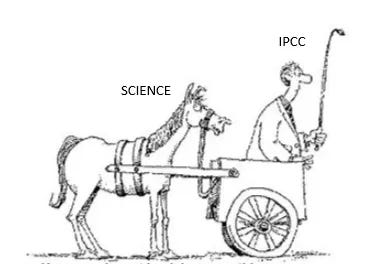
Consensus cart before the science horse
If you were an apologist for the IPCC, you might attempt to argue that it started out as a scientific body but was corrupted. You’d be wrong. It began its life as a political body posing as a scientific body. The IPCC has never tried to do science.
In my first foray into the climate debate, I argued, with evidence, that in the 1970s, the ‘experts’ believed in global cooling. Back then they were convinced that we weren’t going to hell in a handbasket, but rather to the Arctic in a cooler bag. This consensus of scientists culminated in headlines in the New York Times in 1978 like this one: “International Team of Specialists Finds No end in Sight to 30-year Cooling Trend in Northern Hemisphere.” And yet only eight years later in 1988, the arrival of the Boiling Earth circus was trumpeted with the founding of the IPCC. The key thing to grasp here is that the CAGW theory was institutionalised before the scientific evidence to support it had been accumulated. To which I must add: there is still no evidence to support it.
Judith Curry reminds us that[5]:
“The UNFCCC climate policy ‘cart’ has been well out in front of the climate science ‘horse’ throughout its history. When the UNFCCC was established, there was as yet no clear signal of human-caused warming in the observations.” [emphasis added]
At the beginning of the climate treaty movement, as far back as 1985, “the policy movement to eliminate fossil fuels became detached from its moorings in the science [when] the rhetoric of precaution argued that we should act anyway to eliminate fossil fuels, just in case.”[6]
She goes on to quote the IPCC’s first assessment report in 1990:
“The size of this [global] warming is broadly consistent with predictions of climate models, but is also of the same magnitude as natural climate variability.” [emphasis added]
Thus, “scientific support for the 1992 UNFCCC Treaty was not based on observations, but rather on theoretical understanding of the greenhouse effect and simulations from first generation global climate models.”[7] [emphasis added] Go back to the articulation of science at the beginning of this piece. A theory on its own is not enough. You need empirical data and observational evidence to back it. We must acknowledge that the IPCC is not a scientific body and is not doing anything that remotely resembles science.
From here, the precautionary principle was adopted to justify taking extreme action based on a theoretical threat, as articulated by the IPCC itself at the Rio Earth Summit in 1992[8]:
“In order to protect the environment, the precautionary approach shall be widely applied by the States according to their capabilities. Where there are threats of serious or irreversible damage, lack of full scientific certainty shall not be used as a reason for postponing cost-effective measures to prevent environmental degradation.” [emphasis added]
The adoption of the precautionary principle in and of itself is confirmation that the position they took on human-caused climate change was unproven.
The logic, or illogic, behind the precautionary principle starts from the position of uncertainty about various theories or scenarios, but then insists that the consequences of the worst-case scenario are so frightening that it would be irresponsible not to act to prevent it.
A systematic approach to risk assessment involves understanding and gathering evidence for different possible outcomes. However, the precautionary principle not only acknowledges initial ignorance, it then entrenches it by automatically bypassing a systematic approach to risk assessment that comes from doing the work to properly understand the risk in the first place. It entrenches ignorance by simply assuming the worst possible outcome, and demanding action to prevent it. This removes the incentives for questioning the basis of assuming the worst possible outcome. It is anti-intellectual, and dangerous for that reason.
The precautionary principle often comes with huge costs (think lockdowns), but it is fear-driven, and fear of the worst-case outcome blinds us to a rational assessment of the costs of avoiding that outcome. Like lockdowns, a core issue “at the heart of the climate policy debate is whether the precautionary ‘cure’ in terms of rapid elimination of CO₂ emissions is worse than the climate ‘disease’ in terms of the costs of eliminating CO₂ emissions, concerns about energy security, and broader opportunity costs.”[9] The precautionary principle is thus geared to ignoring basic principles of proportionality in the response to risks[10].
In short, the IPCC did not lose scientific objectivity; it never had any to begin with. Progress in science is driven by competition between rival theories, and reinterpreting evidence and data in the light of new paradigms and frameworks. The IPCC from its inception has actively sought to suppress rival theories, and reinterprets data to align with the theory it settled on at inception. The IPCC is anti-science.
Despite the 2009 Climategate scandal, the IPCC juggernaut of political consensus has continued to steamroll the scientific community into submission. Quite how the anti-imperialist Left and the New Left Conspiracy Realists manage to shrug that off is a mystery I will speculate on in Part V. The leaked Climategate emails of 2009 revealed that “IPCC authors had violated the norms of science by evading Freedom of Information Act requests for data, manipulating the peer review process, downplaying uncertainty, and otherwise attempting to squash disagreement and dissent from ‘skeptics’.”[11] This isn’t science; it’s the driving animus of a modern-day Inquisition.
Climategate should have been the end of the climate alarmist gravy train, but because the whole charade has nothing to do with science and everything to do with political warfare, it was swept under the rug with a label attached: “Keep moving; nothing to see here.” It is this total disregard for soul-searching, an examination of conscience, and ethics that really disgusts me about large swathes of the Left, more than its misunderstanding of science and the uncertainties of climate science. It is one thing to be ignorant, and another to be mean. But being both is a lethal combination.
The ‘97%’ fake consensus re-litigated
The attempt to build consensus appeared to receive a shot in the arm when, in 2013, an Australian researcher, John Cook, published a study based on the abstracts of 11,944 climate papers. Cook’s study claimed that 97% of scientists agreed with the IPCC that human-made climate change was the primary driver of global warming. The claim went viral when US President Obama tweeted the claim and a link to the paper.
The study, such as it was, was very quickly ripped to shreds to reveal that the methodology was seriously flawed and that the percentage of scientists who explicitly endorsed the IPCC view was closer to 0.5%. This is because of the overwhelming failure to quantify the extent of the human contribution to global warming. In other words, while it is not in dispute that man-made greenhouse emissions cause some global warming, the vast majority of papers are far from conclusive on how much global warming human activity is causing and whether or not it is ‘dangerous’. These are fundamental points in the whole debate.
When I challenged Jonathan Cook (no relation to the study author) on his boilerplate climate alarmism, I included that scandalous attempt to manufacture consensus as part of my rebuttal. After I published my piece, a writer whose acquaintance I had recently made, and who I respected as a critical thinker, emailed me privately to say that Jonathan Cook was actually right about his climate alarmism, and that the debunking of the 97% consensus claim had itself been debunked. He did not share the debunking of the debunking with me, so I looked into it myself. I’m afraid too many independent sources have looked at the infamous ‘97%’ paper and condemned it. If someone could share the debunking of the debunking, I’ll begin the process of reconsidering my position on it. Until then, I will share some of those independent critiques of the ‘97%’ consensus-claim study.
In 2014, UN lead author Richard Tol researched the claim and said[12]:
“As far as I can see, this estimate just crumbles when you touch it. None of the statements in the papers are supported by the data that is actually in the paper […] this 97% is essentially pulled from thin air. It is not based on any credible research whatsoever.”
Andrew Montford of the Global Warming Policy Foundation authored a critique of Cook’s claim stating[13]:
“The consensus as described by the survey is virtually meaningless and tells us nothing about the current state of scientific opinion beyond the trivial observation that carbon dioxide is a greenhouse gas and that human activities have warmed the planet to some unspecified extent. The survey methodology therefore fails to address the key points that are in dispute in the global warming debate.”
In 2014, climatologist David Legates and his team of researchers from the University of Delaware challenged the claims saying[14]:
“The entire exercise was a sleight-of-hand trick. What is the real figure? We may never know. Scientists who disagree with the supposed consensus – that climate change is man-made and dangerous – find themselves under constant attack.”
Judith Curry in her 2023 book: Climate Uncertainty and Risk: Rethinking Our Response, had this to say[15]:
“The key scientific issue is not whether anthropogenic greenhouse gases have caused any increase in global temperature – the issue is how much warming has been caused by humans, about which there is disagreement among scientists […] The consensus in the Cook et al paper referred to the abstracts of published papers, not to scientists agreeing about climate change; nor did the paper refer to any agreement about ‘dangerous’ climate change.” [bold emphasis added]
John Cook, the author of the ‘97%’ consensus-claim study revealed his motivation for doing the study[16]:
“A part of what we were doing was closing that consensus gap, and the consensus gap is delaying climate action. We wanted to have a tangible impact.” [emphasis added]
This is frankly disgraceful, and this kind of scientific fraud is precisely why distrust of scientific institutions is growing. They’re using science as a sword, not as a tool for truth.
I have already quoted the IPCC’s open admission that it is not doing science, but rather consensus politics. It is worth quoting academics in other fields who add their consensus-manufacturing voice to the debate with no apparent appreciation of what science is. Historian Naomi Oreskes’s view is that[17]:
“If we believe that a policy question deserves to be informed by scientific knowledge, then we have no choice but to ask, what is the consensus of experts on this matter […] If there is a consensus of experts – as there is today over the reality of anthropogenic climate change – then we have a case for moving forward with relevant action.” [emphasis added]
This is the transference of the see it-fix it paradigm from engineering science to all science. Thus, if there is a perceived problem (in the case of climate, arguably mostly imagined), we call in the experts, they formulate a solution (because they’re infallible), we fix it. But crucially, at the beginning of the process, the problem and its solution are carefully framed in such a way as to limit debate on the preconceived causes. In other words, scientific dissent on whether a problem actually exists must be muted.
John Cook, the author of the ‘97%’ study, and the historian Naomi Oreskes, both openly advocated within academia for the politicisation, and therefore debasement, of science. If academics are that ignorant about the philosophy of science, what is the state of knowledge in the general public?
Curry points out that the “key question is whether existing scientific knowledge is certain enough to compel action.” The historian quoted above is not interested in advancing “logically indisputable proof, but rather a robust consensus of experts”[18]. It’s quite possible that she is not remotely interested in scientific truth, but, giving her the benefit of the doubt, the kindest thing we can say about her view is that she does not realise that scientific truth and a consensus of experts are not the same thing.
How the consensus juggernaut works
So, we’ve established the existence of the consensus juggernaut, but how does it work?
“Pressure to support the climate consensus… comes from universities and professional societies, scientists themselves who are green activists, journalists and from federal funding agencies in terms of research funding priorities. Because evaluations by one’s colleagues are so central to success in academia, it is easy to induce fear of social sanctions for expressing the ideas that, though not necessarily shown to be factually or scientifically wrong, are widely unpopular.”[19]
Why is science in the West so corrupted? Curry’s explanation should come as no surprise to the anti-imperialist Left and the New Left Conspiracy Realists because they acknowledge all levels of corruption in The System, and yet remain silent about corruption of The Science[20]:
“Today nearly all of scientific research is funded by governments and therefore by taxpayer dollars. In the United States the current social contract between scientists and society dates back to Vannevar Bush and the conclusion of World War II. To address the emerging Soviet threat, US leaders demanded a broad, sustained program of research and development. The National Science Foundation was established in 1950. Science in the United States has been very well funded […] However, as a result of this support, science has strayed from the ideal of independent, self-motivated individuals, and has become increasingly bureaucratized. For research areas where the political stakes are high such as climate change, any dissent from the official consensus may be hazardous to a researcher’s career […] Success for individual researchers, particularly at the large research universities, is driven by the research dollars that they attract … If a proposal conforms to the consensus framework, it is relatively easy to get funded […] It is very difficult to obtain federal research funding for climate science research that challenges the existing paradigm.”
The result is emails like this one received by Curry from a scientist employed at NASA[21]:
“I was at a small meeting of NASA-affiliated scientists and was told by our top manager that he was told by his NASA boss that we should not try to publish papers contrary to the current global warming claims, because he (the NASA boss) would then have a headache countering the undesirable publicity.”
Returning to the definition of science, the process works when scientists are constantly working to disprove theories. The manufactured political consensus is designed to kill scientific scepticism because, from the outset, scientists were discouraged from questioning the IPCC orthodoxy. They are collectively doing the exact opposite of what they should be doing – they are constantly looking for the best way to prove a manufactured consensus view, not to disprove it.
The term ‘climate denier’ was coined in 2006 to advance a proposal by the climate cult that scientific scepticism of the forged IPCC orthodoxy should be treated as equivalent to Holocaust denial. The psychological weaponisation of Covid science and climate science has shown very clearly that the West has a social credit system, and that it operates just as effectively, perhaps more so, than China’s. Having delved a little into China’s social credit system, I have come to the conclusion that the West’s system may well be more ruthless and effective. The amazing thing about it is that it is entirely voluntary; it’s self-imposed. In fact, that is the source of its effectiveness. All it takes to unleash a ferocious cult army is the mere suggestion from a talking head that a thought-crime has been committed. Western cultural apologists who promote the idea of liberalism and tolerance as uniquely Western phenomena are of course completely impervious to this contradiction.
As Michael Northcott points out, Western culture’s social credit system achieves a remarkable perversion of science by criminalising the very principles on which science depends – the disciplined examination of evidence, the falsification of hypotheses, and the ongoing revision of findings in the light of new evidence.
Renowned epidemiologist Professor John Ioannidis received death threats during the covid hysteria for doing his job as a scientist. Unleashing this kind of savagery is, with the Establishment, the work of a moment if manipulating public opinion is deemed essential to defending its interests. It’s time people faced up to the fact that it’s not the climate that is collapsing; it’s the scientific institutions that the West has built its fraudulent reputation on.
The theory that the cause of global warming is both predominantly human and dangerous is not a scientifically proven fact, and the IPCC, on its own admission, advocated for maximal global action under the lazy and anti-intellectual precautionary principle before empirical evidence had been gathered to support the theory. This is unscientific.
The final point I’ll make about consensus is that if there actually were a genuine consensus, Little Hitlers like Chris Packham wouldn’t need to polish their jackboots and threaten dissenters with jail. The threats are made precisely because they haven’t won the argument. If there actually were a genuine consensus, then pro-official narrative scientists publishing their papers wouldn’t need to write emails about trying to get sceptic editors fired: emails like this:
“If you think that Saiers [a journal editor] is in the greenhouse skeptics camp, then, if we can find documentary evidence of this, we could go through official AGU channels to get him ousted.”
Climategate showed that in order to enforce a weak manufactured consensus, the IPCC thugs had to sabotage the dissent. Truth does not need the Mafia to protect it, but lies do. The simple fact is this: the reason I’m able to take the position I’m taking – scepticism – is that there are an awful lot of scientists like Judith Curry who won’t shut up, and that annoys the petit fascists tremendously. You see, dissenting from the official climate narrative and being a scientific sceptic is just not a Flat Earth position, and the climate totalitarians can’t come to terms with that.
The absence of a scientific consensus is the absence of scientific proof
Let’s recap how the scientific process works in order to show that the hypothesis – Catastrophic Anthropogenic Global Warming (CAGW) – has not been scientifically proven.
A hypothesis, supported by empirical data and relevant calculations, is put forward. It is subjected to a process of rebuttal and argumentation. Depending on the nature of the scientific disputation, the hypothesis may advance, be rejected, or be modified. There may come a point at which the same or a modified hypothesis becomes widely accepted by virtue of the absence of further dispute. It can then be said to be indisputable, at which point it can be said that there is a scientific consensus on the hypothesis.
At that point, it is adopted as a relatively stable paradigm that structures and organises scientific knowledge. It is relatively stable because new discoveries or challenges may render it obsolete. It is important to recognise that a scientific consensus is not a numbers game when it comes to the rejection of a hypothesis – it only takes one successful, undisputed challenge to the hypothesis at a future date to create a new paradigm or to render the previous paradigm obsolete.
Regarding the CAGW hypothesis, we have engaged with much evidence that confirms that the scientific arbitration process that gives rise to a scientific consensus has not occurred. While the absence of a scientific consensus is evidence that there is no satisfactory scientific proof of the CAGW hypothesis, it is not the ultimate reason for the absence of proof. The reasons (there are many) can all be categorised under the heading of: Deep uncertainty around climate science. Contrary to the propaganda, this uncertainty has not been resolved. This deep uncertainty is the subject of Part III of these essays.
What would be needed to provide scientifically robust proof of the Catastrophic Anthropogenic Global Warming hypothesis? Well, take a look at the name of the hypothesis. There are three key strands to it:
- It is claimed that there is global warming, or a predicted level of global warming;
- It is claimed that this warming is caused by human emissions of CO₂ – that’s the anthropogenic part, and;
- It is further claimed that this warming will be catastrophic for the planet and humans.
To prove that human CO₂ emissions are indisputably the primary driver of catastrophic global warming, you would need to: produce empirical data (observations) that, when subjected to calculations and formulae, indisputably demonstrate the theory that a specified increase in human emissions of CO₂ leads consistently to a specified increase in the global temperature, specifying and proving the time lag if there is one, and that this increase is ‘catastrophic’.
This proof has not been provided. There are many reasons for this, which as I’ve said, fall under the rubric of deep uncertainty in climate science, but here are just a few:
- There is no certainty (therefore no scientific consensus) on the sensitivity of global temperature to a given increase in CO₂ emissions.
- The quality of the historical record on the oceans, global temperatures, and atmospheric CO₂ levels (including paleoclimate reconstructions from geologic data) does not provide a definitive empirical record with sufficient predictive power to support the CAGW hypothesis. These are some of, but not all, the evidence areas in which historical data is sparse and inadequate.
- Assumptions about the human contribution to the greenhouse gas effect are confounded by uncertainty around the extent to which natural climate variability plays a role in climate change.
- What is ‘catastrophic’? There is no scientific proof that the disastrous increase in temperature specified by the IPCC will lead to catastrophic consequences. And have there been other times in history when global temperatures reached the ‘catastrophic’ levels specified by the IPCC, but in which humans and the planet nevertheless thrived? Many well-credentialled experts, including Judith Curry, believe that “the Earth has undergone geological periods of higher temperatures and atmospheric CO₂ concentrations during which life thrived”.[22] But, as a sceptic I am not going to promote that. I would rather say that it signifies the absence of scientific consensus around a core issue of the debate. Therefore, it is much more truthful to say: we don’t know.
The deep uncertainty that permeates climate science poses huge barriers to a scientifically satisfactory proof of the CAGW hypothesis. Those barriers, which I will discuss in the next essay, are so great that it is questionable whether the hypothesis is even falsifiable at this stage of history. That puts it into the sphere of religion, a scientifically unprovable belief. That may change at some point in the future with breakthroughs, time, and better data, but right now, that’s what it is.
A reader in the comments section of Part I asked: “Where are the data to support your theses?” I thought that I had already made it clear in Part I that I am a sceptic, but I will do so again. I do not need data because I am not advancing a hypothesis. One does not need ‘data’ to prove that the other side’s data is garbage. I am a sceptic because the side that actually claims to have a hypothesis (CAGW) does not have the empirical data and scientific proof to support its hypothesis. For all the reasons stated here, and to be stated in Part III, they are making an unproven claim that the sky is falling on our heads. The onus is on them to provide proof that survives scientific disputation, and they have not done so.
As I will discuss in Part III, the uncertainty about the hypothesis that existed at the outset has not been resolved. There is therefore no requirement for sceptics of the dominant climate narrative to present alternative data and technical arguments about how climate change mechanisms work in order to dismiss climate alarmism. The onus is on proponents of climate alarmism to explain why they have unquestioningly accepted an unproven theory, and indeed why they believe that anything good could possibly come out of the IPCC cesspool.
If you liked this article but don’t want to commit to a paid subscription, please consider rewarding my writing using the BuyMeACoffee link below. Thank you!
[1] Judith A Curry, Climate Uncertainty and Risk: Rethinking Our Response, Anthem Press, 2023, Ch. 2, Pg. 17.
[2] Ibid., Pg. 15.
[3] Ibid.
[4] Ibid.
[5] Curry, op. cit., Ch. 4, Pg. 45.
[6] Curry, op. cit., Ch. 10, Pg. 151.
[7] Curry, op. cit., Ch. 4, Pg. 45.
[8] Ibid.
[9] Curry, op. cit., Ch. 11, Pg. 166.
[10] Curry, op. cit., Ch. 11, Pg. 167.
[11] Curry, op. cit., Ch. 4, Pg. 46.
[12] Marc Morano, The Politically Incorrect Guide to Climate Change, Regnery Publishing, Washington DC, 2018, Ch. 3, Pg. 35.
[13] Ibid., Pg. 35-6.
[14] Ibid., Pg. 37.
[15] Curry, op. cit., Ch. 2, Pg. 16.
[16] Ibid.
[17] Ibid.
[18] Ibid.
[19] Curry, op. cit., Ch. 4, Pg. 49.
[20] Ibid., Pg. 50.
[21] Ibid., Pg. 51.
[22] Curry, op. cit., Ch. 10, Pg. 152.


Comments are closed.