
The Rhodesian Dog Whistle: Part V – “Who Gave You This Land?”

[AUDIO FILE COMING SOON]
I will begin this essay with two illuminating quotes – the first from the settlers’ Bulawayo Chronicle in 1900[1], and the second, some 70 years later, from one of the Zimbabwean liberation struggle’s greatest minds: Herbert Chitepo, Southern Rhodesia’s first Black barrister, murdered by the Smith regime’s security services in 1975.
“It was a scene that no Bulawayan who took part in it can or ever should forget. There was something more than mere talking in the congregation, there was as it were an electricity, a pride of Empire, a belief in the Anglo-Saxon destiny, a belief that Britain has a God-given right to civilise the waste places of the earth.” – The Rhodesian Bulawayo Chronicle describing the jubilation among the Rhodesian settler community following the lifting of the siege of Mafeking in May 1900 during the Boer War. [emphasis added]
And
“I could go into the whole theories of discrimination in legislation, in residency, in economic opportunities, in education. I could go into that, but I will restrict myself to the question of land because I think this is very basic. To us, the essence of exploitation, the essence of white domination, is domination over land. That is the real issue.” Herbert Chitepo, Chairman of ZANU [emphasis added].
We have already looked at the first critical blows dealt by British settlers to the Zimbabwean people through the occupation and conquest that occurred between 1890 and 1897. We have also discussed the cronyism and corruption marking the distributions of land that took place under the auspices of the British South Africa Company (BSAC) in those early days, which, apart from the obvious trauma to the African, were to exacerbate tensions between the settlers and the Company.
Three major processes or events in relation to land alienation occurred between 1890 and 1930. The first was the setting aside in 1894 of two native reserves for the Ndebele following the Ndebele war of 1893. The second was a ‘squeezing-out’ process marked by the ‘White Agricultural Policy’ set in motion in 1908. The third major landmark occurred with legislation introduced in 1930 that divided land, unequivocally and unequally, into European areas and African areas.
This essay can be split into five parts:
- Explaining the ‘Native Department’ and deconstructing the contradiction between the existence of a racist administrative structure on the one hand, and the metropole’s purported concern over discrimination against ‘the native’ on the other hand.
- Important political and legal developments, leading up to the ‘White man’s Magna Carta’ in Rhodesia. These developments include the BSAC exiting the stage to give the settlers Responsible Government, and the Privy Council’s Judicial Committee ruling on land ownership.
- The ‘squeezing-out’ process and the ‘White Agricultural Policy’ that laid the ground for legalised African land disenfranchisement in 1930. I will touch briefly here on the state protection afforded to White farmers at the expense of African peasant farmers, and the deteriorating conditions in the cramped ‘reserves’ to which the African was relegated.
- The ‘White man’s Magna Carta’ in Rhodesia – the Land Apportionment Act of 1930 and the Land Tenure Act of 1969 – and an explanation of why the fake ‘Bill of Rights’ did nothing to stop concrete discrimination.
- An epilogue on the Zimbabwean Land Problem. Has it been solved? Does the UK have a land problem? If so, what lessons does Zimbabwe offer for the so-called ‘free’ world in the West?
The Native Department – the name says it all
Colonial regimes did not set up ‘European Departments’ to manage the European colonists. The European colonists set up ‘Native Departments’ to manage the indigenous inhabitants. Therefore the mere existence of a ‘Native Department’ is confirmation in itself of the creation of a racial hierarchy and structures designed to prioritise coloniser interests and entrench separate development.
Historian Arthur Keppel-Jones captures the Native Department hierarchy in Rhodesia — this encapsulated the burgeoning segregationist architecture implemented in the wake of the suppression of the uprisings[2]:
“The hierarchy was clearly defined. Below the Administrator-in-Council stood the secretary for native affairs, head of the Native Department and “principal executive officer of the Administrator in Council in regard to native affairs.” Below him were the two Chief Native Commissioners of Mashonaland and Matabeleland. The country was to be divided into districts and sub-districts “for the purpose of native administration”; over each district there was to be a Native Commissioner, who might have assistant native commissioners to help him… The powers given to these authorities were the measure of the rebels’ defeat. The Administrator-in-Council appointed all chiefs and, with the approval of the high commissioner, could depose them. By the same authority a chief and his family could be removed from one reserve or piece of vacant land to another, a tribe could be divided or several tribes amalgamated. The native commissioner was given the power, “subject to the approval of the Administrator-in-Council, of assigning lands for huts…”
For the avoidance of doubt:
- The Administrator-in-Council was the most senior official in the BSAC.
- A native commissioner was not a “native”. He was a White official in the BSAC.
- Chiefs, as you might have guessed, were Black indigenous members of the top strata of the indigenous social hierarchy.
The complete subordination of African social stratification to a White-run Native Department with complete powers over the Chiefs now represented the substitution of a White Chief for the deposed Black Chiefs. The Native Department thus became a bureaucratic pillar of segregation.
Rhodesia’s adoption of colonial structures almost identical to those already developed in South Africa at the time is obviously not a coincidence, and that will be discussed in slightly more detail in Part VI. Suffice to say that, confronted by the logic of the system itself, it is futile to deny that colonial Rhodesia was fundamentally racist, as Unbekoming attempts to do.
Perhaps this denial stems from the inclusion in Southern Rhodesia’s 1923 Constitution, following formal annexation to the Crown as a colony in 1923, of provisions to prevent “measures which discriminated against Africans (except in respect of arms and liquor)”. Such measures could not receive the Governor’s assent unless they contained a clause suspending their operation until the King had signified his intention not to disallow them.”[3]
Given the logic of occupation, conquest, and Native Department structures, the metropole’s role was not to prevent racism, but rather to keep the settlers on a leash. That leash cannot be interpreted as the imposition of a moral code that you and I might recognise as acceptable and adequate. Thus, in the same way that it would be futile to deny that boxing is a violent sport on the grounds that there is a referee in the ring, it would be futile to deny that colonial Rhodesia’s laws were discriminatory on the grounds that the metropole was ‘refereeing’ an unfair tussle between the colonial administration on the ground and the colonised African.
The limited aim of ‘preventing discriminatory legislation’ was in fact to pre-empt the development of a ‘lynch law’ environment in the colonies, which would have been counterproductive to the overall economic aims and objectives of colonisation. The function of this good cop/bad cop relationship was to prevent total mayhem precipitated by the worst excesses of settler savagery. That had in fact already happened in the uprisings of 1896-7.
Jameson’s intervention to prevent a lynching by settlers provides a perfect case study of how things could go wrong without a moderating influence. Although there is an insufficient historical record to suggest that White Rhodesians applied lynch law widely – only two attempts are recorded – Jameson stopped a lynching in 1893 in Mashonaland “with the characteristic and effective argument that Mashonaland was expecting a boom which would be wrecked if the world saw that it had no respect for law and order.” With the lynching averted, “he then stood drinks all round to the ring leaders.”[4]
Palley discusses imperial intervention in two cases reported by the Rhodesia Herald in 1908 in which “Europeans had flogged Africans to death [and] were, in the one case, found guilty of common assault, and in the other acquitted.”[5] White juries were notoriously biased in favour of White defendants. Juries were all-White since the jury was empanelled by the voter, and Blacks were effectively barred from voting by the “merit-based voting system”, which I will deconstruct in Part VII. Of course, Black defendants also suffered from the same prejudice in cases where they were accused of crimes on Whites. In 1911, under pressure from the imperial government, trial by jury had to be abolished in cases involving both Africans and Europeans.[6]
In abolishing trial by jury in cases involving both African and European, the imperial government was tacitly acknowledging that, as Keppel-Jones articulated: “prejudice was too deep, the sense of white solidarity too strong; and how could justice, even if it was done, be seen to be done to a member of the conquered race by a jury composed exclusively of his conquerors?”[7] [emphasis added]
Behind the farce of intervening to prevent discrimination, there were influential constituencies in the metropole that were policing colonial policies, and conducting campaigns to raise awareness about the worst injustices occurring in the colonies. These constituencies were often cynically referred to by some historians as ‘negrophiles’. They were in fact people whose consciences and sense of morality were more developed than those of the hard-nosed colonial office bureaucrat, or Rhodesian settler. The pressure they brought to bear on the whole system cannot be dismissed out of hand. On the rare occasions when the metropole did intervene, it was often as a result of either direct pressure from these constituencies or a wish to avoid pressure from them.
The progression from Company rule to Responsible Government
Up until 1907, a majority of the Legislative Council was appointed by the Company, with a minority comprising elected White settler representatives. There had always been an expectation that the Company would transfer governance to a self-governing colony, but the unanswered question of who would own the land not yet doled out to settlers – ‘unalienated’ land – hung like a cloud. The BSA Company retained the exclusive right to grant all land in the territory, but Grants were accompanied by an occupation clause that resulted in forfeiture and reversion to the Company in the event of failure by the grantee to occupy within a stipulated period. Most landholders refused to take out title deeds because of their objection to the occupation clause included in them.
For the settlers, an escape from the Company into the loving arms of the imperial father could not come too soon, and a motion was passed in 1902 to petition the king to annex Rhodesia to his dominions. The motion was defeated by the official Company majority.[8]
The Company had not always seen eye to eye with either the Colonial Office or the settlers, but the directors appear to have formed the view that an alliance between the Company and the settlers would be more effective in confronting London on major issues. Thus, after 1902, equal membership on the Legislative Council was given to elected representatives, with the Administrator of the Company retaining a casting vote. However, the directors’ primary concern was the balance sheet, and so fiscal control remained exclusively within the ambit of the Administrator.
Keppel-Jones points to the decision in 1903 to grant settlers greater power in BSAC government as “the most important decision… along the road to an independent Rhodesia under white domination.”[9] After 1907, elected members gained a majority on the Legislative Council, which was a factor in accelerating resolution of the issues of land and self-government.
Increased settler representation in the Legislative Council around that time was certainly a factor in giving the ‘White agricultural policy’ a head of steam in 1908 (discussed in more detail in the next section). Suffice to say that the well-heeled speculative companies that had benefitted from Jameson’s largesse were drawing more fire from the settlers. While the rentier and share-cropping large land holders had benefited from African tenancy, the settlers saw it as “locking up” land that could otherwise have gone to new settlers.
By the time the question of the Company’s governing role had come to a head in 1920, the Colonial Office had come to dislike it “partly because it was an anomaly which did not fit into the established colonial categories… and partly because they believed that a commercial company… was bound to be pulled two ways in its governing role. This was precisely the point so often made by the settlers”.[10]
In April 1920, the opportunity of a break with the Company was given to the settlers by way of a vote in the Legislative Council elections offering them the choice between Responsible Government or union with South Africa. And because this essay is a rebuttal of ridiculous claims made in defence of Rhodesia, readers will be reminded of an obvious fact – 98% of the population – the indigenous “native” – had no say in the matter. ‘Responsible Government’ of a whole population of 864,000 was granted to 2% of the population by virtue of their being White.
75% of those who expressed a preference in the Legislative Council vote in 1920 opted for Responsible Government. Despite this apparently resounding settler vote for Responsible Government, Rhodesia might still have become a province in the union of South Africa. This was in fact the Establishment line. When the Company informed the Colonial Office of the result in the 1920 Legislative Council vote and requested Responsible Government, London delayed the decision and began complicated negotiations with Company representatives and the South African government to bring about the inclusion of Rhodesia into the South African Union. Generous terms were offered to the Rhodesian legislators, a discussion of which is, for the most part, extraneous to the objective of this rebuttal.
However, two of the terms are relevant in that they confirm the segregationist nature of the Rhodesian and South African political systems, and thus expose the ridiculousness of the claims I am rebutting, chief among them that Rhodesia was not a racist endeavour. Rhodesian farmers feared that union with South Africa might result in a flight of African labour further south for better wages. To address this concern, General Smuts, Prime Minister of the Union of South Africa, provided assurances that there would be no recruitment of Rhodesian native labour to other parts of the union. In other words, Rhodesia’s Black population would not be allowed to seek work outside their homeland, within the union. The second condition regarding free movement within the union entailed assuring Rhodesians that there would be no restriction on the movement of Whites between provinces.[11]
The choice of Responsible Government or union with South Africa was put again to the Rhodesians in a formal referendum in 1922. The vote was closer this time than it had been in the Legislative Council elections in 1920, but Responsible Government still won comfortably, taking 59% of the vote.[12]
Southern Rhodesia was formally annexed to the Crown as a colony on October 1, 1923,[13] and the terms of Rhodesia’s Responsible Government constitution were established under Letters Patent promulgated in September 1923. Executive and legislative power were subordinated to the imperial Government, which retained the right to legislate and to appoint the Governor and give him orders. It also retained control over Rhodesia’s Native Department with ‘reserved powers’ that enabled it to veto any legislation detrimental to the African population.[14]
In practice, this was never used owing to the establishment of what came to be known as ‘The Convention’ under which the Southern Rhodesian Government first submitted measures to Whitehall before introducing them in the Rhodesian Assembly, and dropped or amended them if the UK Government objected. Thus, haggling over legislation was done behind the scenes to present a picture on the surface of a harmonious partnership, and a well-run colony.
Despite the British Government’s right to intervene to prevent discriminatory legislation, it did nothing to stop the notorious 1930 Land Apportionment Act, discussed later, which allocated half the total land area to Europeans, while leaving 30% for African use. Africans were forced off European land and moved into Reserves demarcated under the Act. It also did nothing to halt the Industrial Conciliation Act of 1934, which specifically excluded Africans from the definition of an employee in wage and industrial agreements negotiated under it.
Keep this background to Responsible Government in mind, as it will acquire further significance when we discuss the so-called ‘great betrayal’ in Part VIII.
“Whoever now owns the unalienated lands, the natives do not.”
A crucial development in the run-up to Responsible Government was a landmark legal ruling to determine who owned the ‘unalienated land’ – land not doled out to settlers and Company cronies – at the transition from BSAC governance to Responsible Government. The BSAC’s parting gambit was to stake a claim for all of the ‘unalienated lands’. The Privy Council claimed that it had never belonged to the Company and so the matter was referred to its Judicial Committee for a ruling. Once again, we enter the twilight zone of colonial legalism.
At this point, there emerged a section of society in Britain, represented by the Aborigines Protection Society (APS), that understood the gross violation of Natural Law that had taken place in 1890 and 1893. The APS entered the fray and made a case for ‘native’ ownership.
In assessing the chances of the APS’s case for ‘native’ ownership, we must acknowledge the futility of trying to recover stolen goods by appealing to the moral compass of the thief. That said, it was a commendable gesture which demonstrated that there were pockets of consciousness in the empire’s capital that remained relatively uncolonised, even at the height of Britain’s imperial infamy. I doubt they thought they had a chance of winning, but they acted in accordance with their consciences. The historical benefit of the APS’s contestation of land ownership is that it compelled the Empire to admit to and record its crime in a legal process.
In response to the APS’s appeal for the court to consider the land rights of the “native” population, Lord Sumner pronounced:
“Some tribes are so low in the scale of social organization that their usages and conceptions of rights and duties are not to be reconciled with the institutions or the legal ideas of civilized society. Such a gulf cannot be bridged. It would be idle to impute to such people some shadow of the rights known to our law and then to transmute it into the substance of transferable rights of property as we know them.”
Underlining the points I have already made about colonial legalism, Critical Legal Thinking points out that “the Privy Council’s approach was typical of the way in which European colonial powers instrumentalised legal doctrines to clear the way for White settlement unfettered by prior occupation or title.” Thus Lord Sumner declared that:
“Whoever now owns the unalienated lands, the natives do not.”
As Critical Legal Thinking put it, the ruling was “the Empire’s most expressly and egregiously racist justification for the land dispossession of indigenous peoples.”
Contrasting with the Judicial Committee dismissive assessment of the Zimbabwean people’s land rights is Palley’s more considered and educated view that[15]:
“The Court’s view of African Land tenure in Southern Rhodesia has been disproved by modern sociological research. This has established that in respect of Shona land tenure the traditional tribal ward (dunhu) functions primarily as a land unit: ‘The ward community as a component part of the chiefdom holds the communal right over all the territory within its boundaries. It is as an accepted and eligible member of this community that a person has a right to make use of the land for building and cultivation purposes. Land used as such was invariably held by the village community as a collective unit, but eligible villagers could vest subsidiary rights in individual portions of the village allotment’.”
In any event, the upshot of the Judicial Committee’s ruling, as articulated by Blake, was that[16]:
“the Committee dismissed all claims to the ownership of the unalienated land other than that of the Crown. The ‘natives’ had lost by conquest whatever title they possessed. The Company had no claim independent of the Crown, the Lippert Concession being legally worthless, if historically interesting. The Company had conquered the country as the Crown’s agent under its charter and had acted as agent ever since. Nor had it acquired a title by lapse of time. Because the Crown had not annexed the territory at once it did not follow that the Crown had renounced the right to do so at a future date.” [emphasis added]
Again, Critical Legal Thinking’s summation of the basis of the ruling provides confirmation of the essence of colonial occupation in Rhodesia: “Whatever the nature of the rights of the indigenous population prior to conquest, these were simply extinguished when the BSAC (aided by the British Bechuanaland Border Police) slaughtered them.”
Palley also deftly highlighted the contradiction between, on the one hand, the Judicial Committee’s dismissal of native land rights owing to their “low scale of social organisation” and, on the other hand, the British government’s acknowledgement of Lobengula’s undisputed sovereignty over Mashonaland and Matabeleland in the lead-up to September 1890.[17] Notwithstanding this contradiction, conquest had resolved it. Conquest was therefore built into the ‘civilised’ European law of international property and land acquisition.
You will recall from Part II the farcical nature of the concessions and the role they played in colonial legalism. The Lippert concession was acquired by Rhodes with great subterfuge and expense, but when the government and the Company fought among themselves, the Lippert Concession became “legally worthless”.
The brutishness of the Judicial Committee’s ruling trumpets the violation of Natural Law that took place, which is central to my rebuttal of Unbekoming’s defence of Rhodesian colonialism. Its confirmatory power lies in its source, that being the heart of the system itself. The explicit admission of guilt is made all the more powerful by the system’s lack of awareness that a crime was actually committed. The customary artifice is completely absent, and this absence of self-awareness gives the ruling a power that might otherwise have been diluted had the system’s servants felt the need to grapple with a conscience and dissemble accordingly. It appears that the stakes for His Majesty’s Government were simply too high.
The ‘squeezing-out’ process and the ‘White Agricultural Policy’
In 1898, land had not yet become a pressing issue in Mashonaland, but in Matabeleland, the settlers had seized virtually all of it.[18] Recall the young Ndebele chief’s challenge to Rhodes in the first peace indaba of early August 1896: “Where are we to live, when it is over?”. In the very early years following the occupation of Mashonaland in 1890, the Shona suffered very little disturbance in the occupation of their land. That would change, but by 1896, there were fewer settlers in Mashonaland than there had been in 1892. The settlers in Mashonaland at that time were still afflicted with gold fever, and land alone had failed to cure it. Many rushed to Matabeleland following Lobengula’s demise in November 1893.
The land grab played out quite differently in Matabeleland after 1893 than it did in Mashonaland. The settlers who had volunteered in the 1893 Ndebele War, and had been promised 6,000 acres of land, invariably pegged their farms in the area with the best soil and climate, which corresponded “exactly [with] the area that had appealed to the Ndebele and had been their heartland. The 1,070 farms pegged by 1895 covered an area of over 10,000 square miles, identical with the region settled by the Ndebele.”[19]
Grabbing all the land was one thing, but doing something with it was entirely another. The Civil Commissioner in Bulawayo in March 1895 reported that, of the 1,070 farms pegged, only about 150 were occupied and, even then, only 6 acres per farm (900 acres in total) were under cultivation. One settler wrote in the 1890s: “In those days… no farmers grew grain, it being cheaper to trade the country’s requirements from the natives.”[20] Thus, Palmer records:
“Under the benevolent gaze of Leander Starr Jameson, one sixth of the entire country, or some 15 ¾ million acres, passed nominally into European hands ‘during the age of the fortune hunters’ in the 1890s. Much of this was simply paper alienation, with European farms existing only on the surveyor general’s maps, while nearly 2/3rds of this land was in the hands of the same kind of speculative companies which had earlier taken such a stranglehold over Natal.”[21]
The war had scattered the Ndebele into the north west and north east. When the fighting was over and they tried to return to their former homes, they were told that they were now living on White men’s farms. While this did not result in immediate physical expulsion – the usurpers had not begun farming in earnest – it caused bitter resentment, which would only grow. Some of the settlers saw the “resident native” as a valuable labour pool, while others preferred to have the land to themselves, getting labour from elsewhere through the newly established native commissioners, and moving labour on and off the land as it suited them.[22] This made it impossible for the Ndebele to grow their own food, but also to sell food to Whites who depended on them for it, and were largely uninterested in farming in the early days.
In 1894, a Land Commission was established “to assign land sufficient and suitable for the personal and individual agricultural and grazing requirements of the natives.” It demarcated two “native reserves” for the Ndebele. These areas were the most feverish or drought-stricken areas and the Ndebele had not farmed there for that reason. The commissioners feigned surprise when the Ndebele refused to move into the “native reserves” set aside for them.[23]
Even if we were to completely discount the events that had occurred up that point – deception, forced occupation, and a war of conquest – any sane person reading this would understand that the forced relocation of one ethnic group by another for the purpose of creating separate living areas constitutes an important pillar of a racist system of separate development.
It is not my intention to insult the readers’ intelligence by stating the obvious in the above paragraph. Rather, it serves as a reminder that I am rebutting the most ridiculous piece of writing I have encountered in the alt-media space since the global outbreak of hostilities by the ruling class in 2020. That piece appeared in a normally sane publication, arguing that Rhodesia was a misunderstood beacon of light in the otherwise grim annals of colonial history. So, I feel obliged to state the obvious every now and again in order to appeal to readers of that piece who thought they had witnessed the freedom or truther movement dropping another truth bomb, as opposed to the stink bomb that it actually is.
African tenancy on European farms was introduced after the rebellions. The Native Commissioner in Umtali (Now Mutare) wrote in 1897: “In my opinion, the Mashona works his lands better than any other native tribe I know.”[24] The European population, preoccupied with mining, were in fact reliant on the African farmer for agricultural food production. Palmer points out that “it was not until twenty years after the white occupation of Rhodesia in 1890 that European farming began to offer any serious threat to African cultivators.”[25]
Under these tenancy agreements “the landowner had a claim to the labour of any who would work for wages”, although there was no compulsion to enter into a labour contract.[26] When labour was part of the agreement, the usual requirement was for three months’ labour a year. If the tenant gave no labour, he usually paid a rent per hut or per adult male in the family.
Eight years after the colonisation, there were only an estimated 250 White farmers, whose activities consisted mostly of “trading, wood cutting and transport riding”, and “cultivating a small patch of mealies”.[27] The settlers had grabbed the land, but had not ploughed it. They were also hampered by a lack of capital investment, an undeveloped domestic market, and a continuing shortage of cheap labour – Africans preferred to grow and sell their own food. As a result, the mines were largely dependent on African producers for food supplies.[28]
Starting in 1905, there was a deliberate shift in Company policy to diversify the economy by boosting settler farming. A Land Settlement Committee was instituted and, two years later in 1907, a party of BSAC directors toured Rhodesia and decided to put an end to the myth of the Second Rand.[29] This was the beginning of an official ‘White agricultural policy’, which would see the formulation of policies to stimulate settler agricultural output and activity. In 1912, the Company told its shareholders[30]:
“In the early years of the territory the mining industry was the Company’s chief care. While this industry continues to receive such assistance as its circumstances require, land is today claiming a much greater share of the Company’s attention, and the industries connected with it are rapidly gaining ground that capital is available for their support.”
This policy shift was instrumental in expanding the output and efficiency of the White farming sector, and was supplemented by legislation that handicapped African producers and prevented them from competing with settler farmers. This was the beginning of what the settler-centric historian Hugh Marshall Hole termed the “the squeezing-out process”.[31] I will now describe the key BSAC policies between 1906 and 1912 that boosted settler agriculture and hobbled the African farmer.[32]
In 1906, the Company began implementing the recommendations of its land settlement expert, C D Wise, to prepare experimental farms in areas selected for resettlement. The experimental farms were financed by a special grant and their purpose was to train and prepare newly arrived settlers in techniques for farming. Successful techniques would then be disseminated more widely. Assistance to new settlers included subsidised relocation costs. Crucially, the Company followed Wise’s recommendation to sell farms to new settlers at discounted rates. Furthermore the Company undertook to pay rebates to farmers on the purchase price of land if they carried out specified improvements to the land. In short, the Company began heavily subsidising the White settler farmer.
As we have seen, African tenancy on European farms was introduced after the rebellions. With White farms massively under-utilised, it suited both the experienced African farmer and the few amateur settler farmers who were trying, albeit fecklessly, to grow on the land. In 1908, that changed with the introduction of the Private Locations Ordinance (PLO), which limited the number of African adult males on a 3,000 acre farm to 40, and stipulated the number of months’ work the tenant had to supply his landlord at current wage rates. The dual purpose of the legislation, as explained by the Attorney General of Rhodesia at the time, was to ensure that the settler farmer “should not be deprived of a reasonable quantity of labour”, and that there should not be “so many natives [on the settler’s farm] that the land could not support them, and they thereby become a great nuisance to neighbours, by living and preying on the surrounding country”.
The Attorney General also expressed his total agreement with the objectives of this legislation, which was essentially a replication of what had been introduced in South Africa. He complained that allowing large numbers of Africans on White-owned land “restricts the supply of labour [to other sectors of the economy]; that it fills up with natives much land which would otherwise be better utilized and developed, and it leads to the absence of due control over them.” The effect of the PLO was to shift more Africans into less fertile reserves and to force them into the cash economy.
Yet when African labour was in short supply on the farms, the peevish and entitled settler farmer could demand that the Company government procure labour for them more quickly than the Rhodesia Native Labour Bureau. Thus, in September 1911, settler farmers held a mass demonstration and passed a resolution demanding that the Government “supply at once a minimum number of boys, sufficient to relieve temporarily an unprecedented crisis which otherwise will prove the ruin of the whole of the farming community”. Native Commissioners immediately instructed Chiefs to force their subjects to contract labour on settler farms.[33]
1908 also saw the establishment of an Estates Department designed to promote European settlement and deal with land applications. Offices were opened in London, Glasgow and South Africa to publicise Rhodesia and attract people with sufficient capital, farming experience, and a loyalty to Britain.[34]
Operations at scale were also encouraged by earmarking £1 million for expenditure on five ranches of 500,000 acres each. Development of large estates, such as citrus estates, also commenced.
The Company established a Land Bank in 1912 to provide farming loans on terms more favourable than the going commercial rate. The policy of both the Land Bank, and a larger Land and Agricultural Bank created in 1924, was to make credit facilities “available for persons of European descent only”.[35]
By the end of the second decade of the 20th century, these policies had ensured self-sufficiency for the settler farmer, and had initiated penetration of markets in the sub-continent and overseas.
Thus, while the critical blows of occupation and conquest had been struck between 1890 and 1897, the serious competition for land did not begin until the introduction of the White Agricultural Policy in 1908, which accelerated full possession and control by the settlers of the best arable land. Africans tried to retain their lifestyle and independence in the face of the new threat. Between 1908 and 1914, African-owned cattle more than doubled from 195,800 to 406,189. This brought the owners into direct conflict with the new White Agricultural Policy and led to intense competition for grazing lands with settlers.[36]
At the same time, the policies catalysed competition between the African and the European for markets. In addition to the labour demands from mines, the White Agricultural Policy placed new demands on the labour pool. We have seen how the peevish settler farmer responded in September 1911 when the competition was acute. In 1905, Southern Rhodesia’s total estimated Black labour requirement was 25,000 labourers. By 1910, the mines alone were demanding 39,000 and the farmers 23,000.[37]
These factors converged to produce three Rhodesian settler policies. First, a demand for a further reduction in African land holdings resulting in more sequestration of the best land for White farmers. Second, reliance on migrant labour from depressed areas. And third, a tax mechanism to compel Africans to work on their farms. As Palmer observes, this was not going to be easy since the Shona had “developed an almost universal anti-farming mentality which considered that a Shona…had sunk very low, socially and economically, if he worked for a white farmer”. Thus higher rents and other burdens like dipping fees were imposed to push the Africans into the reserves. The Private Labour Ordinance was an exemplar of this “squeezing-out”. In 1909, the Company imposed a £1 rent on unalienated land – land that had not been formally sequestered for White settlement.
All of the combined squeezing-out measures prompted Africans in one district to declare that the landowners would soon be “taking money from the flies in our kraals next; better to be dead than pay such demands.”[38]
The mindset underpinning the determination of the suitability of lands designated as African ‘reserves’ is illustrated by this statement made in 1915 by F W Inskipp, Director of Land Settlement[39]:
“I see no objection [to making it a Native Reserve] as the area in question, which is practically a conglomeration of kopjes [hills] with very small cultivable valleys in between, is infested with baboons and is only traversable by pack animals.”
Despite the squeezing-out and the massive economic impediments to Africans being able to buy back the land that had been stolen from them, there was nevertheless at this time (before the Land Apportionment Act 1930) a legal clause stipulating that: “A native may acquire, hold, encumber and dispose of land on the same conditions as a person who is not a native.” This clause was introduced in 1894 at the insistence of the imperial government. Highly unpopular with Rhodesians, it was easily circumvented by a simple refusal by both the Company and White landowners to sell land to Africans. Thus, by 1925, a mere “14 farms, totalling 46,866 acres, had been sold, seven to Black Rhodesians, and seven to Black South Africans, mostly at inflated prices.”[40] Allowing Africans to own farms and compete with the settlers was in conflict with the White farmers’ demands for African labour.
The Land Apportionment Act 1930
All of the above conditions resulted in Africans being relegated to ‘Reserves’ and completely unable to buy better quality unalienated land. The Land Apportionment Act 1930 (LAA), purportedly enacted to address the plight of the African farmer, became the cornerstone of African disenfranchisement.
The significance of the LAA, as noted by Mlambo, was that[41]:
“While racial segregation had always been present since the establishment of the colony in 1890, it had not been formalised in law. The LAA made segregation formal by making land tenure permanently dependent on race, thus aping the South African Land Act of 1913.”
The LAA formally and irretrievably divided the country into White areas and Black areas, exposing as a complete sham the Native Department’s and imperial government’s purported concerns about discrimination against Africans. The ‘compromise’, such as it was, to address Native Department ‘concerns’ about excessive African land dispossession was the setting aside of ‘Native Purchase Areas’ in which Africans alone could purchase land. The quid pro quo was that they were now legally barred from buying land in better-situated White Areas, a restriction which, as we saw, was working quite well in practice through both the refusal to sell land to Africans and the unaffordability of it.
The LAA came to be known as “the Magna Carta of racial segregation on land in [Rhodesia]”[42]:
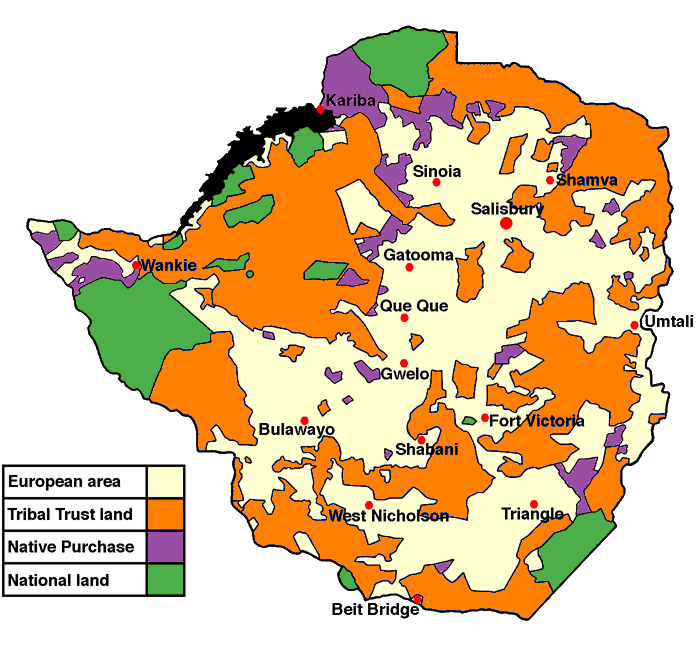
“This Act divided the land along racial lines, spelling out white areas where Africans could never acquire land, African purchase areas [native purchase areas] reserved for those Africans who wanted to and could afford to purchase land, and Tribal Trust Lands (TTLs) [‘native reserves’] which were the African Reserves of old where land was owned in Trust on behalf of the Africans. Another category was that of [unassigned] Crown lands that were owned by the state in reserve for future allocation as need arose, as well as for public parks and state forests. It allocated 51 per cent of the total land area of the country to approximately 50,000 whites [4% of the total population] and only 29.8 per cent to more than 1 million Africans [96% of the population].” [emphasis added]
Land Allocation under the 1930 Land Apportionment Act:

Source: Alois S. Mlambo, A History of Zimbabwe, New York, Cambridge University Press, 2014, Ch. 4, pg. 62
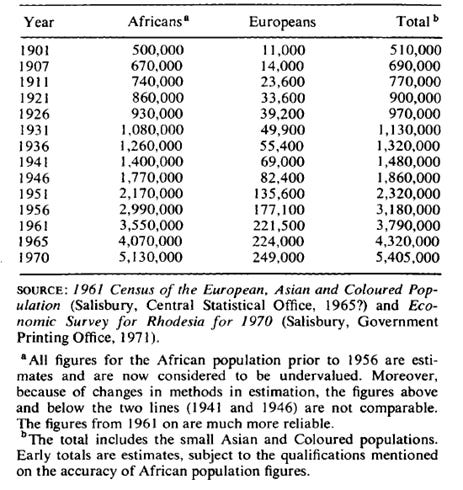
Rhodesian Population Growth: 1901 – 1970:[43]
What made that legislation all the more galling was that 14 out of 31 million acres (45%) of European designated land in 1925 were lying unoccupied – land from which Africans were moved.[44] Worse still, Blake reminds us that “even as late as 1965, by which time there had been a vast extension of European farming, only 36 million acres [of the 49 million allocated to Whites] were occupied, and nearly all the development had occurred on the 31 million acres already in European ownership forty years earlier.”[45] The greed is jaw-dropping.
The Land Apportionment Act (LAA) also ensured that virtually every town and city was included in the European purchase area, which “meant that no African could buy or rent a house in Salisbury, Bulawayo or any urban area.” Thus, African labour that had become integrated into the European economy and no longer wished for a rural life, was relegated to African townships in African purchase areas.[46]
In light of the above analysis and facts, there can be no doubt that the LAA was discriminatory against Africans. A Select Committee on the Resettlement of Natives submitted a report to the Southern Rhodesia Parliament in August 1960 recommending repeal of the Act. The committee, which travelled over 20,000 miles and took 2,000 pages of evidence, concluded that it was illogical to reserve land in specific areas on the basis of race.[47] Far more curious than the obvious conclusion is the 2,000 pages of evidence that it took to arrive at it. One must assume that great care was taken to consider all possible counterarguments.
Contrary to Rhodesian government propaganda that the LAA was passed to protect Africans’ interests, there are two facts that point to the precise opposite – namely, that it served purely White interests. First, the only meaningful opposition to it ever came from Africans. Had it been done purely in the interests of Africans, one would have expected some European resistance. Second, “the only Rhodesian Government which ever proposed its abolition, Sir Edgar Whitehead’s, crashed to disaster at the general election of 1962 largely for that reason.”[48] Whitehead’s liberal United Federal Party was responding to Macmillan’s ‘Winds of Change’ speech that spurred Black nationalist ambition in Africa. The UFP lost to the reactionary Rhodesian Front, which campaigned to preserve the LAA.
The significance of the LAA in providing the justification for Zimbabweans to take up arms after nearly 70 years of begging for equality should be self-evident. Land was the central issue in the armed struggle; landlessness had forced Africans into degrading cheap labour in White-owned industries and farms. Conversely, the LAA’s supporters described it as the ‘White Man’s Magna Carta’.
In examining the policies and legislation that were implemented in the lead-up to the LAA, it is easy to lose sight of the racial animosity that was both causal to and engendered by these policies. Even Gann and Duignan, who strived to “maintain a balance between… the ‘Eurocentric’ and the ‘Afrocentric’ approach to Europe’s record in Africa”, had to admit in relation to Rhodesia that[49]:
“the frontier farmer’s racial outlook was usually of the harshest… there can be no doubt that early white colonization in Rhodesia rested on an elaborate structure of coercion. The pioneering period saw a great deal of cruelty, for on the farms and in the mining camps the white boss was usually a law unto himself. Insults and beatings went unpunished; manslaughter or even murder earned derisory penalties. White juries were notoriously unwilling to convict whites for crimes committed against blacks.”
State protection of White farming
The Rhodesian farmer exerted enormous influence over the government. This power began with the BSAC’s policy shift to develop agriculture in the first decade of the 20th century, and by the beginning of the 1930s, state protection of the White farmer was entrenched. When the Depression hit, the Rhodesian farmer, always quick to raise the spectre of African competition, called again on the government to bail them out. In order to protect the maize industry in Southern Rhodesia and Kenya, smaller Nyasaland was forbidden to grow maize in 1933.[50]
A Maize Control Board was set up in 1931 to guarantee the settler farmer a controlled price that was set higher than the free market price. However, not all areas were under the Board’s control. So consumers in controlled areas were able to avoid the inflated Board price by buying more cheaply from peasant producers and from exempted areas. The commercial settler farmer complained that “the exempted maize, which is mainly native-grown, is taking the larger part of the market.”[51]
After more pressure from the commercial settler farmer, the 1934 Maize Control Amendment Act extended the jurisdiction of the Board over the entire country and the African farmer was once again squeezed out. African maize growers of the Belingwe district found that “whereas they had previously been able to sell some 10,000 bags a year, after the Act they were able to sell none at all.” The local Native Commissioner in the Mazoe district wrote: “never before during my 30 years service in this department have I heard natives express themselves so strongly or so openly display a spirit of antagonism to any law as they did to the Maize Control and Cattle Levy Acts.”[52]
The Chief Native Commissioner, who had previously expressed a desire to dispatch all “advanced natives” to Northern Rhodesia concurred with this assessment of the discriminatory nature of the Act, saying that it was “quite impossible for natives to benefit in any way” from the Act.[53]
Conditions in the ‘Reserves’
While the land had now officially been given a racial colour, large tracts of ‘European’ land remained unoccupied. The Africans on it were now ‘squatters’, and as time went on, and more immigrants arrived from Europe, Africans would be progressively evicted. In the decade immediately after the Land Apportionment Act (1930s), 50,000 people were moved to ‘native reserves’. Between 1945 and 1959, another 85,000 were moved, which created considerable unrest. And between 1964 and 1978, at least 88,000 were evicted.
In the late 1920s, there were already reports that the ‘reserves’ set aside for Africans were full. Mlambo reports that “the Godlonton Commission discovered in 1944, an estimated 24 reserves were more than 5% overpopulated; 19 were 50 to 100% overpopulated; and 19 were overpopulated by 100% or more.”[54] Reserve land was notable for poor soil and rainfall. They were also far removed from lines of communication, and it was almost impossible to get surplus produce to market. The Native Department itself reported: “Deterioration in the Reserves assumed such proportions that even laymen can note it and present methods of agriculture cannot continue. . . . The soil is being exhausted.”[55]
As the racial disparities in landholding and quality grew ever larger, the Rhodesian regime saw fit to pass the Natural Resources Act of 1941. Under the pretext of preventing environmental degradation due to overstocking, African cattle were subject to compulsory sales at depressed prices to a newly established Cold Storage Commission. More than 1 million head of cattle were forcibly acquired from the Reserves through supervised sales programmes.[56]
Rather than address the gross inequality in land allocation, the Rhodesian regime doubled down by continuing to infer that the solution lay in telling the African to take better care of the land they had allocated to him. In 1951, the government introduced the Native Land Husbandry Act (LHA), whose objective was to require adherence to land conservation practices in the reserves. The Act failed to achieve its aims because the government could not acknowledge the contradiction it had created. Having taken all the best land for Whites and created overcrowding in the reserves, the Rhodesian regime did not want to comfortably accommodate Africans in cities either.
At its core, the LHA was a cynical move that simultaneously acknowledged the dire conditions in the African Rural Areas while trying to make already impoverished Africans pay to rectify the problem. The Rhodesian government actually introduced a levy on African agricultural produce in order to finance the cost of LHA implementation.[57]
The LHA also crucially sought to shift land tenure in the reserves from communally held tenure to individually held tenure in order to assign responsibility more accurately for land care and usage. One of the few important functions of chiefs was to allocate reserve land. Under the LHA, this right was withdrawn and the native commissioner became the local land registrar.
Under the African communal system, “all Africans had a right to claim a share of the land. It was theirs by birthright, their social security. The LHA jeopardized this cornerstone of African life, since it did not intend to provide land for all Africans. Those who did not receive land were expected to find ‘livelihood in the expanding industries of the Colony.’”[58]
Bowman summarises the reasons for the failure of the LHA[59]:
“From a conservation standpoint, assigning deteriorated land to individual tenure was often the worst thing possible. The land needed rest, not perpetual usage. The act failed because the underlying reason for its implementation—the white desire to save the Land Apportionment Act —set the conditions for its failure. There was, in fact, no land shortage in Rhodesia; in the 1950’s ten million acres of European assigned land were still unallocated. There were, however, political realities which prevented a rational or just land-use policy. While LHA land allocations averaged 6 acres per African farmer, European farmers held a minimum plot of 750 acres; 895 European farms were over 10,000 acres in size. The Europeans told one another that Africans were incapable of caring for land, all the while ignoring the crucial cause of land deterioration—their own insistence on land segregation… Furthermore, the act did not work because the Rhodesian economy did not provide jobs for Africans who became landless; thus rural land fragmentation and deterioration remained unchecked,”
The pressure on reserves led Ken Brown, a former Land Development Officer in the Native Agriculture Department, to write in 1959: “The majority of arable areas in reserves are already so eroded and so exhausted of fertility that nothing short of a 12 to 15 year rest to grass will restore them to a state of structure and fertility which would enable economic crop production to commence.”[60]
Africans rejected the Act and refused to cooperate with the state’s administrative structures. As an African nationalist leader put it at the time, “The problem of the African, the cause… of the people’s agony, is landlessness.”[61] African nationalists were quick to capitalise on African resistance to the LHA, and in 1961, the government quietly abandoned it. This was partly a tacit admission that it had inadvertently strengthened the hand of the nationalists, but it was also part of a new liberal government tactic to support chiefs by giving them back their land allocation function. It was a bribe to curry favour with them under the new United Federal Party policy of ‘partnership’.
Running in tandem with the overcrowding in reserves was the perennial issue of underutilisation of White owned land, huge tracts of which were held by absentee landlords. By 1977, the reserves, or Tribal Trust Lands as they came to be known, were carrying 675,000 cultivators – nearly three times the number that can safely be carried, while the White owned farms were held by 6,400 White farm-owners and 1,400 White tenant farmers.[62]
Limiting land allocation to Africans while developing an expanding industrial economy presupposed that “the European economy would obtain its labour force from the African population; an increasing proportion would, therefore, become an urban proletariat permanently uprooted from the land, as had occurred during the Industrial Revolution in England.”[63] The problem with this was that successive Rhodesian governments had refused to accept that the African urban worker should have a permanent home in the cities and towns. “On the contrary he was and still is [in 1977] regarded as a migrant whose ultimate destiny was to go back to the reserves.”[64]
This contradiction was acknowledged by the government itself in the Good Husbandry Bill of 1948. This bill recognised that the colony was running in a “dual mode” under which Africans worked in the European economic sector for a wage for part of the year, and then returned to the Reserves to eke out a living on the land for the remainder of the year. The government report acknowledged that this situation “did not conduce to efficiency in either area”, and that “if the principle of the limitation of numbers [allowed to farm in the Reserves] is accepted, then we have to accept that an increasing number will become permanently divorced from the land. Most of these will find a livelihood in the European area.”[65]
Yet in 1958, the government “rejected a proposal to allow more urban migration, in part to prevent African competition with semi-skilled white workers.” Once again, unwilling to resolve its self-imposed contradictions, the Rhodesian regime simply recorded the contradiction in its 1960 Second Report of the Select Committee on the Resettlement of Natives, which “concluded that if the Land Husbandry Act were really to be enforced, 30% of African families would have to be thrown off the land.”[66] Exactly where they might go was not elaborated on.
In 1965, one year before the 14-year bush war commenced, the legal segregation of land in Rhodesia was comprehensive. Quoting Palley’s analysis of the LAA in 1965[67]:
“No African shall acquire, lease, or occupy land in the European Area and it is a criminal offence for owners or occupiers to permit, suffer, or allow any African to occupy such land, or to lease, or to attempt to dispose of it to an African… Even more severe restrictions are placed on occupation by Africans of land in areas under the jurisdiction of local authorities. Once a local authority has established an African township… ‘no African may lease, use or occupy any land outside that area which falls within the area under the jurisdiction of the local authority’.”
And[68]:
“…quite apart from legislative provisions which make it impossible for Africans to acquire land in many areas of Southern Rhodesia, particularly in the urban areas, an extensive practice of inserting racially restrictive title deed conditions has been established. Thus one of the conditions of title inserted in many title deeds to immovable property is that the land in question shall be reserved for the ownership of or occupation by persons who are wholly of European descent.”
The Declaration of Rights that accompanied the 1961 Constitution was a toothless piece of propaganda that only serves to underscore Rhodesian sympathisers’ absurd denial of Rhodesian segregationist legislation. Palley noted dryly that “Section 70(1)(b) of the Constitution provides that the Declaration [of Rights] shall not apply to anything contained in or done under the authority of any law in force immediately prior to the coming into operation of the Constitution and which has continued in force at all times since that date.”[69]
Thus, Palley concluded that there was no reason why restrictive title deed covenants at that time could not continue to be enforced, as they indeed were. As we shall see, the Declaration of Rights was again powerless to nullify the racialised allocation of land under the Land Tenure Act of 1969, which replaced the LAA. We will now discuss this as the final chapter in the segregationist land allocation in Rhodesia.
The Land Tenure Act of 1969
Three years after Zimbabweans took up arms in the war of liberation, the Rhodesian government passed the Land Tenure Act of 1969, which replaced the Land Apportionment Act. It maintained the continuity of a racialised and unfair allocation of land to Africans. In some respects it was worse. Africans were barred from leasing land outside the designated African areas for entrepreneurial purposes, and could therefore not participate in any meaningful way in the entrepreneurial activity of the developed economy. Rhodesian lawyer Bernard Whaley summed it up in 1976: “the Land Tenure Act is, metaphorically speaking, the ‘constitution’ of racial discrimination in this country”.[70]
Principal Land Categories under the Land Tenure Act (1969)[71]:
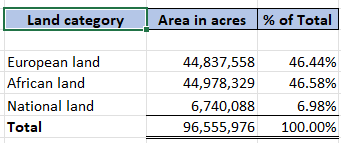
Approximately 250,000 Whites arrogated to themselves fully half of the best land, leaving nearly 6 million Africans to make do with the worst half. An Agro-Ecological survey in 1960 divided the land into 5 regions. Regions four and five were where crop production was most difficult because of their marginal soils and erratic rainfall patterns. 80% of African land was in regions four and five.[72]
Sections 11 and 24 of the Land Tenure Act explained that the purpose of the Act was to ensure[73]:
“that each race shall have its own area…the interests of each race shall be paramount in its own area…neither race may own or occupy land in the area of the other race, except by permit, which shall be issued or refused by a Minister of Government when it seems in his opinion desirable.”
Summarising the Land Tenure Act, Mutiti[74] said:
“The main industrial and urban areas are all in the European section, and Africans cannot live or trade in them… Africans are required to have permits to live [owing to working for Whites in the capacity of domestic workers] and work in the European area. There is a commission which examines the restrictions on the movement of individuals between the European and African areas and also considers the question of removing restrictions on professional Africans who may be practising in a European area.”
Writing in April 1975, D.G. Clarke (University of Rhodesia) did a quantitative and qualitative analysis of land inequality on the basis of ownership. Starting with the quantitative analysis, one must keep in mind the vast population differential – 249,000 Europeans and 5,130,000 Africans in 1970 – and that 60-70% of the Black population resided in, and derived part of its livelihood from the rural areas. Acres per capita in 1969 stood at 8.8 for Africans, and 152 for Europeans – a differential of 17.3 times[75].
In 1965, the total area reserved for European farming interests was 33.7 million acres. Clarke’s observation is as follows:
“The number of farms in this [European] sector was 6,266, giving an average farm size of 5,376 acres… [A]llowing for an average number of 3.5 dependents per owner… the total White population directly dependent on ‘European’ rural land assets would be 28,197 or 13.4 percent of the White population in 1966. Thus, it is a small minority of the White population which owns and directly benefits from control over the rural land resources allocated to ‘Europeans’.”
On the African side of the equation, Clarke allocates an equal amount of land for African farming – the Land Tenure Act is roughly a 50/50 split. Although 60-70% of the African population is rural, he drops the total estimate of Africans owning and deriving a livelihood from the land to 2,500,000, which is roughly 50%. The basis of tenure is different to European tenure in that it is communal, but this is the best we can do to derive a comparable estimate for numbers deriving a livelihood from the land.
This resulted in a White/Black acres per capita differential of 88.5:1.
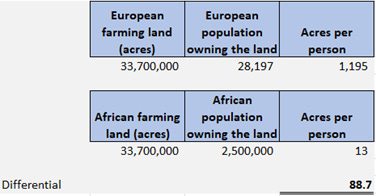
The upshot is that “even allowing for a wide margin of error, the conclusion that land distribution is highly inequalitarian is unavoidable.”[76]
Moving to the qualitative analysis of land inequality, the key factor already alluded to is that “in the main a higher proportion of “European” land is suitable for more intensive and profitable farming, and a larger share of Black land falls in less favorable regions.” In addition, “the effect of differential investments in infrastructure (roads, power, electricity, irrigation, water services, etc.) is an important factor and can be seen to provide a set of supports for White production structures markedly superior to those available for Blacks.”[77]
The Rhodesian Dog Whistler’s fake Bill of Rights
Perhaps the only thing more disturbing than the above statistics, is that the statistics themselves would not exist had the land itself not been divided into ‘European’ and ‘African’ areas in accordance with the segregationist policies that took root upon colonial occupation in 1890. In Part IV, I pointed out that Rhodesians, as opposed to South Africans, were dishonest racists. One has to wonder at a mind that claims not to be racist, and then proceeds to divide the country’s land resource along racial lines, allowing statistics to be easily calculated that prove the racist intent of the division.
This is what I find most puzzling about Rhodesians. It’s not the racism itself; it’s the denial of such obvious racism. And it’s this denial of undeniable racism that is at the heart of the Unbekoming defence of colonial Rhodesia. They’re saying: “We’re not racist, but we divided the land up into European and African areas and then took the lion’s share.” This is a perfect illustration of the seemingly contradictory combination of deviousness (trying to hide racism) and stupidity (enacting provable racism) that Rhodesians seemed to, and still seem to, relish.
Whereas apartheid South Africa put up signs on park benches and beaches saying “Whites Only”, Rhodesians preferred to erect elaborate but transparent propaganda props to try to convince ignorant outsiders that they weren’t racists. One such prop to which I have already alluded is the famed Declaration of Rights that you will find extolled to the high heavens on every Rhodesian Dog Whistle website.
The Declaration of Rights in the Constitution proclaimed the right of every person to enjoy the fundamental rights and freedoms of the individual without distinction as to race, political opinion, colour or creed. However, the Constitution contained exceptions and provisions that rendered these supposed guarantees worthless. The insidious clause in the Constitution that nullified fundamental rights and freedoms stated that a law would not be construed as discriminating if it permitted:
“different treatment of persons or communities if such treatment is fair and will promote harmonious relations between such persons or communities by making due allowance for economic, social or cultural differences between them.” [emphasis added]
A further clause, which went to the heart of the matter, declared that a law could not be construed as being inconsistent with the Declaration of Rights, where such law provided for “restrictions on the ownership, occupation or use of land”. In other words, the Land Tenure Act – the ‘constitution of racial discrimination in Rhodesia – was outside the scope of the Declaration of Rights.[78]
The most comprehensive nullification of the Bill of Rights was contained in section 84 of the Constitution which stated[79]:
“No court shall inquire into or pronounce upon the validity of any law on the ground that it is inconsistent with the Declaration of Rights.”
The Bill of Rights was essentially non-justiciable.
A legal report by the International Commission of Jurists in 1976 pointed out that the Rhodesian Constitution made a distinction between Africans and Europeans. However, this distinction clashed with the Land Tenure Act since two other minorities – Asians and Coloureds – had been classified as European under the Constitution. In order to prevent Asians and Coloureds from encroaching into White areas, a Property Owners (Residential Protection) Bill was published in 1967. Under the terms any area could be declared an “exclusive area” for one race pursuant to a petition by 15 property owners of the predominant race. The bill was not enacted owing to criticism from both within and outside Rhodesia so instead, an amendment to the Deeds Registries Act allowed for restrictive covenants on sale that prevented sale of properties to non-Whites.[79]
Private businesses including restaurants and entertainment venues, could reserve ‘Right of Admission’, which meant they didn’t have to serve a person they didn’t like the look of, and didn’t have to explain why. Thus, every White Rhodesian business had a ‘Right of Admission Reserved’ sign up instead of the South African sign that said “Whites Only”. It also avoided breaking the law when, on the odd occasion every six months, they wanted to admit a Black person for some peculiar reason.
We have confirmation of this from none other than a Detective Inspector of the Special Branch intelligence unit, Mac McGuinness, who describes how he used his power to circumvent the racist admission laws in Rhodesia in 1974. He was transporting none other than Robert Mugabe from a prison facility in Gwelo to Salisbury, and stopped off with his Black prisoner for some lunch at a White-owned hotel. He obviously knew what to expect, but he needed to eat, and relished the opportunity to demonstrate his power. The hotelier approached McGuinness while he and Mugabe were looking at the menu and said, “Sorry, we don’t serve blacks here.” McGuinness explained in forceful terms who he was, and that the restaurant would be closed down if he didn’t serve both of them. The hotelier rushed off, arranged the steak, egg and chips, and offered to waive the bill.[80]
Land epilogue
An amendment to the Land Tenure Act was passed in March 1977. White farming lands and industrial and commercial lands in central districts were opened to all races, but Tribal Trust Lands were to remain the preserve of Africans. By this time, the Rhodesian regime was collapsing under the weight of civil war and international pressure.
In August 1978, the Rhodesian government announced a partial relaxation of racially discriminatory legislation: all public places (mainly of entertainment) were opened to people of all races and restrictions removed on trading and industrial areas, on facilities operated by local authorities and on voting in local government elections. However, hospitals, schools, the government service and residential areas were not included.[81]
February 1979 saw the attempted imposition of an ‘internal settlement’, which was not recognised internationally as it excluded the main African nationalist parties that had fought against the Rhodesian Front regime since 1966. The Lancaster House negotiations that took place in 1979 formed the basis of a peace settlement and a legal transition to independence overseen by a British Governor. Under the agreement, elections were to be held in 1980 under a universal franchise, and the winning party could form a government.
The land question was crucial to the success of those negotiations. Both factions of the liberation struggle stated in the most clear terms that it was the key pillar of White racism they had fought to remove. The talks nearly collapsed as a result of failure to obtain the necessary assurances that the African nationalists needed regarding land reform.
The agreement that was eventually reached at Lancaster House in respect of land was that land acquisition by the new Zimbabwe government could only take place on a willing seller-willing buyer basis. Farmers could not be forced to sell, and if a sale was agreed, it would be at market prices with compensation payable in foreign currency. After the farm invasions in Zimbabwe began in 2000, Mac McGuiness, who was a senior ranking intelligence officer in the Smith regime, was interviewed by Heidi Holland for her book, Dinner With Mugabe. He recalled a conversation he had with Robert Mugabe in 1974 shortly before he was released from prison after being jailed for 10 years by the Smith regime[82]:
“Uppermost in his [Mugabe’s] mind was to take back the land. That is why we feared him more than some of the others. He was saying all the same things then that he says now, about the land having been stolen by the British and the settlers and therefore his government not needing to pay compensation to get it back.” [emphasis added]
Indeed, the ZANU and ZAPU African nationalist leadership at Lancaster House sought guarantees that Britain would fund the repurchase of land to enable a redistribution. The verbal assurances they were supposedly given turned out to be not worth the paper they were written on. If one believes that promises were broken at Lancaster House, the error appears to be a repeat of the Lobengula debacle that took place 90 years earlier. Bertus de Villiers, a constitutional law expert, wrote in 2003 that[83]:
“The government of Britain promised £75 million and the US promised US$500 million, but none was in the form of written guarantees. By the year 2000 Zimbabwe had only received approximately £30 million, in contrast to Kenya where in its land restoration and resettlement process £500 million was provided.”
In Part VIII, I will write about politicians who fail to get proper assurances on agreements obtained during negotiations and then cry foul when the party that supposedly made the promise reneges. That said, what is interesting about this particular allegation is that Britain never denied that the promise was made. It simply said that it no longer felt obligated to fulfil it. Writing to the Zimbabwean government in 1997, the British Secretary of State for International Development, Claire Short, confused her private persona with her official capacity as a representative of the British government, stating:
“I should make it clear that we do not accept that Britain has a special responsibility to meet the costs of land purchase in Zimbabwe. We are a new government from diverse backgrounds without links to former colonial interests. My own origins are Irish and, as you know, we were colonised, not colonisers.”
The failure to obtain proper guarantees for land reform and redistribution was seen by some at the forefront of the liberation movement as a “crucial capitulation”, while others saw it as a necessary compromise to move Zimbabwe forward. The ZANU/ZAPU alliance was under severe pressure from its sponsors in the Frontline States to accept an agreement that afforded the opportunity for free and fair elections. The military struggle could not continue without their sponsorship, and it was not certain that it would continue if the talks broke down. All sides were exhausted from the war. But there can be little doubt that the failure to agree a satisfactory solution to the land question led to paralysis in the new government on a key issue that Zimbabweans wanted resolved.
The new government could not act decisively in the interests of landless peasants, and for the next twenty years White commercial farmers got the continuity they had hoped for in those very uncertain first few months of 1980. Another factor tying the new government’s hands was that commercial farmers by 1980 had achieved the monopoly on agriculture that the entire colonial machinery had endeavoured to give them since 1908. They were producing 90% of the country’s marketed food output, which made security of commercial farming a political sine qua non, at least in the short to medium term.
Some redistribution nevertheless did take place, although it fell well short of the unrealistically ambitious targets the government set itself in 1980. In 1969, the estimate of overpopulation in the rural areas was 220,000 families. 52,000 were resettled within the first 10 years, which was 32% of the 1982 target of 162,000 families. This entailed acquiring 16% of the area owned by commercial farmers.[84]
By the end of the 1980s, resettlement stalled due to both a lack of resources and capacity to do it. There were numerous other factors involved, including shifting government priorities and inability to cope with post-settlement infrastructural and support demands. Funding tended to go more to the acquisition than to the resettlement, which was equally important to make a success of it. By 1990, despite the missed redistribution targets, farming was being hailed as a success due to the continued stability of commercial farming and an increase in productivity of the small-scale farmer in the communal areas due to the government assistance programmes. However, population pressures in the communal areas had not been relieved, and in fact was getting worse owing to increased population growth.
The terms of the Lancaster House agreement had a 10-year expiry date, which was reached in 1990, and political pressure to achieve redistribution resulted in amendments to the Constitution that relaxed the land acquisition terms in favour of the new government. The government could now expropriate land at a “fair” compensation, and it was no longer required to be in foreign currency.
As is now well known, a chaotic land redistribution did take place between 2000 and 2003. I have invoked Natural Law throughout these essays to condemn the deception, occupation, conquest, and exploitation of Zimbabweans that was inherent in the colonial project initiated by Rhodes to fulfil his vision of colonising Africa for Britain. I therefore cannot escape it in describing the post-independence farm invasions of 2000 – 2003. By the time the farm invasions began, some 4,500 White farmers owned 29% of the land. An estimated 7 – 10 farmers were killed. That’s a violation of Natural Law that I unequivocally condemn. They were needless deaths that should not have happened.
There is very little doubt that former President Robert Mugabe “tethered the issue of land reform to his own political survival” and, in so doing, unleashed a wave of political violence. But, as I have endeavoured to show in this essay and the ones preceding it, the land issue was not his invention. All of these essays might be summed up in the words of Tanzania’s President in 1979, Julius Nyerere, who warned that it would be untenable “to tax Zimbabweans in order to compensate people who took [land] away from them through the gun.” Mugabe followed through on the sentiments he expressed to his gaoler, Mac McGuiness, in 1974, by sanctioning farm occupations and amending the constitution to permit expropriation without compensation. Occupations haunted Zimbabwe again as 1890 reverberated with a vengeance.
Recall in Part III that when White settlers approached the Shona Chief Chinamora in the 1890s and spoke to him about their “ground, boundaries and beacons”, the chief responded by asking them: “Who gave you this land?”
In 2013, a clause was incorporated into the Zimbabwean constitution explicitly placing sole responsibility for compensating the owners on Britain. Were they really the owners? They thought they were the owners – they had the colonial ‘law’ of the jungle on their side.
However, in an apparent U-turn in 2025, the Zimbabwean government has agreed to start compensating White farmers for the farms it seized between 2000 and 2003. It seems colonial law still applies even after decolonisation.
While penning The Idiot’s Guide To A Class Analysis of The Great Reset, I stumbled upon something that made my jaw drop. The Royal family owns “more than 115,000 hectares of agricultural land and forests… and about 55% of UK foreshore (beaches).” [emphasis added]. It’s the ownership of beaches bit that made my jaw drop although the ownership of forests is disgusting enough. I subsequently learnt that the appositely named Earl of Shaftesbury owns the largest lake in Ireland. This tweet provided the answer to the question of how such brazen theft of natural resources occurred: “colonialism, cultural erasure, and a global pattern of land theft disguised as empire.”
The ‘volunteers’ who occupied Mashonaland in 1890, and the ‘volunteers’ who partook of the Ndebele War of 1893, and who signed, in Keppel-Jones’ words, “nothing less than a contract for robbery under arms”, willingly accepted their government’s authorisation to commit theft and murder. Rhodes, Jameson and his accomplices definitely knew they were deceiving the Mashona and Ndebele people, and they knew why they were doing it. The BSAC and the Judicial Committee knew that they were stealing land that was not theirs to take, but the taking of it was justified through conquest by sword. Successive Rhodesian governments knew how that land had been acquired. Settlers buying land from the government took comfort from the fact that they were entering into a ‘lawful’ transaction with Her Majesty’s Government, and thus none of them were plagued by their conscience. Or perhaps they were? We can’t know. As Palley notes, Natural Law was not enforceable, so no one needed to consider whether they were dealing in stolen goods. But they were dealing in stolen goods.
Having presented a more comprehensive origin story than that offered in Unbekoming’s defence of colonial Rhodesia, I now put the following questions to you:
Were people who bought farms in Rhodesia dealing in stolen goods? If so, were they doing so knowingly, but were unbothered because it was ‘legal’?
If government perpetually authorises conduct by its ‘subjects’ that is legal but not moral, then is the institution of government the originator of terror and true moral lawlessness?
If so, is this terror fuelled by our collective uncritical acceptance of government’s ‘legal’ authority?
And if so, who is more to blame – the individual citizen who uncritically accepts the authorisation from their government to commit crimes or the government that authorises crimes?
Asking the same question directed specifically to the Rhodesian situation: Did the crimes in Rhodesia start with the Crown’s grant of the Royal Charter, or did the crimes start when brigands followed orders to violate Natural Law?
If the British Crown expressly authorised, oversaw and supported property theft in Rhodesia, why is the Crown not on the hook for compensation of the farmers to facilitate a more equitable distribution of land?
Should anyone even own vast tracts of a God-given resource like land, let alone forests and beaches? If not, how do we share these resources that we all depend on for our survival?
My penultimate question is: should Zimbabwe succumb to international pressure from War criminals and the administrators of organised theft in the West to return land the British Crown stole in 1890 – 1897? A theft which its own legal system, in the form of the Judicial Committee of the Privy Council, confirmed had taken place by conquest.
And finally, to answer a question with a question, I ask citizens of the UK and Ireland (and the numerous other victims of the crime of Grand Theft Colony: “When are we going to unite in solidarity to get back the beaches, lakes, and forests taken by the same thieves who stole Zimbabwe’s land in 1890?”
In Part VI, we examine the background and legislation that led to segregation in employment and education, creating disparities on racial lines.
[1] Arthur Keppel-Jones, Rhodes and Rhodesia: The White Conquest of Zimbabwe 1884-1902, Kingston and Montreal, McGill-Queens University Press, 1983, Ch. 15, pg. 609.
[2] Keppel-Jones, op. cit., Ch. 13, pg. 530.
[3] Robert Blake, A History of Rhodesia, Eyre Methuen Ltd, London, 1977, Ch. 13, pg. 192.
[4] Blake, op. cit., Ch. 11, pg. 159.
[5] Claire Palley, The Constitutional History and Law of Southern Rhodesia 1888 – 1965, Clarendon Press Oxford, 1966, Part 1, Ch 8, pg. 158.
[6] Blake, op. cit., Ch. 11, pg. 160.
[7] Blake, op. cit., Ch. 11, pg. 160.
[8] Keppel-Jones, op. cit., Ch. 15, pg. 625.
[9] Keppel-Jones, op. cit., Ch. 15, pg. 628.
[10] Blake, op. cit., Ch. 12, pg. 174.
[11] Blake, op. cit., Ch. 12, pg. 185.
[12] Blake, op. cit., Ch. 12, pg. 187.
[13] Blake, op. cit., Ch. 13, pg. 191.
[14] Blake, op. cit., Ch. 13, pg. 195.
[15] Palley, op. cit., Part 1, Ch 2, pg. 27-28.
[16] Blake, op. cit., Ch. 12, pg. 177.
[17] Palley, op. cit., Part 1, Ch 2, pg. 28.
[18] Keppel-Jones, op. cit., Ch. 13, pg. 523.
[19] Keppel-Jones, op. cit., Ch. 10, pg. 391.
[20] Edited by Robin Palmer and Neil Parsons, The Roots of Rural Poverty in Central and Southern Africa, Berkeley: University of California Press, 1978, Ch. 9, pg. 228.
[21] Palmer and Parsons, op. cit., Ch. 9, pg. 227.
[22] Keppel-Jones, op. cit., Ch. 10, pg. 392.
[23] Keppel-Jones, op. cit., Ch. 10, pg. 394.
[24] Palmer and Parsons, op. cit., Ch. 9, pg. 223
[25] Palmer and Parsons, op. cit., Ch. 9, pg. 225.
[26] Keppel-Jones, op. cit., Ch. 13, pg. 539.
[27] Alois S. Mlambo, A History of Zimbabwe, New York, Cambridge University Press, 2014, Ch. 4, pg. 54.
[28] Victor Machingaidze, Company Rule and Agricultural Development: The Case Of The BSA Company in Southern Rhodesia, 1908-1923: https://sas-space.sas.ac.uk/4075/1/Victor_Machingaidze_-_Company_rule_and_agricultural_development%2C_the_case_of_the_BSA_company_in_southern_Rhodesia%2C_1908-1923.pdf
[29] Palmer and Parsons, op. cit., Ch. 9, pg. 230.
[30] Machingaidze, op. cit.
[31] Palmer and Parsons, op. cit., Ch. 9, pg. 234.
[32] Machingaidze, op. cit.
[33] Machingaidze, op. cit.
[34] Palmer and Parsons, op. cit., Ch. 9, pg. 231.
[35] Machingaidze, op. cit.
[36] Palmer and Parsons, op. cit., Ch. 9, pg. 233.
[37] Palmer and Parsons, op. cit., Ch. 9, pg. 234.
[38] Palmer and Parsons, op. cit., Ch. 9, pg. 235.
[39] Mlambo, op. cit., Ch. 4, pg. 61.
[40] Palmer and Parsons, op. cit., Ch. 9, pg. 235.
[41] Mlambo, op. cit., Ch. 4, pg. 61
[42] Mlambo, op. cit., Ch. 4, pg. 61
[43] Larry W. Bowman, Politics in Rhodesia: White Power in an African State, Harvard University Press, Cambridge Massachusetts, 1973, Ch.1, Pg. 13.
[44] Palmer and Parsons, op. cit., Ch. 9, pg. 242.
[45] Robert Blake, A History of Rhodesia, Eyre Methuen Ltd, London, 1977, Ch. 13, pg. 202.
[46] Robert Blake, A History of Rhodesia, Eyre Methuen Ltd, London, 1977, Ch. 13, pg. 202-3.
[47] Aaron Benjamin Mutiti, Rhodesia and Her Four Discriminatory Constitutions,: https://journals.co.za/doi/pdf/10.10520/AJA00020117_159
[48] Blake, op. cit., Ch. 13, pg. 203.
[49] LH Gann and Peter Duignan (eds), The History and Politics of Colonialism 1914-1960 Vol 2, Cambridge University Press, 1970, pg. 108
[50] Palmer and Parsons, op. cit., Ch. 9, pg. 240.
[51] Kay Muir, University of Zimbabwe, Economic Review of Crop Production, January 1981: https://files01.core.ac.uk/download/pdf/29136202.pdf
[52] Palmer and Parsons, op. cit., Ch. 9, pg. 241.
[53] Palmer and Parsons, op. cit., Ch. 9, pg. 241.
[54] Alois S. Mlambo, A History of Zimbabwe, New York, Cambridge University Press, 2014, Ch. 4, pg. 64.
[55] Hanlon, Manjengwa and Smart, Zimbabwe Takes Its Land Back, Kumarian Press, 2013, Ch. 11, Pg. 176
[56] Mlambo, op. cit., 2014, Ch. 4, pg. 64.
[57] Bowman, op. cit., Ch.3, Pg. 50.
[58] Bowman, op. cit., Ch.3, Pg. 49.
[59] Bowman, op. cit., Ch.3, Pg. 49.
[60] Hanlon, Manjengwa and Smart, Zimbabwe Takes Its Land Back, Kumarian Press, 2013, Ch. 1, Pg. 2
[61] Mlambo, op. cit., Ch. 4, pg. 66.
[62] David Martin and Phyllis Johnson, The Struggle for Zimbabwe, African Publishing Group, 2012, Ch. 4, Pg. 55.
[63] Blake, op. cit., Ch. 13, pg. 200
[64] Blake, op. cit., Ch. 13, pg. 200
[65] Mlambo, op. cit., Ch. 4, pg. 65.
[66] Hanlon, Manjengwa and Smart, op. cit., Ch. 11, Pg. 176
[67] Palley, op. cit., Part 2, Ch 5, pg. 637.
[68] Palley, op. cit., Part 2, Ch 5, pg. 640.
[69] Palley, op. cit., Part 2, Ch 5, pg. 642.
[70] Mlambo, op. cit., Ch. 4, pg. 67.
[71] Mlambo, op. cit., Ch. 4, pg. 68 (converted from hectares to acres).
[72] Mlambo, op. cit., Ch. 4, pg. 68.
[73] https://www.colonialrelic.com/appendixes/appendix-vi-the-land-tenure-act-1969-and-the-land-apportionment-act-1930/
[74] Aaron Benjamin Mutiti, Rhodesia and Her Four Discriminatory Constitutions,: https://journals.co.za/doi/pdf/10.10520/AJA00020117_159
[75] D. G. Clarke, Land Inequality and Income Distribution in Rhodesia, Cambridge University Press, April 1975: https://doi.org/10.2307/523705
[76] Ibid.
[77] Ibid.
[78] International Commission of Jurists, Racial Discrimination and Repression in Southern Rhodesia: https://www.icj.org/wp-content/uploads/1976/01/Southern-Rhodesia-Racial-discrimination-and-repression-report-1976-eng.pdf
[79] D.G. Baker, Time Suspended: The Quenet Report and White Racial Dominance in Rhodesia, Zambezia (1979), VII (ii).
[80] International Commission of Jurists, op. cit.
[81] Heidi Holland, Dinner with Mugabe, London, Penguin Books Ltd., 2009, Ch. 3, Pg. 30.
[82] Institute of Contemporary British History, Britain and Rhodesia: The Route to Settlement, 2008, https://www.kcl.ac.uk/sspp/assets/icbh-witness/rhodesia2.pdf
[83] Holland, op. cit., Ch. 3, Pg. 32.
[84] Bertus De Villiers, Land Reform: Issues and Challenges, Konrad Adenauer Foundation, 2003, pg. 7: https://www.kas.de/c/document_library/get_file?uuid=6c7f5134-b92f-3955-d920-ffefd911062f&groupId=252038
[85] De Villiers, op. cit., pg. 11.
Comments are closed.