
The UK Electricity Disaster

Introduction to the National Democratic Party
The National Democratic Party (NDP) is a socialist political organisation, committed to advancing political and economic change, openness and democracy, wherein our economy works in the public’s interests and not in the interests of private capital.
The NDP calls for social ownership of key sectors such as infrastructure, finance and strategic industries, providing a stable environment for small and medium enterprises (SMEs) which play an important role in our economic development. The NDP opposes past and future lockdowns on the basis that they were undemocratically implemented and negatively impacted the (real-world) economy.
The UK electricity disaster
Every single country on Earth depends on electricity to survive. It is a key factor determining our homes, industry and commerce. The price of electricity helps determine our competitiveness, efficiency and the comfort of our homes. But the UK, since privatisation, has among the highest prices of electricity in the World. Only the EU has higher prices. Here, we in the National Democratic Party examine why.
Privatisation
Before nationalisation in 1947 the system was a fragmented mess of over 600 private and municipal companies. Nationalisation merged them into the British Electricity Authority (later becoming the Central Electricity Generating Board, or CEGB) and 12 regional area boards. The Goal: To create a unified national grid that could provide reliable power to the entire country, including rural areas that private companies had previously ignored. Prices, under public ownership were low, especially for industry.
The shift back to private ownership happened in stages during the late 1980s and early 1990s under Margaret Thatcher’s Conservative government. The Stated Goal: To encourage competition, drive down costs through efficiency, and reduce the state’s financial burden. The Real Goal, of course, was to boost the profits of the finance sector which would end up owning the shares. And the results:
Our UK electricity shambles
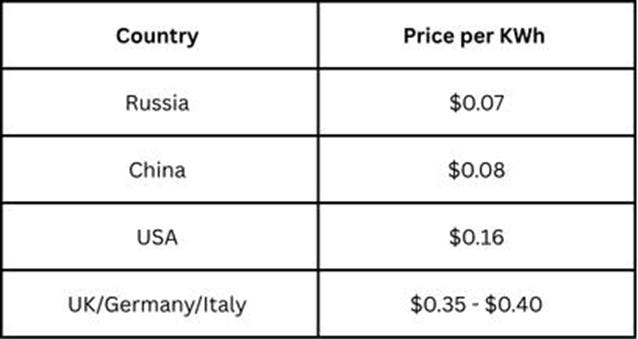
UK electricity is amongst the most expensive in the World. It is privatised. The major companies that control it are themselves controlled by the US finance giants: Blackrock, Vanguard, etc. In 2024 and 2025, the total profits across the entire UK energy sector reached an estimated £30 billion annually. For the average consumer, this means roughly £500 of your annual bill is going toward corporate profit.
Electricity prices are usually lowest among those countries with nationalised electricity production and distribution. Thus our high electricity prices are the result of political decisions, not economic or technical. The only major countries with higher prices than the UK appear to be Ireland, Italy, Germany and Belgium. All, note, within the European Union.
The cheapest electricity in the World is in Iran followed by a number of African countries with hydro-electric power sources.
UK insanities resulting from privatisation
1. Marginal Pricing. Under a formula agreed with the Corporate Electricity Generators, energy prices in the UK are linked to those energies commanding the highest market price. This is absurd. In the UK, the price of electricity is linked to gas, which is the most expensive form of generation.
2. Fragmentation of electricity supply has meant we have three separate sectors: Generators, Distributors and Retailers. Each sector and each company demands profit for shareholders, vast salaries for its CEOs and other major administrative jobs.
3. Huge costs were incurred when dozens of small private retailers went bust in 2021 to 2022. Needless to say, these costs were passed on to the consumer via standing charges.
4. Private companies have prioritised shareholder dividends over investment in modern technology and maintenance. They expect and will probably get tax-payers money to subsidise the shortfall.
5. There is now a huge backlog of investment. This will need £60 billion in emergency investment which will be added on to household bills.
The big shareholders of our electricity companies care nothing for the effects on UK consumers and the effects on UK industry and high costs. This is partly due to them being foreign shareholders, especially the US financial giants such as Blackrock, Vanguard etc. Not that UK companies are patriotic – they also follow the money.
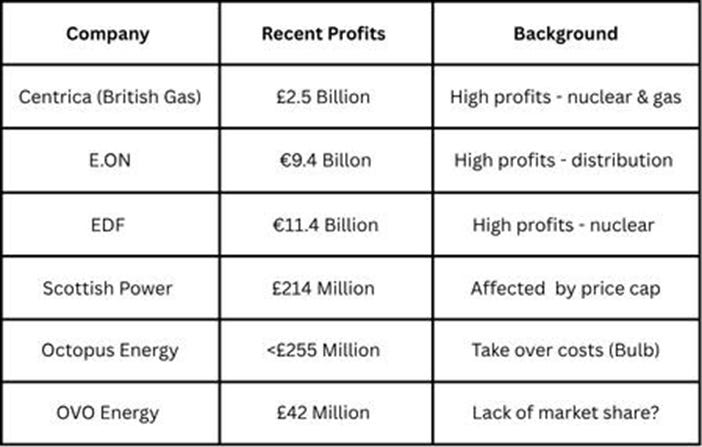
To understand the profits of the “Big Six,” it is important to distinguish between the Retail side (the companies that send you the bill) and the Generation/Parent side (the companies that own the power plants and wind farms). The below table shows the UK’s main retailers, some which are also involved in Generation.
Electricity generators
Most of the electricity profits go to the generators. Notably RWE: £5.l billion, EDF: £1.9 billion and Scottish Power: £3.15 billion. Over one billion pounds are paid to RWE straight from your taxes as a subsidy.
RWE is a German company whose second biggest shareholder is Blackrock. Scottish Power’s largest shareholders are Blackrock and Vanguard.
EDF is wholly owned by the French government. Our electricity customers are subsidising the French tax-payers!
Ofgem: While this toothless body claims it limits retail profits to 2% the reality is that these companies just transfer their profits to the Generating and Distribution sectors.
The UK’s unique burden: Standing Charges
While the unit rate (kWh) in the UK is high, the Standing Charge (the daily fee just to be connected) is increasingly a global outlier.
By April 2026, UK standing charges are forecast to rise to cover £24 billion in grid upgrades.
In many G20 countries (like China or parts of the US), fixed fees are minimal or non-existent, meaning if you don’t use electricity, you don’t pay. In the UK, you can pay over £200 a year before turning on a single lightbulb.
Where the money actually goes
While retail companies like Octopus or Ovo often report modest profits or even losses, the upstream parts of the system are where the real money is made.
The Grid Operators (The Hidden Profit): Companies like National Grid and regional distribution networks (often owned by overseas investment funds) have profit margins as high as 38%. These are effectively “natural monopolies” where you have no choice but to pay their fees via your standing charge.
The Parent Groups: Even if British Gas (the retailer) shows a small margin, its parent company Centrica makes billions by selling the gas that the retailer buys. This “vertical integration” is a common criticism of the privatised model.
Shareholder Returns: In 2025, Centrica increased its dividend to shareholders by 22% and continued a £2 billion share buyback program. For many, this is the “smoking gun” of privatisation: billions being returned to investors while millions of households remain in fuel poverty.
A note on smart metres
Money is being wasted on the roll out of smart meters for both electricity and gas. NDP co-founder Alex Jackman has personal experience as a gas engineer employed by a Gas Distribution Network, which also works on gas meters for suppliers (basically as a sub contractor to them). ‘Dumb’ meters, particularly the diaphragm meters, will outlast any digital Dumb or Smart meter, and are actually better for the environment as they contain less plastic and no Lithium battery. Lithium batteries are supposed to last 10 years, which they are more likely to if the meter is internal. But Lithium batteries are negatively affected by the cold and constant change in temperature so only last a couple years if external. Once these fail the whole meter needs to be changed, whereas in the past with the old style card meters, it was possible to solely replace the battery pack, which contained 5D batteries, and these lasted longer.
In addition to issues with the Lithium batteries, there are frequent software faults: they are always going wrong. On the plus side, Jackman and colleagues are now noticing that people are increasingly fed up with smart meters, and would prefer to go back to the diaphragm ‘Dumb’ meters.
Solutions
The National Democratic Party propose the following solutions.
- Nationalise and integrate the whole electricity supply industry. We should nationalise all energy and reduce prices to cost price (plus maintenance). This would reduce costs for business and households alike; reducing inflation and making the UK more competitive.
- Cease share payouts and cut expensive layers of duplicate management.
- Follow up with a massive investment programme. We propose that the UK invest heavily in nuclear energy, support Rolls Royce’s Small Modular Reactor programme, install solar panels on all commercial properties, and on as many residential properties as possible, and increase the generation/use of hydro-electricity where possible.
A cut in electricity costs would re-invigorate British Industry and cut costs for homes. Whilst privatisation was sold to the public as rationalisation and efficiency, in reality it produces the opposite: duplication and inefficiency.
Comments are closed.