
The Collapsing Minds of the ‘Collapsing Climate’ Cult: Part III – Deep Uncertainty in Climate Science

“Not doubt, certainty is what drives one insane.” – Friedrich Nietzsche
I had initially intended to cover three subjects in one essay: the deep uncertainty in climate science; the costs of misdiagnosing environmental problems, and; answering whether the official narrative is definitely a scam, which, on the face of it, would appear to contradict a stance of scepticism stemming from acknowledgement of uncertainty. I have come to my senses and split these three subjects into two more digestible essays. This essay (Part III) deals solely with the uncertainty in climate science.
“Not doubt, certainty is what drives one insane.” – Friedrich Nietzsche
What is the source of uncertainty in climate science?
In Part II, I argued that there is no scientific consensus on the official climate change narrative. That is to say, there is no consensus that would make the Catastrophic Anthropogenic Global Warming (CAGW) hypothesis scientifically unassailable, rendering it a relatively stable paradigm that structures and organises the climate science knowledge base. I will now move to a discussion of why the scientists disagree – why is there no scientific consensus?
In her book Climate Uncertainty and Risk: Rethinking Our Response, Judith Curry notes that the fundamental source of disagreement is over the importance of natural climate variability – the relative importance of natural versus human-caused climate change. This disagreement arises for four main reasons[1]:
- “There is little acknowledgment that some climate processes are poorly understood or even unknown.”
- “The historical data is sparse and inadequate, particularly in the oceans.”
- “There is disagreement about the appropriate logical framework for linking and assessing evidence.”
- There is disagreement over the quality of different classes of evidence, most notably global climate model simulations, and paleoclimate reconstructions from geologic data.
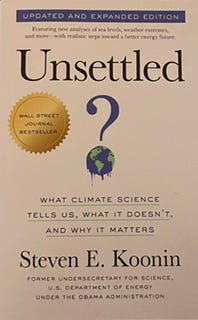
In this essay, I will also reference Steven Koonin’s book – Unsettled: What Climate Science Tells Us, What It Doesn’t, And Why It Matters. Who is Dr Koonin? He is one of America’s most distinguished scientists, a member of the National Academy of Sciences, and a leader in United States science policy. For almost thirty years, he was a professor of theoretical physics at Caltech. He also served for nine years as Caltech’s vice president and provost, facilitating the research of more than three hundred science and engineering faculty and catalysing the development of the world’s largest optical telescope, as well as research initiatives in computational science, bioengineering, and the biological sciences.[2]
Steven Koonin is currently a professor at New York University, where he holds appointments in the Stern School of Business, the Tandon School of Engineering, and the Department of Physics. He served as Undersecretary for Science in the US Department of Energy under President Obama, where his portfolio included the climate research program and energy technology strategy. He was the lead author of the US Department of Energy’s Strategic Plan (2011) and the inaugural Department of Energy Quadrennial Technology Review (2011). Before joining the government, Dr. Koonin spent five years as chief scientist for BP, researching renewable energy options to move the company “beyond petroleum”.[3]
When the American Physical Society (APS) held a workshop in 2014 to consider its statement on climate change, it explored disagreement among climate scientists. From reading a full transcript of the workshop, an Australian policy analyst and journalist concluded that “climate scientists are much less certain than they tell the public.”[4] [Emphasis added]
Steven Koonin was the scientist who was asked by the APS to lead that workshop. Six leading climate scientists and six leading physicists spent a day debating where climate data was poor, which assumptions were weakly supported, and how reliable the models were in describing the past and projecting the future. This was Koonin’s Damascene road to climate scepticism. He sat in a room with twelve of America’s best scientists and all he heard was doubt. He realised there was no scientific consensus on climate science, and he concluded that “the science is insufficient to make useful projections about how the climate will change over the coming decades, much less what effect our actions will have on it.”[5]
Think about that. The verdict delivered by a jury of twelve of America’s best science minds contracted by the APS to draft its position on climate science: Uncertainty. And the position adopted by the climate cult: certainty. How has that happened? The latter group has been propagandised to hell and buggery, but they can’t admit it. Talking heads like Jonathan Cook fear looking stupid if they step down from the ledge. But what’s their answer? Keep placing bets on a fake consensus. The reality is that the only emotion they would encounter once they embrace uncertainty is liberation. Freedom to explore the real environmental problems highlighted in the next essay.
Climate science is not merely a complicated problem; it is a complex problem. There are several causal mechanisms in climate change, and these mechanisms interact in feedback loops. The mechanisms themselves are not fully understood, and not easily elucidated. The climate system, which is complex and non-linear, is characterised by uncertainty, ambiguity and chaos[6].
The uncertainty is so vast that “the unquantifiable uncertainties and ignorance [about climate mechanisms] dominate the quantifiable uncertainties.”[7] [emphasis added] Because the IPCC is a consensus-seeking political body, it has sought to simplify the uncertainty by ignoring or downplaying it, and to convey confidence where it is unfounded. I delved into the IPCC’s consensus-manufacturing process in Part II.
In this Part III, we’ll deal first with fundamental problems that are largely generated by the unrealistic CAGW hypothesis itself. So, we’ll look at the problems with the assumptions and data that the climate models use to generate predictions about future climate states.
We’ll then look at the problems with the climate model simulations. These are supposed to translate the hypothesis and the data into predictions that match real-world observations.
Problems with assumptions and data
The models presenting climate simulations are a fundamental source of uncertainty but, as an evidence tool, they can only reflect the theoretical assumptions about causal climate change mechanisms, and the data to which the assumptions are applied. If the causal assumptions and data are flawed, we are firmly in the territory of garbage in, garbage out. And that indeed is where we are, and have been since 1988.
A model simulating a complex dynamic system will, of necessity, make countless assumptions about numerous variables, but we need only punch two holes in the overarching assumption of the CAGW hypothesis to sink the ship while it’s still in the harbour.
First, in insisting on CO₂ as the primary driver of global warming, the hypothesis must successfully quantify the increase in temperature caused by a specified increase in atmospheric CO₂ concentration. It has failed to do that. This is known as climate sensitivity, which is defined as the global surface warming that occurs when the concentration of CO₂ is doubled relative to pre-industrial levels. Clearly, this is a fundamental uncertainty since the whole hypothesis hinges on this sensitivity.
Second, the hypothesis rules out the effect of other known climate change mechanisms, but proponents of the hypothesis have failed to prove that the other mechanisms play a negligible role.
As you can see, there is a dynamic interplay between these two problems – they can’t quantify climate sensitivity to CO₂ because they can’t prove that CO₂ is the dominant climate change mechanism. And the undeniable evidence that they can’t prove temperature sensitivity to CO₂ is that the predictions of the climate simulation models fail miserably to align with the real-world observations. We deal with this in the next heading: The models are not looking good.
There is substantial uncertainty about the sensitivity of temperature increases to increases in CO₂ concentrations for numerous reasons[8], not least of which is the potential confounding effect other climate change mechanisms would have on temperature sensitivity if they were not only theoretically understood, but also quantifiable.
One such climate change mechanism that is not at all understood but which is known to have an effect is clouds and their interaction with aerosols. A lead researcher directly involved with the models had this to say on the subject:
“Cloud-aerosol interactions are on the bleeding edge of our comprehension of how the climate system works, and it’s a challenge to model what we don’t understand. These modellers are pushing the boundaries of human understanding, and I am hopeful that this uncertainty will motivate new science.”[9] [emphasis added]
How did the IPCC modellers deal with their inability to quantify this influence on the climate system? Referring to an explanation provided by a Max Planck Institute modeller, Steven Koonin explained that they simply “tuned their model to make its sensitivity to greenhouse gases what they thought it should be.” To which he added: “Talk about cooking the books.”[10]
For these reasons, the axiom that the Earth’s climate has a given ‘sensitivity’ to a particular level of CO₂ in the atmosphere is non-empirical in that it is as yet unsupported by observational evidence. It is therefore unscientific. The simple fact of the matter is that “there is no precise link between CO₂ emissions and the global mean surface temperature owing to uncertainties in climate sensitivity to CO₂ and the poorly constrained natural variations of the climate system.”[11]
What’s more, there is no scientific basis for claiming that the temperature targets of 1.5-2.0°C would be ‘dangerous’ if exceeded[12] since “the Earth has undergone geological periods of higher temperatures and atmospheric CO₂ concentrations during which life thrived.”[13]
Let’s turn to the second problem of ignoring, or implausibly downplaying, other climate change mechanisms. There is still huge uncertainty about all the climate change mechanisms at play, how they operate, how to quantify them, and crucially, how to quantify the dynamic interplay between the mechanisms. In this regard, climate science is technically in a state of deep uncertainty described as[14]:
“fundamental uncertainty in the mechanisms being studied and a weak scientific basis for developing scenarios; future outcomes lie outside of the realm of regular or quantifiable expectations.”
For illustrative purposes, I will briefly discuss one other climate change mechanism suppressed by the IPCC CAGW hypothesis – solar forcing, which Global Climate Models (GCMs) render risibly negligible. Curry sums up the issue over solar variations[15]:
“The impact of solar variations on the climate is uncertain and subject to substantial debate. However, you would not infer from the IPCC assessment reports that there is debate or substantial uncertainty surrounding this issue [… ] Researchers have speculated that multi-decadal and longer changes in solar activity could be a major driver of climate change […] The IPCC AR5 [Fifth Assessment Report published between 2013 and 2014] adopted the low variability solar reconstructions without discussing the controversy.”
Once again, we have another example of IPCC politics throttling science. In response to this controversy, a defence of science was published in the journal Research in Astronomy and Astrophysics in 2021 by 23 co-authors who, despite having a range of perspectives on the matter, were “united by their agreement not to take the consensus approach of the IPCC […] The authors found that the Sun/climate debate is an issue where the IPCC’s consensus statements were prematurely achieved through the suppression of dissenting scientific opinions.”[16]
For a sceptic of the current narrative, this incident conveniently kills three birds with one stone: it emphasises the absence of scientific consensus; it demonstrates the uncertainty about causal mechanisms of climate change, and; it demonstrates the IPCC’s ongoing fraudulent attempts to exorcise the demon of uncertainty by enforcing a consensus.
We now turn to fundamental questions about the raw data. There are serious problems with current and long-term temperature data. These problems were exposed in the Climategate scandal — see below — but questions continue with the methodology for measuring current temperatures owing to the decreasing number of weather stations, and the preponderance of weather stations situated in urban areas and airports, which are known to be artificially hotter than rural environments owing to large areas of exposed concrete and tarmac, compounded by jet and heat pump exhausts in the case of airports. Rural and high-latitude stations have also been eliminated, further skewing the data.
Adding to the temperature data controversy, Climategate emails “disclosed that prominent climate scientists had discussed how to ‘hide the decline’ in a tree-ring proxy temperature record that diverged from instrumental data after 1960 – a divergence raising fundamental questions about the reliability of the proxies used to reconstruct pre-instrumental temperatures. The documents also exposed the suppression of the Medieval Warm Period data in Michael Mann’s Hockey Stick paper, in IPCC assessments, and in peer review processes. Phil Jones, the CRU director, wrote explicitly of his intention to prevent papers that do not support the anthropogenic climate narrative from being cited in, or influencing, IPCC assessment reports.” [emphasis added]
We get a strong hint of this historical data problem in Steven Koonin’s elucidation of the uncertainty in climate science. He deals with a specific data problem under the heading of modelling problems, but in reality it is both a data problem and a problem with the assumptions built into the models, as dictated by the CAGW hypothesis. Here is his description of the failure of the models to correctly depict the past:
“But another equally serious issue is […] that the ensembles fail to reproduce the strong warming observed from 1910 to 1940. On average, the models give a warming rate over that period of about half what was actually observed.” [emphasis added]
The IPCC squirmed over this, but the upshot of its unsatisfactory dismissal of this highly consequential glitch is that “they’re [the IPCC] saying that we’ve no idea what causes this failure of the models.”[17]
From the perspective of the (in)validity of the hypothesis , the significance of this glitch is that the IPCC has observed a late 20th century warming which it attributes to human influence, but it sees a comparable early 20th century warming which it can’t attribute to human activity, and therefore must be caused by natural variability. This opens up the dreaded possibility that the late 20th century warming, neatly filed under ‘human emissions’, might also just be natural variability.
If you were the cynical type, you might suspect, as many do, that the early observational data reflecting the 20th century warm period was doctored to cool things down in the period 1910-1940.
So, having assumed that CO₂ is the single dominant factor in climate change, the GCMs then generate outputs based on this unproven paradigm. Not only are the GCMs being asked the wrong question, but, owing to the level of ignorance about the operation of climate mechanisms, scientists can’t actually formulate a set of complete questions that would give a reliable answer. The simple fact of the matter is that “emissions-driven climate model simulations do not allow exploration of all possible scenarios that are compatible with our background knowledge of the basic way the climate system actually behaves … Some of these unexplored possibilities might turn out to be the real ones.”[18]
When you factor in the issues relating to data paucity and manipulation, it beggars belief that someone armed with this knowledge of what we don’t know could still cling to the idea that the science is settled – that there could plausibly be a scientific consensus on a situation that is more accurately described as bedlam.
The models are not looking good
“One aim of the physical sciences has been to give an exact picture of the material world. One achievement of physics in the 20th century has been to prove that that aim is unattainable.” – Mathematician and philosopher Jacob Bronowski.[19]
Global Climate Models (GCMs) are used to create simulations of the Earth’s climate system. Their outputs play a central role in generating predictions under different scenarios, and in developing international and national policies. The simple truth about these models is that “there is considerable uncertainty and disagreement about the extent to which climate model simulations provide accurate information about the world.”[20] Curry goes on to explain that:
“Ongoing research continues to reveal unforeseen complexities in the climate system that add to the perceived uncertainty of climate models; examples include ice sheet dynamics, under ocean and under ice geothermal heat flux, atmospheric chemistry processes that impact the aerosol indirect radiative effect, and solar indirect effects. Furthermore, there are unresolvable limits to the reduction of scientific uncertainties owing to limits to our capacity to handle complexity, computer limitations, and the inherent unpredictability of the climate system.”
That’s a hell of a lot of uncertainty about the climate system as a whole, and it completely contradicts the ability of GCMs to produce the sort of unequivocal conclusions conveyed in the IPCC press releases and policy statements.
The models, which are supposed to provide the proof of the CAGW hypothesis, only serve to underline the implausibility of the hypothesis. Let’s be clear on what we mean by this. The models use data, assumptions and calculations to generate predictions primarily about global temperatures, but also other climate variables. The assumptions essentially represent the hypothesis – namely that human CO₂ emissions are the primary driver of global warming. If the hypothesis, the data, and the calculations are correct, then predictions should match the actual real-world observations. So, what is the track record of these models?
Two highly credentialled scientists, Happer and Lindzen[21], wrote in 2023 to the US Environmental and Protection Agency on the folly of using climate model data as a basis for policy. They cited the work of John Christy, Ph.D., Professor of Atmospheric Science at the University of Alabama, who applied the scientific method to 102 predictions of temperatures from 1979 to 2016 by models from 32 institutions to see if these predictions matched the actual outcomes. The upshot of Christy’s findings as summarised by Happer and Lindzen was that “101 of the 102 predictions by the models… fail miserably to predict reality”.[22] Of course the models are running hot – the predictions are always significantly warmer than the actual temperatures – because they reflect the sky-is-falling-on-our-heads hypothesis.
Far from providing proof of a ‘collapsing climate’, the models are indisputable proof of a collapsing CAGW hypothesis. And, lest you think that they’ve improved since 2016, as of 2024 they are getting worse. In Steven Koonin’s 2024 edition of his book Unsettled: What Climate Science Tells Us, What It Doesn’t, And Why It Matters, he notes:
“One stunning problem is that… the later generation of models is actually more uncertain than the earlier one. So here is a real surprise: even as the models became more sophisticated – including finer grids, fancier subgrid parametrizations, and so on – the uncertainty increased rather than decreased. […] The fact that the spread [differences between models] in their results is increasing is as good evidence as any that the science is far from settled[23].”
You could analogise climate models as the digital incarnation of the ancient Oracle of Delphi. However, I believe this would be grossly unfair to the Oracle of Delphi because Delphic prophecies were far more sophisticated. They relied on strategic ambiguity by framing predictions with a dual meaning, thus placing the responsibility of interpretation on the client using them. Ancient Delphic prophecies – at worst a 50/50 coin-toss – therefore had a greater chance of success than climate model predictions.
Writing for Watts Up With That, Kip Hansen’s considered opinion is:
“… climate modeling has problems so serious that is has become to be seen by many, myself included, as only giving valid long-term projections accidentally… in the same sense that a stopped clock shows the correct time twice a day”.
In the absence of John Christy’s analysis of the model’s abysmal predictive performance, you might be able to dismiss the above quote as an opinion, but Christy’s analysis is not a complex and contentious study. It entirely supports Kip Hansen’s amusing but factually correct statement. It’s quite straightforward: you plot the predictions against the actual outcomes on a graph and see how wide of the mark they are. Take a look for yourself at the graph in the Happer-Lindzen paper on page 19, and then tell me that the science is ‘settled’.
But this hasn’t stopped a certain climate alarmist writer from claiming that the science behind global warming is “basic sixth grade science”. He can’t understand why everyone doesn’t get it. Once readers have read Parts II and III of this series, they might ask themselves if this is a reasonable statement to make. You might also like to look at an actual climate science study[24] such as this one, to see if the sorts of scientific debates around causal mechanisms of climate change really are “basic sixth grade science”.
The reality that the climate cult are incapable of grasping – avoidance of reality is the defining feature of a cult – is that the climate system is so complex that the notion of controlling it by fiddling with the knob on one single variable looks utterly deranged once you peel away at the layers:
“Variations in climate can be caused by external forcing such as solar variations, volcanic eruptions, or changes in atmospheric composition such as an increase in carbon dioxide. Climate can also change owing to internal processes within the climate system. The best known example of internal climate variability is El Niño / La Niña (ENSO). Modes of decadal to centennial to millennial internal variability arise from the slow circulations in the oceans and their interactions with the atmosphere. As such, the ocean serves as a flywheel on the climate system, storing and releasing heat on decadal to millennial timescales and thus acting to stabilise the climate. As a result of the time lags and storage of heat in the ocean, the climate system is never in equilibrium. Many processes in the atmosphere and oceans are nonlinear, which means that there is no simple proportional relation between cause and effect. The nonlinear dynamics of the atmosphere are described by the Navier-Stokes equations […] The solution of Navier-Stokes equations is one of the most vexing problems in all of mathematics: the Clay Mathematics Institute has declared this to be one of the top seven problems in all mathematics and is offering a one million prize for its solution.”[25] [emphasis added]
The models are unable to deal with this complexity, and the situation has been described by scientists involved as “pandemonium”[26]. The models are simply not fit for purpose for numerous reasons, one of which is the ‘Butterfly Effect’, a term which was coined to “describe the sensitive dependence of chaotic systems to initial condition uncertainty. Curry describes the problem as follows[27]:
“The Butterfly Effect revealed that in deterministic nonlinear dynamical systems, slight differences in an initial condition can yield widely different outputs, raising concerns about the impact of observational errors in the initial conditions for a model simulation. By analogy to the Butterfly Effect, the Hawkmoth Effect implies that if the model structure is only slightly wrong, then the results may not be close to the correct solution. Due to the Hawkmoth Effect, even a model with good approximation to the equations of the climate system may not produce output that accurately reflects the future climate. The nonlinear compound effects of even a small tweak to the model structure can be so great that the marginal performance benefits of additional subroutines or processes may be zero or even negative. In short, adding detail to the model can make it less accurate, and complex models may be less informative than simple models.”
This phenomenon as it relates to climate models is also well explained in this piece at WattsUpWithThat, which summarised the results of an actual experiment conducted on climate models by climatologists in 2016. The researchers wanted to explore the effect on the models of making a miniscule change in one variable – Global Atmospheric Temperature. They ran the exact same climate model 40 different times, changing this variable each time by… wait for it… less than one trillionth of one degree. This yielded 30 significantly different climate trends and, according to the authors, proved Edward Lorenz’s seminal paper on Deterministic Nonperiodic Flow. The implication for climate models is that they “cannot not fail to predict or project accurate long-term climate states. This situation cannot be obviated. It cannot be ‘worked around’. It cannot be solved by finer and finer gridding.” The double negative is the author’s way of saying failure is the only expected result.
Steven Koonin concurs, albeit in less dramatic language, insofar as the concept that Lorenz elucidated on at MIT in 1961 applies to climate science. Koonin explains that with chaotic systems, “no matter how precisely we might specify current conditions, the uncertainty in our predictions grows exponentially as they extend into the future. More computer power cannot overcome this basic uncertainty.”[28]
I’ll round off with this observation from Steven Koonin about the state of the models. The IPCC compiles its assessment reports by averaging the results of a “few dozen different models from research groups around the world”.[29] If the science were settled, you’d be entitled to assume that the individual models were broadly in agreement. “But that isn’t at all the case”, says Koonin, noting that:
“Comparisons among models within any of these ensembles show that, on the scales required to measure the climate’s response to human influences, model results differ dramatically both from each other and from observations. But you wouldn’t know that unless you read deep into the IPCC report. Only then would you discover that the results being presented are ‘averaging’ models that disagree wildly with each other […] One particularly jarring failure is that the simulated global average surface temperature [… ] varies among models by about 3°C, three times greater than the observed value of the 20th century warming they’re purporting to describe and explain.”[30]
The Global Climate Models (GCMs), like all computer simulations, are not magical oracles. They are designed to answer the questions you ask them, and according to the way you have asked them. In other words, there are numerous input variables, most of which are flawed. But even if the inputs were complete and flawless, which is a virtual impossibility in the current state of climate data and modelling, there would still be the uncertainty behind the equations reflecting the way the climate system actually works. To be clear, both problems exist at the moment.
Conclusion
Once you acknowledge even some of this uncertainty about climate science, you are in a firm position to recognise the Pravda-style propaganda generated by National Geographic and other climate cult outlets claiming that “the link between extreme weather and climate change has never been more clear”. It is, in fact, as clear as mud.
This is the key message of these essays. Embracing uncertainty does not lead to madness; it leads to maturity. Whereas uncritically accepting the mainstream propaganda actually can lead to mental illness, as shown by the references in Part II to the BBC’s article about heat anxiety. Uncritical acceptance of mainstream propaganda assigns you to the role of victim. Embracing uncertainty makes you more emotionally resilient because you are less susceptible to fear porn which crafts a message of absolute certainty that the sky is falling on your head. Embracing uncertainty marshals problem-solving reserves, curiosity, and creativity.
I do not care if climate cultists reading these essays decide to dismiss the likes of Judith Curry and Steven Koonin as wrong. Maybe they are! But that’s not the point of my argument. The real point is that they are not charlatans, they are arguing in good faith, and they represent a much larger body of dissent in climate science. This points to three undeniable facts – there is no scientific consensus; there is no certainty; the science is not settled.
That a majority of the population could still believe in ‘settled’ climate science despite the gargantuan uncertainty permeating every layer of it is testimony to the sheer force of the propaganda machine. However, it is also testimony to the ignorance, including within the hallowed halls of academia, about what the process of science actually is. So potent is the propaganda that it is now serving as a mode of birth control. ‘Climate anxiety’ is now a recognised psychological phenomenon. So much so that a 2024 study in Lancet Planetary Health found that 52% of respondents aged 16–25 said they were hesitant to have children because of climate change.
The truth about the state of climate science today is that it would provide any half-decent comedian with a rich seam of material to mine for years. Instead, it is being used as part of a psychological operation by a corrupt global leadership to walk us into the jaws of fascist technocratic rule.
In Part IV, I’ll discuss the cost of misdiagnosing environmental problems, and whether it’s possible to conclude with certainty that the ‘collapsing climate’ narrative is a scam when I’ve been emphasising the deep uncertainty of climate science.
If you liked this article but don’t want to commit to a paid subscription, please consider rewarding my writing using the BuyMeACoffee link below. Thank you!
[1] Judith A Curry, Climate Uncertainty and Risk: Rethinking Our Response, Anthem Press, 2023, Ch. 2, Pg. 18.
[2] Steven E. Koonin, Unsettled: What Climate Science Tells Us, What It Doesn’t, And Why It Matters, BenBella Books Inc., Dallas, 2024, About the Author.
[3] Ibid.
[4] Curry, op. cit., Ch. 2, Pg. 19.
[5] Koonin, op. cit., Pg. 4.
[6] Curry, op. cit., Ch. 3, Pg. 39.
[7] Curry, op. cit., Ch. 5, Pg. 61.
[8] Curry, op. cit., Ch. 7, Pg. 85.
[9] Koonin, op. cit., Ch. 4, Pg. 93.
[10] Ibid.
[11] Curry, op. cit., Ch. 10, Pg. 151.
[12] Curry, op. cit., Ch. 10, Pg. 151.
[13] Curry, op. cit., Ch. 10, Pg. 152.
[14] Curry, op. cit., Ch. 5, Pg. 60.
[15] Curry, op. cit., Ch. 8, Pg. 101-2.
[16] Curry, op. cit., Ch. 8, Pg. 103.
[17] Koonin, op. cit., Ch. 4, Pg. 89.
[18] Curry, op. cit., Ch. 9, Pg. 117.
[19] Curry, op. cit., Ch. 7, Pg. 61.
[20] Curry, op. cit., Ch. 6, Pg. 65.
[21] William Happer is Emeritus Professor of Physics at Princeton University, and Richard Lindzen is Emeritus Professor of Earth, Atmospheric, and Planetary Sciences at Massachusetts Institute of Technology.
[22] https://co2coalition.org/wp-content/uploads/2023/07/Happer-Lindzen-EPA-Power-Plants-2023-07-19.pdf
[23] Koonin, op. cit., Ch. 4, Pg. 87-8.
[24] Ronan Connolly et al., How much has the Sun influenced Northern Hemisphere temperature trends? An ongoing debate., Research in Astronomy and Astrophysics, 2021.: https://iopscience.iop.org/article/10.1088/1674-4527/21/6/131
[25] Curry, op. cit., Ch. 6, Pg. 67.
[26] Curry, op. cit., Ch. 6, Pg. 68.
[27] Curry, op. cit., Ch. 6, Pg. 71.
[28] Koonin, op. cit., Ch. 4, Pg. 79.
[29] Koonin, op. cit., Ch. 4, Pg. 86.
[30] Koonin, op. cit., Ch. 4, Pg. 86-7.

Comments are closed.