
Blowing the Whistle on the Rhodesian Dog Whistle: Part VII – The Voting Franchise

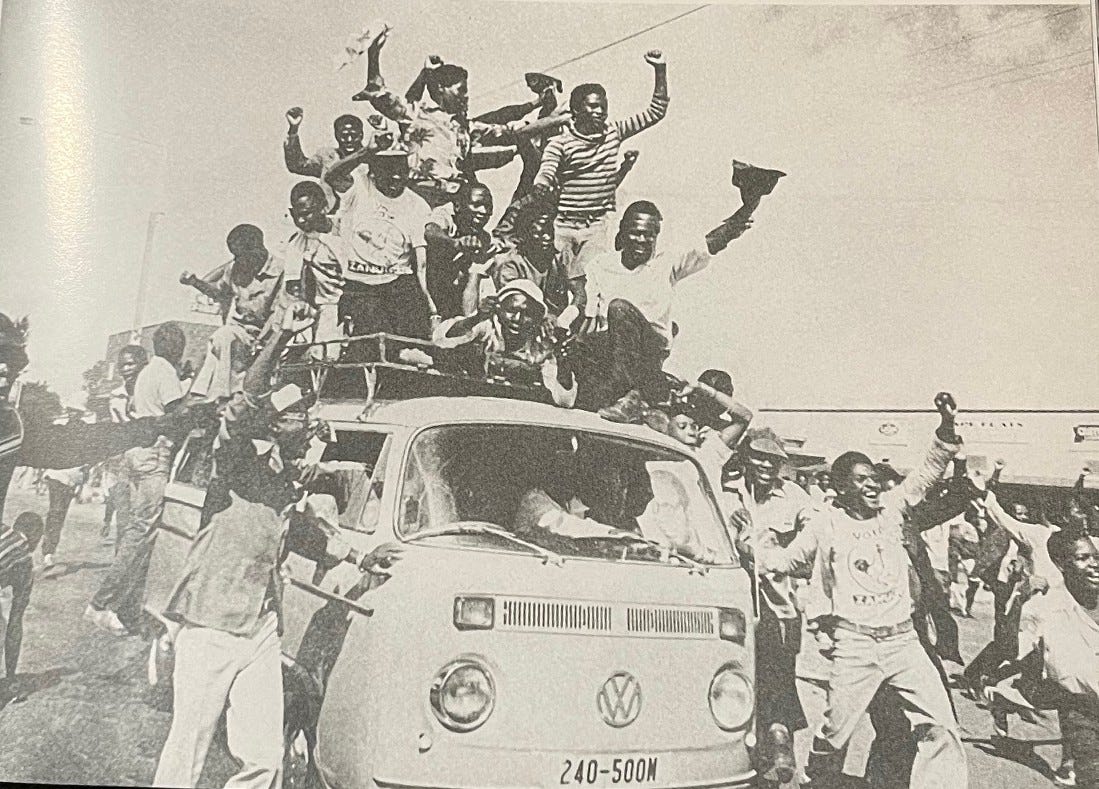
“It was not Rhodesia’s policy to educate her people for the purpose of assisting them to vote.” – Ian Smith, Prime Minister of Rhodesia, 1964 – 1979[1]
The claim made in Unbekoming’s defence of colonial Rhodesia regarding the voter franchise is:
“Rhodesia’s voting system was merit-based rather than racially exclusionary. Both blacks and whites could vote if they met income or property qualifications, with the system evolving to include guaranteed black representation through “black-only seats.”
That two-sentence claim raises six key questions that need to be addressed:
1. If the “merit-based” system was not “racially exclusionary”, why was there a need to guarantee “black-only seats”?
2. In a country in which Blacks comprised 95% of the population, why would this majority need to receive a guarantee of “black-only seats”?
3. Who was providing the majority Black population with a guarantee of “black-only seats”? (Spoiler: It was the less-than-5% White minority electorate, the majority of whom were not born in the country, as was established in Part IV.)
4. If the answer to question 3 is that the White minority making up 5% of the population was determining how many black-only seats were available to the majority, does this not introduce an element of racial exclusion that contradicts the first sentence of the claim?
5. Why was the system “evolving”?
6. What was it evolving into?
None of these obvious questions are answered in the Unbekoming piece, and with that list of questions we now come to the final nail in the coffin of African advancement. Having squeezed Africans off the best land, dragged them kicking and screaming into the wonders of a modern economy as the proletariat base of their colonial capitalist pyramid, and subjected them to segregated employment and education, Rhodesians threw in the voting ‘franchise’ as the joker in the pack.
Like many things Rhodesians did in colonial Rhodesia, the misnamed voting ‘franchise’ was both devious in its design and yet entirely transparent in its effect.
While doing the research for this essay, I stumbled on information about America, that land of the free, which I thought I’d share seeing as we’re talking about colonies and their voting ‘franchises’. This piece of information made me angry. Not all Native Americans were granted citizenship or the right to vote in the US until 1924. And it was only in 1955 that the state of Maine extended full voting rights to Native Americans who live on reservations. There’s that word – “reservation”, the equivalent in Rhodesia being “reserves”.
The structure of this essay is straightforward. We will just plod through Rhodesia’s misnamed voting ‘franchise’ from day one, until we can’t laugh at it any more. Then I will laugh a little at the knaves in the freedom movement who hold Rhodesia up as beacon of light. In the process, I hope to show how the system successfully disenfranchised the majority of the population, from its inception through to its last days before the collapse of the fascist Smith regime.
Rhodesia’s “merit-based” voting system
The first statute to govern qualification for voting in the Legislative Council was the Southern Rhodesia Order-in-Council of October 1898. With respect to the voter franchise, it followed the electoral law of the Cape Colony at that time in almost every detail.[2]
While the law made no distinction as to race, the voter had:
- to be a male British subject over twenty-one;
- to own or occupy premises worth £75; OR to receive a salary or wages of not less than £50 a year; OR to demonstrate ownership of a block of reef claims or of an alluvial claim as an alternative to the property or income qualifications.
- to be able to sign his name and write his address and occupation.
Additionally, “as in the Cape since 1887, a share in tribally or communally owned property did not qualify (this change had been made in the old colony to remove most Africans from the roll without mentioning race).”[3]
As we have seen in Part VI, an African employed in a mine around this time was lucky to receive £1 per month, and even then, he was not working for the whole year. Nor would the vast majority have been able to write their address and occupation in those early days. As we will see, this bar kept getting raised to ensure that virtually the entire African population could not reach the qualification.
Insofar as we are able to measure the attitude of the candidates and the electorate to the indigenous inhabitants, the rhetoric of Hans Sauer, a legislative Council candidate and close associate of Rhodes, provides a clue. In December 1898, he told the voters that it had been proved beyond doubt that[4]:
“the African negro was not the white man’s equal in mental capacity, in sentiment, or in any of the finer feelings of the human race. It had been proved that the average African native had three ounces of brain less than the average European, therefore his brain capacity could not be equal to that of the European. That being so, he might say shortly that he believed and he thought it was the proper policy for the white man in Africa to govern the native by a benevolent despotism. He should be treated as a child. He should be governed justly, but with a rod of iron.”
Sauer understood what the Rhodesian voter wanted to hear, and indeed these remarks were met with applause. He also wanted the hut tax increased to induce the native to work. This too was met with applause.[5]
The effect of the voter qualifications was to remove virtually all Black voters from the franchise. Keppel-Jones observes that “it is almost certain that in 1899 no black Rhodesian was on the roll.”[6] In 1904 there were forty-two black voters, but all were “Colonial Natives” from the Cape Colony working in Rhodesia. “The number of Africans in the country in 1898-9 was officially estimated as: Mashonaland, 269,521; Matabeleland, 144,257; total, 413,778.”[7] The White community was estimated at 13,365 in 1900.[8]
The total number of votes polled in Matabeleland in the 1899 election was 2,311. Sauer secured the most votes with 1,187[9]. Even though it was almost certain that no Black Rhodesian was on the roll in 1899, he petitioned the imperial government to “abrogate the franchise at present extended to natives.”[10] Sauer’s argument for dispensing with the deceitful game of creating an insurmountable bar was that Africans were not paying their fair share of tax. This was a very Rhodesian thing to say (refer to Part VI for the definition of the adjective Rhodesian) in that it deliberately ignored the rather obvious catch-22 that prevented Africans from paying a similar share of tax as the settler. Non-Rhodesian readers will understand.
Sauer further argued that since “the entire cost of the police is necessitated by the native population”, their paltry tax contribution was “ridiculous.”[11] Again, Africans neither asked for, nor required police, so Sauer was once again being thoroughly Rhodesian.
In the referendum held on Responsible Government in 1922 (discussed in Part V), “out of a European population of 35,000 some 20,000 were on the register. The black population was nearly 900,000 with 60 on the register.”[12] If all eligible voters, Black and White, had cast a vote, the Black vote would represent 0.3% of the total votes, while the White vote would represent 99.7% of the total votes.
Thus, after nearly 30 years of occupation and conquest, the “merit-based voting system” had resulted in a tiny White minority making up less than 4% of the population garnering 99.7% of the political power.
Responsible government in 1923 ushered in a Legislative Assembly of 30 members. As with the BSAC system of voting, the franchise qualification was based on property, income and literacy.
- The property qualification had now risen to £150 represented by real property or mining claims OR an income of £100 p.a.
And
- a literacy test.
- Voters had to be over twenty-one and British subjects.
There was formally no racial discrimination, but in practice the electorate was almost exclusively white, with a few Indian shopkeepers and a handful of prosperous African farmers.[13]
To get clarity on how the Rhodesian administrators viewed the franchise and how its qualifications were agreed, it is instructive to look at specific instances of changes in the qualification and how they were agreed.
In 1906, a draft Ordinance to abolish the African franchise was prepared. It generously permitted the 51 Africans on the roll at that time to remain on it, but sought to explicitly prohibit any further additions. Before submitting the draft, it was learnt that the Secretary of State was highly unlikely to approve the Ordinance. Informal discussions continued “in order to reach agreement on raised qualifications that would effectively exclude Africans.” The South African High Commissioner (Selborne), whose official role was that of overseer and go-between for the Colonial Office and the Rhodesian Administrator (Milton), then began sounding out the Rhodesian Administrator on how to introduce legislation that was “couched in non-discriminatory language but discriminatory in effect.”
With Selborne’s approval, a draft Ordinance more than doubling the property and income qualification, and making the literacy test more robust, was prepared. The Colonial Office resigned itself to accepting the Ordinance but the London Board (of the BSAC) advised against proceeding for fear of adverse publicity. The franchise amendment was postponed until 1912, at which point the property and income qualifications were raised to £150 and £100 respectively – the levels outlined above and which prevailed at the time of granting Responsible Government in 1923.[14] The leader of the Rhodesian Legislative Council complained that “if they had the power they would have got rid of the native franchise altogether.”[15]
The franchise qualifications remained in place until 1951, when they were raised again considerably.[16] The pressure put on the Rhodesian legislature by its White electorate to remove the African franchise persisted. In 1932, the Rhodesian Prime Minister, Mr Moffat, asked the British Government whether they would assent to closing the voters’ roll to further African registration. Similar proposals were put forward in 1934 and again in 1936.[17] The proposals were rejected, but the rejection should not be construed as a progressive metropolitan attitude; Africans had already been very effectively barred from political participation by the highly restrictive qualifications. It must be seen in the light of my analysis of the natural tension between the metropole and the settler, with the former acting as a restraining influence on the settlers’ worst excesses.
Complete closure of the franchise to Africans, despite it being already effectively closed, remained official Rhodesian government policy well into the early 1950s. In 1947, the Rhodesian Prime Minister, Godfrey Huggins, proposed “that Africans should be debarred from the common roll and be compensated by the appointment of two Europeans representing African interests in the Legislative Assembly.”[18] Huggins may have been nervous because although there were only 136 Africans on the roll, 6,000 were eligible should they have chosen to register. When this was once again rejected by Imperial officials, the Rhodesians sought the next best thing, which was another increase in the qualification. The British Government, as good cop, duly obliged in 1951.
In 1951, the property and income qualifications were increased to £500 (an increase of 233%) and £240 (an increase of 140%) respectively.[19] In addition, applicants had to be able to speak and write English, as opposed to merely being able to fill in the application form unassisted.
The effect of the voter qualifications in the “merit-based voting system” is shown in the voter registration figures in the table below.[20]
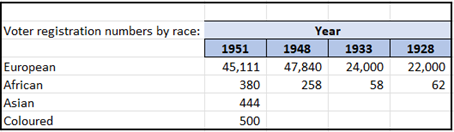
The total electorate in 1956 was 52,184, and the African registration was 560. In April 1957, the Rhodesian government estimated that 5,000 Africans may have been eligible based on annual income of £240.[21]
The Electoral Act of 1957 provided for further complex changes, which in theory had the potential to increase the number of African registrations by making concessions in the income and education qualifications. Crucially, however, the total increase in African registrations was to be capped at 20% of the total number of voters, after which the stiffer qualification would kick in again.[22] Thus, the total share of the African vote would constitute 20%, while the White share of votes would be 80%, from a group representing 5% at most of the population.
Newly emerging African political parties rejected the crumbs offered and advocated a policy of non-enrolment. The upshot was that by the end of November 1960, a total of 3,129 Africans registered to vote out of a total electorate of 75,061. By November 1961, there were 5,177 African voters out of a total electorate of 88,820.[23]
Membership of the House remained at 30 from 1924 to 1962. In 1960, the size of the House was increased to 50 seats.[24]
As internal and external pressure from London mounted on the Rhodesia government to set out a credible path for increased African participation in government, a Southern Rhodesian Conference was convened at the end of January 1960 to agree on Constitutional changes that would transition Rhodesia to African majority rule. It is important to point out that African majority rule did not mean that the government of the day had to be Black. Rather, it meant elections held under a universal franchise which, given African grievances against execrable Rhodesian governments since 1890, would in all likelihood result in the election of African parties representing the majority of the people.
Chaired by Edgar Whitehead, leader of the United Federal Party and Prime Minister of Rhodesia at that time, the period of transition to majority rule was estimated to be 15 years, and a complex proposal for a new voters’ roll to introduce Black seats in parliament was proposed. It entailed a two-tier roll comprising:
- An ‘A’ roll of of constituencies to elect 50 members of the Legislative Assembly.
- A ‘B’ roll of electoral districts to elect a further 15 members of the Legislative Assembly, bringing the total to 65.
Cross-voting could take place, but when the proportion of ‘B’ roll votes cast for an ‘A’ roll constituency amounted to more than 25% of the votes cast, the votes would be proportionately devalued and vice versa in the case of ‘A’ roll votes cast for a ‘B’ roll electoral district.[25] In effect, ‘A’ roll voters could have up to 20% influence in an electoral district, and vice versa.
The franchise qualification was a combination of property or income, and education. Because of the vast disparities in income and education between Whites and Blacks, these qualifications were heavily biased to ensure that the vast majority of White voters were eligible for the ‘A’ roll. The result, by design, was that the 50 constituency seats (77% of the total number of seats) were reserved exclusively for Whites. Even the ‘B’ roll qualification, which was introduced for the purpose of admitting Blacks into registration, was prohibitive, but that too was by design so that only a small number of Blacks would end up electing the remaining 15 seats, and this small number would have virtually no effect on cross-voting.
One of the following had to be met for the ‘A’ roll qualifications[26]:
a) Annual income of £792 or property value of £1,650
Or
b) Annual income of £528 or property value of £1,100 and primary education of prescribed standard
Or
c) Annual income of £330 or property value of £550 and 4 years’ secondary education of prescribed standard
Or
d) Appointment to the Office of Chief or Headman.
One of the following had to be met for the ‘B’ roll qualifications[27]:
a) Annual income of £264 or property value of £495
Or
b) Annual income of £132 or property value of £275 and two years’ secondary education of prescribed standard
Or
c) For persons over 30 years of age with annual income of £132 or property value of £275 and primary education of prescribed standard
Or
d) For persons over 30 years of age with annual income of £198 or property value of £385.
Or
e) All Kraal heads with a following of twenty or more heads of families.
Or
f) Ordained ministers of religion with university degree or five years of full-time training and three years’ service.
The average annual wage of a Rhodesian African worker in 1963 was £114. The sector with the highest annual average wage was manufacturing with £184.[28]
Ultimately the easiest way to understand these two rolls is by their fruits. Writing in 1965, Palley summed it up as follows:
“The effect of the franchise requirements is at present to place control of the constituencies [comprising 50 members] in the hands of Europeans, who form the vast majority of ‘A’ roll voters, and to place control of the electoral districts [comprising 15 members] in the hands of Africans who form the large majority of ‘B’ roll voters… The position in January 1965 was that out of a total of 97,284 ‘A’ roll voters, 92,405 were European and 2,330 were African.”
The estimate of the total number of Africans who might be eligible for the ‘A’ roll was a paltry 5,500.[29]
In respect of the ‘B’ roll, “there were 11,577 voters in all, of whom 10,689 were African and 587 were European.”[30] The table below shows the position at various points between 1961 and 1965:
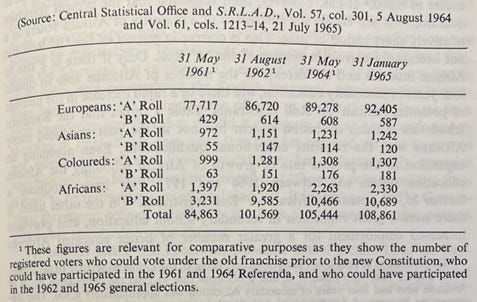
Source[31]
The White population at that time was estimated at 228,000 and the Black population at 4,200,000. Africans, who represented 95% of the population, were thus offered a maximum of 23 percent of the seats in parliament. Furthermore, that vote was based on an ‘elite’ black electorate that made up a mere 0.25% (10,689/4,200,000) of the population, whereas the White ‘A’ roll voters constituted 40% (92,405/228,000) of the total White population. This situation was intended to persist until Black voters caught up with the White population in terms of reaching the income and education qualifications. We will discuss shortly what the time estimates for that were.
The 1960 Constitutional Conference was convened on the basis that the final proposals should be accepted by the African people. In the event, the proposals were strenuously rejected by the National Democratic Party (the African nationalist party in Southern Rhodesia at that time) led by Joshua Nkomo. Other nationalist leaders had boycotted the discussions after attending the opening session. Despite the rejection by African leaders, the UK Government decided to implement the proposals of the conference.[32] It was a repeat of ignoring Lobengula’s repudiation of the Rudd concession in 1889. In July 1961, the Southern Rhodesian electorate voted in favour of the new Constitution.[33] Once again, as in 1923, a White minority, by virtue of its complete domination of the voters’ roll, imposed a Constitution on the 95% African majority population.
African leaders discouraged their followers from engaging in the literal whitewashing of the 1962 general elections by registering for the meaningless ‘B’ roll. The basis of their rejection was that the amended franchise was designed to permit only an African elite to vote for 23% of the seats. Thus, had they been defeated, it would have appeared as if the African people as a whole had rejected them and their policies.[34] The 1961 Constitution was, as Palley points out, “couched largely in non-racial terms which could eventually lead to majority rule but, in practice, meant that European control was to continue for a lengthy period.”[35] [emphasis added]
Blake summed up the new dispensation as follows[36]:
“Elaborate — and futile — calculations were made about the time needed for them [Africans] to gain a Parliamentary majority. There was no way of predicting it, for enfranchisement depended on African educational and economic advance, which in its turn depended on the policies of a European-controlled government. The reality was that the Europeans could retain their majority for a very long time without setting the franchise clock back by a single minute.” [emphasis added]
Bypassing both the Southern Rhodesian and British governments, the NDP leader, Joshua Nkomo, took his grievance to the Trusteeship Committee at the UN in 1962 and received a sympathetic audience, which annoyed both governments.
Meanwhile, in September 1962, the Rhodesian government began cracking down on African political leaders and parties. The movement of African nationalists was restricted to the Tribal Trust Land areas (effectively the Reserves of old) and the most vocal African nationalist party, the Zimbabwe African People’s Union (ZAPU), was banned. Zimbabwe’s own ANC formed in 1957 when it merged with the City Youth League, and was banned in 1959 after the arrest of 500 of its members. The National Democratic Party (NDP) was formed in 1960, and was banned in 1961. The Zimbabwe African People’s Union (ZAPU) formed in December 1961 to replace the NDP, and was banned in September 1962. All these bans took place prior to the elections in December 1962.
To complete the list of African political party bans, the Zimbabwe African National Union (ZANU), a breakaway faction of ZAPU formed in August 1963 and was banned in August 1964.
In October 1962, both the Trusteeship Committee of the UN and the General Assembly called on Britain to suspend the 1961 Constitution, and to cancel the general elections scheduled for December. It called on the convening of a new conference to formulate a new constitution to extend the franchise immediately to all inhabitants, which is what African leaders were asking for. Africans were asking for nothing more than what had been obtained in Britain and the rest of the so-called free world. When the final UN vote was taken, the 1961 Constitution had already come into force.
Whitehead’s UFP sought to keep two plates spinning in its bid to win the December 1962 election. On the one hand, it set out to appease the White electorate, whose votes were the only ones that mattered for seats in parliament, with promises of independence. The second spinning plate was an attempt to slow down the transition to majority rule – his estimate of this event was 15 to 20 years away, which in political terms amounted to being non-committal. Nevertheless, the UFP thought it could cool African nationalist fervour with promises of African advancement. Voter registration and turnout by a miniscule class of African voters who had been offered the insignificant crumbs of the ‘B’ roll would have gone some way to endorsing the UFP as the party of ‘partnership’ with the Black majority. Crucially, the UFP also campaigned on a platform of repeal of the Land Apportionment Act.
Both plates spun out of control. The White Rhodesian electorate sought independence from Britain on the basis of a Constitution that guaranteed continued White control of politics and the economy. This Eurocentric version of independence sought by the White Rhodesian electorate was obviously incompatible with African advancement, which is why the White electorate rejected the UFP. The White electorate feared that the UFP would fail to deliver a Eurocentric independence that effectively nullified African advancement.
African nationalists did not trust the UFP either, because they did not believe that the UFP was serious about African advancement. The campaign by African nationalists to encourage Africans to boycott the elections was successful because the small African ‘middle class’ who may have been eligible to vote simply did not believe that White Rhodesians, liberal or otherwise, would give up their position as a ruling caste.[37]
The UFP failed in trying to be all things to all people, when both constituencies wanted completely different things.
The newly formed Rhodesian Front (RF) was in opposition to the UFP platform on everything except independence, now a sacred cow for the majority of the White electorate. Though not couched in extremist language by the Rhodesian standards of the day, the RF campaigned to preserve the Land Apportionment Act (LAA), and rejected “‘dominance by the African of the European before he has acquired adequate knowledge and experience of democratic government’.”[38] The RF’s extremist position on overtly blocking prospects of African advancement and on a Unilateral Declaration of Independence (UDI), came after the election was won. However, Blake believes there is ample evidence to suggest that UDI was a central objective of the RF from its formation, even if it had not been spelt out as a plank of its platform during the 1962 election campaign.
Of the 50 White constituency seats, 35 went to the RF and 15 to the UFP, with 14 Black district seats going to the UFP.
By April 1964, Ian Smith had taken over the leadership of the party, and assumed the premiership. In May he was explicit about the RF’s long-range commitment to White minority rule[39]:
“If in my lifetime we have an African nationalist government in power in Southern Rhodesia, then we will have failed in the policy that I believe in.”
He was in relatively good health and was not planning to die anytime soon.
Subsequent to that statement he reiterated[40]:
“if, for the normal span of life for a man my age we can stave this thing off, then I believe we may stave it off forever. And if, as a Government, we fail to do this, then I don’t think we deserve to be charged with the responsibility of handling the affairs of Southern Rhodesia.”
In 1966, Smith declared that,[41]
“The White man is master of Rhodesia. He has built it and he intends to keep it.”
Eight years into the Rhodesian bush war, Smith was asked in 1974 by a reporter: “Once upon a time, Prime Minister, you said that you would never see Black rule in this country in your lifetime. Do you still stand by that?” Smith’s answer was unequivocal: “Yes I believe that it was a fair comment and I think if we ever got to a stage of having black rule then I think our policy would have failed.”[42]
And in March 1976, 10 years after the bush war had begun, Smith attempted to set a new Guiness Book of World Records for long-range political planning when he declared[43]:
“I don’t believe in Black majority rule ever in Rhodesia. Not in a thousand years.”
Smith was consistent in his racism, and his consistent policy statements on blocking the possibility that a country with a 95% Black population might end up voting in a majority Black government are the reason the White Rhodesian electorate consistently expressed their confidence in him and his party by returning the Rhodesian Front to power for 17 years after their first win in 1962.
The Smith regime’s Unilateral Declaration of Independence on 11th November 1965 was the opening scene in the final act of the Rhodesian colonial drama. Harold Wilson, British PM at that time, declared that UDI was an act of rebellion against the Crown, and that any action taken to give effect to the rebellious Rhodesian government’s new 1965 Constitution was to be considered treasonable.[44] To avoid doubt on the matter, Britain passed the Southern Rhodesia Act 1965, which declared that “Southern Rhodesia continues to be part of Her Majesty’s dominions, and that the Government and Parliament of the United Kingdom have responsibility and jurisdiction as heretofore for and in respect of it”.[45]
The 1965 Constitution that came into effect following UDI doubled down on the discriminatory franchise. It renamed the ‘A’ roll to ‘European Roll and African Higher Roll’, more than doubled the income and property qualifications and stiffened the education qualification to 4 years’ secondary education. It renamed the ‘B’ roll to ‘African Lower Roll’ and, again, more than doubled the income and property qualifications. In addition, the Lower Roll could not elect more than eight Members of Parliament irrespective of whether the number of the voters increased or not.[46]
The White Rhodesian electorate continued to fight universal suffrage tooth and nail and used the franchise qualifications as a means of forestalling Black majority rule for as long as possible. In 1969, the Rhodesian Front legislated a new Constitution accompanying the new Land Tenure Act (discussed in Part V) that barred the possibility of ever having a majority Black government in a country whose population was 95% Black by introducing a ‘parity’ cap.
The 1969 Constitution was more honest and simply rebranded the two rolls as ‘European Roll’ and ‘African Roll’. The European roll would elect 50 seats and African roll 16 seats. The qualifications for each roll were:
(a) European Roll: either an income of £900 or property to the value of £1,800, or an income of £600 or property to the value of £1,200 and four years’ secondary education;
(b) African Roll: either an income of £300 or property to the value of £600 or an income of £200 or property to the value of £400 and two years’ secondary education of prescribed standard.
The concept of ‘parity’ that was introduced meant that the African seats might be increased to ultimate parity with European seats when the African population was paying the same income tax as Europeans. At that time, it was estimated that Africans were paying one half of one per cent (0.5%) of the total personal income tax collected in Rhodesia.
The extract below from the Hansard record of a Parliamentary debate at Westminster in 1970 about the ‘Rhodesian problem’, quotes the preamble to the 1969 Constitution and gives a sense of the timeframe for Africans acquiring ‘parity’[47]:
“Everybody who has studied this matter will agree that the biggest change which has taken place in Southern Rhodesia in the last 12 months is that represented by the introduction of the new republican constitution and the Land Tenure Act which accompanies it…
The new constitution has one prime purpose, which is frankly stated in its preamble. Its purpose is to make majority rule impossible for all time. I think that I should read this preamble, for nothing will show better the obstacles facing the right hon. Gentleman if he wishes to find a way towards a negotiated settlement on the basis of the five principles. The introduction to the proposals for a new constitution published by the Rhodesian Government begins as follows:
‘The Government of Rhodesia believe that the present Constitution is no longer acceptable to the people of Rhodesia because it contains a number of objectionable features, the principal ones being that it provides for eventual African rule and, inevitably, the domination of one race by another’— an ironic phrase— ‘and that it does not guarantee that government will be retained in responsible hands. Therefore it is proposed that there should be a new Constitution which, while reproducing some of the provisions of the existing Constitution, will make certain major changes in order to remove these objectionable features.’
What are these changes? I summarise them as follows. First, the Africans, although they have a majority of over 20 to one already [demographically], and the birth trend suggests that it will be a much larger majority as time passes, will never be given a majority of seats in the Rhodesian Parliament. The maximum they can ever hope for is parity. But this depends on the Africans paying as much income tax as the Europeans. They have been given 16 out of 66 Parliamentary seats already, but they will have no increase in representation until they are paying 26.5 per cent of all the income tax paid in Rhodesia, and that is 45 times as much income tax as they are paying now, and assuming that European income tax payments do not rise faster than African income tax payments.
In fact, at the present rates of relative growth, it would take the Africans 230 years to reach their existing quota of seats, and 500 years to achieve parity with the Europeans; and they can never be allowed more than parity under the constitution, the clauses of which, incidentally, are heavily entrenched. Secondly, the Government are able to adjust income tax rates in favour of indirect taxation to prevent this ever happening at all. Indeed, they have already changed the basis of taxation so that a great deal more falls on indirect taxation than on income tax.
Thirdly, to ensure that parity never comes about, they are now increasingly attempting to tribalise the Africans. They are adopting a policy of separate development, or apartheid. Under the Land Tenure Act they are dividing the country equally between whites and Africans. The good land is going overwhelmingly to the whites. A large part of the African land is being taken from them immediately as national parks. This Land Tenure Act allows individual ownership to Africans of only about 4 per cent. of the total land in Southern Rhodesia, whereas the Europeans have the right to own about 40 per cent. individually of the land in Rhodesia.
When we add to this the fact that the European child has 10 times as much money spent on his education as the African child, and that under the system of job reservation it is very difficult for the handful of African graduates ever to take fit employment in Southern Rhodesia at all, it can be argued that the new Southern Rhodesian constitution is well to the right of that in South Africa at present.” [emphasis added]
The implacable sense of entitlement to a land in which the majority had not been born, and therefore had no traceable lineage, is a curious feature of this little White dictatorship in Africa. We saw in Part IV that the White population more than tripled in the post-war period from 69,000 in 1941 to 218,000 in 1960, and indeed most of the extremists in the Rhodesian Front cabinet – Harper, Dupont (Deputy PM), Lardner-Burke, Wrathall, van der Byl, Graham (7th Duke of Montrose), McClean, Mussett, Lance Smith, Dunlop – all arrived after the Second World War. Rather than extend education to their fellow Black citizens, Rhodesian Whites preferred to bulk-import foreign racists to keep the charade going.
Writing in 1965, the year of the Rhodesian Front’s Unilateral Declaration of Independence, Palley wrote in understated terms: “Whatever may be the future… the present position is that the Southern Rhodesian Legislative Assembly is elected by a predominantly European electorate.”[48]
In 1965, whether or not an African majority could emerge depended on the pace of education and economic advancement, which in turn depended on the policies of a White dominated Government. By 1969, with the introduction of the RF concept of ‘parity’, the 95% African majority would never constitute a majority in Parliament.
Today, in most so-called Western democracies, the skin colour of elected representatives is not designed into the system in the way it was in Rhodesia. The US elected a Black president in 2008 at a time when the majority of America’s electorate was White. Rhodesians, Black and White, were not given the option of being colour-blind at the voting booth.
In 1965, UDI was the final straw for Africans. They had been waiting and hoping for a fair shake of the whip since their humiliation in the first uprising in 1896-97. They understood that a second uprising was called for, and it began in April 1966.
Conclusion
Shallow internet research on Rhodesian history will throw up countless Facebook and YouTube accounts extolling the virtues of Rhodesian ‘defiance’, ‘discipline’ and ‘pluckiness’ in the face of a ‘wicked’ international community that had condemned it. What these people are proudly defending is what I have chronicled above – a refusal by White Rhodesian society to give up their entrenched privileges gained by exploiting the people they conquered, and the denial of the vote to the majority of the population on the basis of skin colour.
The changes that occurred in Rhodesia in 1979-80 were not the result of a change in White racial beliefs. They were the result of the escalation of the civil war and the internationalisation of the conflict. The intransigence of White Rhodesia is illustrated in the Quenet Report issued in 1976, three years before the final peace agreement reached in 1979 at Lancaster House.
The Quenet Commission was instructed in 1975 by Parliament to investigate racial practices in Rhodesia and to “advise Government of those cases or aspects of discrimination which are no longer considered desirable and necessary”[49]. Following the collapse of the Portuguese colonial government in Mozambique and the intensification of the civil war, it was a cynical move to arrest the growing popular movement of Africans in Rhodesia towards the African nationalist movement while preserving White power. It was also hoped that minor concessions might result in the lifting of sanctions.
The intransigence of White Rhodesia in 1976 was evident in the racial beliefs reflected in the Commission’s recommendations. The limited remit of the Commission was itself discriminatory – it was considering only those practices deemed expendable but not fundamental to the White ruling minority, and it had refused to consider the introduction of a universal franchise.
D.G. Baker writing in Zambesia[50] in 1979, summed up the Quenet Commission’s commitment to maintaining the status quo.
It opposed the opening of European residential areas to Africans who could afford such purchases because, in the Commission’s words: “we consider there are many Europeans who would not accept a departure from the existing position”. Which, when you get right down to it, was a very Rhodesian thing to say. The Commission was in effect saying, “We think racism should continue because we are racists.”
It opposed the creation of Government multi-racial schools because in the Commission’s words: “we do not think it is [a proposal] which would be acceptable to the majority of either of the major races.” This was a spectacularly Rhodesian thing to say because, not only were they saying that the racist status quo should continue, but that they felt that those who were most disadvantaged by racism had gotten so used to it that they too would have to had to have agreed on the basis of sheer habituation to racism.
Despite its acknowledgement of “unequal treatment of European and African pupils”, it then contradicted itself by saying it did not think that “different treatment amounts to unfair dealing”. I was almost tempted to say that this was taking Rhodesianism to new heights, but on reflection, this was just another good day in the Rhodesian office.
It also dismissed the idea of a more fair allocation of education funds between European and African schools. And it ruled out the prospect of improvements in African education on the basis that this was “completely beyond the country’s resources at present”. Indeed. Bombing refugee camps in Mozambique and Zambia was an expensive business and the Rhodesians were very good at prioritising important matters.
Acknowledging that there was discrimination against Africans in employment, the Commission stated that “there are some employers who openly declare a preference for European employees”, but it concluded that “that is not an attitude which, in our view, should be controlled by legislation”. Again, you’ve to admire the Rhodesian twist of mind – if legislation had been so crucial in entrenching segregation, what makes you think legislation could get them out of the problem?
In public sector employment, it acknowledged that virtually no Africans held middle-level positions and none could be found at the upper levels. Its recommendation for redress was: “On this topic we simply express the hope that persons of promise and ability will be given every chance for improving themselves.” Never let it be said that hope did not spring eternal in the Rhodesian breast.
The Commission went as far as to attribute the shortage of opportunities for Africans to the high population growth rate, and suggested birth control as the only way to achieve a proper balance. I wonder if Bill Gates is Rhodesian.
On the issue of the “merit-based” voting franchise, it suggested that a return to a common roll (as opposed to the then existing European and African rolls) should be considered, but did not address the issue of the voting qualification that would continue to effectively bar Africans from a common roll. It refused to address any of the issues relating to income and education disparities and so a return to a common roll was derisory, since a common roll had worked very well in the past to exclude Africans from a meaningful voice in elections. That said, a return to a common roll was immediately rejected by the Prime Minister and the Rhodesian Front as a step too far.
Recall that in Part V under the heading ‘The Rhodesian Dog Whistler’s fake Bill of Rights’, I highlighted that the Bill of Rights was non-justiciable owing to section 84 of the Constitution, which stated that “No court shall inquire into or pronounce upon the validity of any law on the ground that it is inconsistent with the Declaration of Rights.” A repeal of section 84 was rejected by the Rhodesian Front Government. Never let it be said that Rhodesians did not have a wicked sense of humour when crafting freedom-enhancing Bills of Rights.
It is difficult to refute Baker’s conclusion that the Quenet report was yet “another effort by the Rhodesian Front and White society to suspend time and thereby preserve White power and privilege by granting concessions to Blacks, concessions which, however, did not threaten White power.”
Have I mentioned that there are growing numbers of people in the freedom movement who think Rhodesia set a fine example for a free and fair society? Ah, we’re doing just fine aren’t we?! I can’t wait for Unbekoming’s Bill of Rights to be circulated in the Freedom Movement.
I’m sure readers are absolutely gagging for the concluding remarks in Part VIII where I will discuss the great ‘betrayal’ that Rhodesians cry into their beer about, but which never actually happened. The betrayal narrative is used to mask the real betrayal that took place – the betrayal of Africans who were expecting independence based on a universal franchise. I will then try to condense Rhodesia in a nutshell, and discuss the consequences for the freedom movement of failing to interpret colonialism correctly.
[1] Aaron Benjamin Mutiti, Rhodesia and Her Four Discriminatory Constitutions: https://journals.co.za/doi/pdf/10.10520/AJA00020117_159
[2] Arthur Keppel-Jones, Rhodes and Rhodesia: The White Conquest of Zimbabwe 1884-1902, Kingston and Montreal, McGill-Queens University Press, 1983, Ch. 14, pg. 562.
[3] Ibid., Ch. 14, pg. 560.
[4] Ibid., Ch. 13, pg. 534.
[5] Ibid., Ch. 14, pg. 560.
[6] Ibid., Ch. 14, pg. 583.
[7] Ibid., Ch. 13, pg. 542.
[8] Ibid., Ch. 14, pg. 580.
[9] Ibid., Ch. 14, pg. 562.
[10] Ibid., Ch. 14, pg. 583.
[11] Ibid., Ch. 14, pg. 584.
[12] Robert Blake, A History of Rhodesia, Eyre Methuen Ltd, London, 1977, Ch. 12, pg. 187.
[13] Ibid., Ch. 13, pg. 192.
[14] Claire Palley, The Constitutional History and Law of Southern Rhodesia 1888 – 1965, Clarendon Press Oxford, 1966, Part 1, Ch 8, pg. 169-71.
[15] Ibid., Part 1, Ch 8, pg. 171.
[16] Ibid., Part 1, Ch 11, pg. 217.
[17] Ibid., Part 1, Ch 12, pg. 244-5.
[18] Ibid., Part 1, Ch 12, pg. 245.
[19] Ibid., Part 1, Ch 14, pg. 308.
[20] Ibid., Part 1, Ch 14, pg. 308.
[21] Ibid., Part 1, Ch 14, pg. 308.
[22] Ibid., Part 1, Ch 14, pg. 310.
[23] Ibid., Part 1, Ch 14, pg. 312.
[24] Ibid., Part 1, Ch 14, pg. 307.
[25] Ibid., Part 1, Ch 14, pg. 316.
[26] Ibid., Figure I: Southern Rhodesia Voters’ Qualifications.
[27] Ibid., Figure I: Southern Rhodesia Voters’ Qualifications.
[28] Larry W. Bowman, Politics in Rhodesia: White Power in an African State, Harvard University Press, Cambridge Massachusetts, 1973, Ch.3, Pg. 48.
[29] Palley, op. cit., Part 1, Appendix Table O, pg. 798.
[30] Palley, op. cit., Part 2, Ch 1, pg. 420.
[31] Palley, op. cit., Part 2, Ch 1, pg. 421.
[32] Palley, op. cit., Part 1, Ch 14, pg. 317.
[33] Palley, op. cit., Part 1, Ch 14, pg. 318.
[34] Palley, op. cit., Part 1, Ch 14, pg. 320.
[35] Palley, op. cit., Part 1, Ch 14, pg. 321.
[36] Blake, op. cit., Ch. 24, pg. 335.
[37] Blake, op. cit., Ch. 24, pg. 341.
[38] Blake, op. cit., Ch. 24, pg. 342.
[39] Bowman, op. cit., Ch.4, Pg. 70.
[40] Bowman, op. cit., Ch.4, Pg. 70.
[41] https://www.nytimes.com/2007/11/21/world/africa/21iht-obits.1.8417707.html
[42] https://www.britishpathe.com/asset/15994/
[44] Aaron Benjamin Mutiti, Rhodesia and Her Four Discriminatory Constitutions: https://journals.co.za/doi/pdf/10.10520/AJA00020117_159
[45] https://www.legislation.gov.uk/ukpga/1965/76/enacted
[46] Mutiti, op. cit.
[xlvi] https://www.legislation.gov.uk/ukpga/1965/76/enacted
[47] https://api.parliament.uk/historic-hansard/commons/1970/nov/09/southern-rhodesia
[48] Palley, op. cit., Part 2, Ch 1, pg. 424.
[49] D.G. Baker, Time Suspended: The Quenet Report and White Racial Dominance in Rhodesia, Zambezia (1979), VII (ii).
[50] Ibid.
Comments are closed.