
Unearthing Marx and Lenin

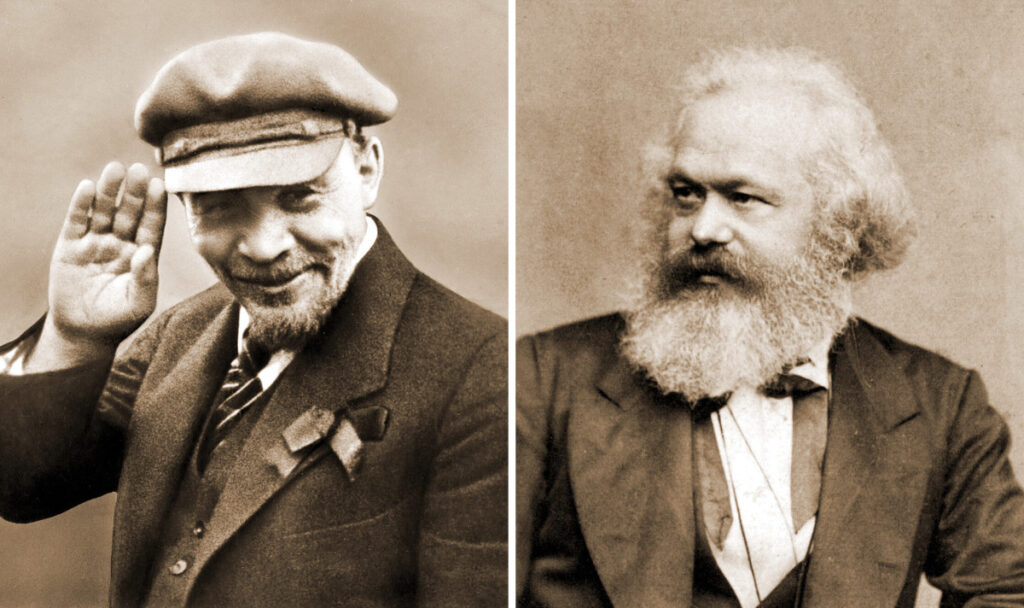
I hesitate to step into the lion’s den but given this is a group genuinely trying to keep the real left flame alive, here goes. None of this is new but the torrent of propaganda is such that what ‘everyone knows’ about Marx and Lenin is largely nonsense. The message we are given is “Don’t listen to them and don’t try radical change as you’ll just make it worse.” So this is an attempt to sketch out a defence of their revolutionary and liberatory tradition. For those of you who can quote Marx and Lenin in your sleep, apologies for the brevity and lack of detailed references.
Karl Marx
…was unequivocally anti-state. Communism for him was the complete absence of the state. Anyone pro-strong state is no Marxist. For Marx socialism, the workers’ state, was deeply democratic, bottom-up, and temporary. And very light touch compared to the bourgeois state, simply there to clear out the old bourgeois structures and habits. For him the Paris Commune was an eye-opening glimpse of how self organisation and bottom up democracy could be the basis of a real workers revolution and state.
Long before that, as early as 1848 in The Communist Manifesto, he wrote: “In place of the old bourgeois society, with its classes and class antagonisms, we shall have an association, in which the free development of each is the condition for the free development of all.” By the time he writes The Civil War in France (1871, following the Paris Commune) he talks about “that parasitic excrescence, the ‘state’, feeding upon and hampering the free movement of society” and “state power, now become superfluous”. He expands on this in his 1875 Critique of the Gotha Programme, and later Engels in Anti-Duhrung (1878) went into some detail about the ‘withering away’ of the state in the transition from socialism to communism.
You can say Marx was a dreamer and it could never happen, but those were his views, he was vigorously and viscerally anti-authoritarian, becoming more so as his ideas developed.
Even in his own lifetime Marx’s ideas were being misused and abused and he famously said that ‘All I know is that I’m no Marxist’. It has got a thousand times worse since then.
Vladimir Lenin
…generally wrote for a purpose. What Is To Be Done for instance was written under extreme Tsarist repression when almost all political work was illegal, and it should be read in that context, not as if it was a prescription for how revolutionaries should organise and behave in general. In these conditions a tightly organised secretive party was necessary for any political activity within Russia, but even then Lenin still insisted on the self activity of the working class being at the centre of the party’s work.
In 1917, during the revolution, Lenin was finishing State and Revolution, the central part of which is analysing how the revolutionaries could create a workers state and how to ensure that this could not become a permanent bureaucracy. It had to be a temporary, deeply democratic state where the state itself could ‘wither away’, so ‘the state ceases to exist’, leading to Marx’s concept of communism, a free association of people. You might think that was pie in the sky but nevertheless that was what he was putting his mind to in the middle of the revolution, to be prepared for what direction to take if they won. Among its many gems the book includes a cogent exposition of the deep state and the puppet-show of parliament: “The real business of ‘state’ is performed behind the scenes and is carried on by the departments, chancelleries, and General Staffs. Parliament is given up to talk for the special purpose of fooling the ‘common people’”. This stuff is not new.
The ‘Lenin Led to Stalin’ trope
Far from Stalin being the inheritor of Lenin he was the gravedigger of the revolution, politically and physically. Stalin’s regime was largely made up of the old Tsarist bureaucracy, and it physically liquidated nearly all the people who had any significant role in the revolution, down to local level. All grass roots democracy was eliminated and a strong state inaugurated which owned the vast majority of the means of production, focused on the extraction of surplus value from the working classes. This looked pretty close to what Engels had called ‘state capitalism’. [NB Beware of sectarian rabbit hole.] It was diametrically opposed to Marx or Lenin’s vision of socialism, let alone communism.
Lenin in his Last Will and Testament famously specifically warned against allowing Stalin a leading role, because Lenin saw him as a dangerously authoritarian bureaucrat.
Lenin also insisted in his Last Will and Testament that there should be no memorials to him, no statues etc, because that would fossilise his work and turn it into dogma, instead of part of the dynamic revolutionary tradition. That of course is precisely why the Stalin regime petrified Lenin into a stone god and turned Lenin and Marx’s works into dead dogma with all real meaning extracted from it. It was a triumph of the counter-revolution done in the name of the revolution. And of course it suited anti-revolutionaries everywhere, as it suited Stalin, to pretend that Stalin’s authoritarian state capitalism (or whatever you wish to call it) was ‘actually existing socialism’.
Was the defeat inevitable?
People talk about the descent from workers revolution to Stalinist authoritarianism as if it all happened calmly. But after the 1917 revolution around 20 countries invaded and attacked Russia to try to smash the revolution – supposed enemies joining ranks to smash a threat to the rule of the rich and powerful (then as now). I actually knew someone who flew for the RAF to bomb revolutionary Petrograd. And of course they pumped arms and money to the remnants of the old Tsarist regime fighting to get back in power. During this war the revolutionary leadership certainly made bad decisions as well as good ones. But the revolution survived, just.
So by 1921 Russia had had three disastrous years of the First World War then four brutal years of invasion and civil war. The people were exhausted and many of the workers who had made the revolution were dead, and industry and housing were smashed. Lenin famously said ‘Without a revolution in Germany we are finished’. Then the German revolution was defeated.
We can’t know of course what might have been. Trotsky believed it was possible for the Communist party to hold the fort and keep the revolutionary flame alive while the working class rebuilt itself and revolutionary currents elsewhere could mature. Was it possible? Maybe, but in reality Stalin seized power, with the Tsarist bureaucracy behind him, and butchered what was left of the revolution. They kept the name and paraphernalia of the revolution as a fig leaf to keep support and to undermine any opposition.
Trotsky believed Stalin was more dangerous for the workers movement internationally than Hitler, because Hitler attacked the workers movement from the outside whilst Stalinism rotted it from the inside. I think he was right, and we see the results to this day, with elitist ‘Marxists’, authoritarian ‘Communists’ and a totalitarian ‘Left’.
So…
All of this is certainly not to say that Marx or Lenin, or for that matter Luxemburg, Trotsky, Connolly, Proudhon or anyone else, has a monopoly of the truth or were always right. It is to say that they were important contributors to the revolutionary tradition.
They all changed over their lifetimes, they all got it wrong sometimes, and for sure you can always cherry pick sentences from their writings out of context to prove anything you want. And now of course AI can produce this stuff by the bucketful. But these old revolutionaries also produced some fantastic insightful work. Anyone interested in globalism for instance could do worse than looking at Lenin’s prescient ‘Imperialism, the Highest Stage of Capitalism‘. All their work and vastly more is available at www.marxists.org as web pages or as downloadable eBooks.
Exploring and discovering things for ourselves is an absolutely key part of a living movement. But we can see further if we stand on great people’s shoulders rather than always starting again from scratch. Of course we can always find a reason to dismiss anyone’s contribution, which does make the world a simpler place to be sure, but more arid. Our enemies put a great deal of effort into poisoning the well and shredding our history. We mustn’t let them.

