
The Technocratic Dark State: Part III – Money Matters

There is no such thing as a digital currency – it’s a digital payment system
Originally published on A Plague on Both Houses substack.
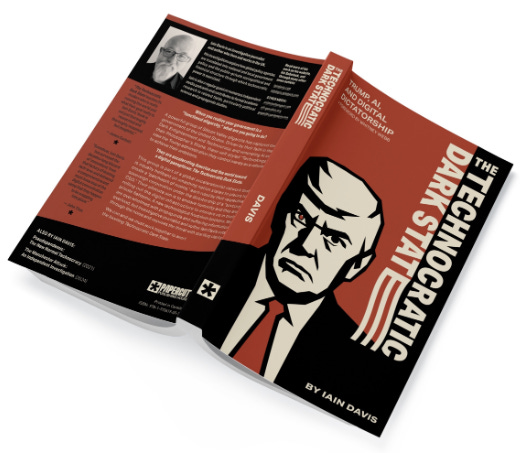
In Part II, using Iain Davis’s latest work – The Technocratic Dark State – we discussed the macro and micro dynamics underpinning technocracy. In this third and final part, I will discuss my thoughts, sparked by reading Iain’s work, on digital money matters generally, and Bitcoin specifically.
There is no such thing as a digital currency – it’s a digital payment system
The distinction I’ve made in the above heading, which is not made in Iain’s book, is an important one. I believe it helps to cut through a lot of the confusion surrounding digital money. To emphasise this, I will add single quote marks around the word “currency” if it’s preceded by the word “digital”.
The distinction separates a complex economic issue – currency issuance – from a simpler issue – a payment system, as encapsulated by the term digital money. This helps to articulate the real threat in simple terms. Currency, in the true sense of the word, is not the real threat we face from the technocrats. It’s the digital payment system, and its capacity for programmability. Technically, you could argue that a one-world currency might not be a threat to freedom provided that the underlying payment system was not digitally programmed to surveil transactions.
‘Currency’ is an obfuscator, as I will argue in due course. If the vast majority of people were absolutely clear that digital money is actually just a new payment system, they would respond by saying: “But we don’t need one.” To which our smug reply would be: “Exactly.”
Iain certainly conveyed the threat of digital ‘currencies’ by articulating the lock-and-key relationship between digital ID and digital money. However, as the discussion crept into the wider topic of the central bank money-printing scam, and the arcane ins and outs of digital ‘currencies’, I started to get a sense of rabbit holes within rabbit holes. I then found myself asking why a particular hole was being explored, and what its implications were for the main threat – that of programmable money.
Sadly, the space we write in is still very niche. To put that more bluntly, I sometimes feel we’re in an echo chamber. The danger of this is that we can become insular, and prone to writing in a way that looks as if we are talking to ourselves. As a rule, we should constantly be trying to make complex issues easy to grasp.
The discussion about stablecoins might serve to illustrate this, while also highlighting the necessity of making the distinction between a currency and a payment system.
And in the interests of following my own advice about making things understandable for everyone, a stablecoin is simply a type of online or electronic money that you can use to make payments. But because it operates on a digitally programmable platform, its threat from a privacy perspective is far greater than the current methods we are accustomed to using for paying our bills.
Will stablecoins prevail over central bank digital ‘currencies’? A red-herring question since both will be slightly different types of programmable digital money. I don’t think Iain disputes this, but it’s worth clearing up right off the bat, before we get into the more complex aspects.
I think Iain and I are in agreement that stablecoins are simply CBDC via the ‘privatised’ backdoor, as opposed to the central bank front door. But I think he goes further by suggesting that the current stablecoin issuance amounts to money-printing, so this debate exemplifies the conflation of money-printing, which is a currency issue, with a digital payment system.
In the chapter about the New World Currency, Iain argues that stablecoin issuers in the US, under the GENIUS Act, have successfully bypassed US Federal government oversight, resulting in a situation in which “stablecoin issuers have been ushered into the oligarchs’ [banking oligarchs] money creation grift by the Act.”[i] Furthermore, he identifies the Office of the Controller of the Currency (OCC) as the “fully independent” body that will “approv[e] and then regulate their [i.e. the ‘NEONERDS’] own privately issued money.”[ii] [emphasis added]
I don’t think it’s that easy to conclude that this move represents the NRx gang muscling in on central bank, or commercial bank, money creation. I’m aware that non-bank entities are permitted to issue stablecoins but, with large technology firms strictly prohibited from issuing stablecoins, with the apparent aim being to ensure that financial services remain separate from major technology platforms, it’s not clear to me that the NEONERDS are even in the running at the moment.
Nevertheless, my contention is that stablecoin issuers, NEONERD or not, are competing for deposits in a system in which currency issuance (or money printing) remains in the hands of the central and commercial banks. Stablecoin issuers are part of the money ecosystem, but not the money creation scheme. For now, anyway.
We could start by speculating on the likelihood of the central bank mafia relinquishing control over the one thing that has put them at the pinnacle of the power pyramid – the money supply. It’s an interesting point to ponder, but I wouldn’t put money on it. More importantly, I don’t think it matters when articulating the threat of technocracy. Arguing over what uniform the jailor will be wearing is not going to change the prison cell. I’m not saying that humanity shouldn’t try to wrest control of the money supply from the banking mafia, but that’s a different debate, and a different problem to the one of a programmable digital payment system.
The Bank of England certainly doesn’t think it needs to give up control of the money supply just because CBDCs are coming. Fielding questions from the House of Lords Economic Affairs Committee in 2022, Sir John Cunliffe, the then deputy governor responsible for financial stability, said in relation to CBDC issuance:
“The central assumption that we are working with is a so-called platform model, which would be partnership between the Bank of England and the private sector. In the same way that we do not issue cash directly to the public—we issue it to the banks, which then issue it to the public—the interface with the customer would be private sector […] The aim would be for us to provide the settlement asset but for the private sector to deal with the distribution, the storage of the settlement asset and the technological innovation around the settlement asset.” [emphasis added]
While the above quote applies to CBDCs, which haven’t yet come to life in the UK, I believe the principle is not that different with stablecoins, as I will argue.
When digital money is issued, be it a stablecoin or CBDC, new money is not created. This is quite simply because digital ‘currencies’ are not currencies! They are a digital payment system, or platform, on which a recognised national currency is converted to digital tokens, which are then spent as if they were the recognised national currency. The token represents the original currency, which is implied in the meaning of the word ‘token’ – a representation of something else.
Calling digital money a ‘currency’, rather than what it actually is – a digital payment system – is its greatest PR success. If they’d called it a payment system instead of a ‘currency’, perhaps the take-up of stablecoins wouldn’t be growing at the rate it currently is. People understand that we don’t need a new payment system, and the House of Lords Economic Affairs Committee was bang on the money when it labelled digital ‘currency’ a “solution in search of a problem”. That argument still holds.
Sir Jon Cunliffe agrees that digital ‘currencies’ are not currencies. When challenged by the House of Lords Economic Affairs Committee on the ‘currency’ canard he replied:
“I agree with you entirely on currency [i.e. the use of the word as a misnomer], but the term is out there now and it is difficult to change it. I would probably refer to it as central bank digital money, because money is a means of payment, rather than central bank digital currency. The horse has bolted. Once an acronym becomes established, it is really difficult to change it.” [emphasis added]
This principle also applies to stablecoins now in issue. To the extent that a stablecoin is issued by an entity other than an existing commercial bank, the new digital money issuer simply becomes a competitor with existing banks for deposits within the existing supply of money. The stablecoin issuer does not issue new money. The main reason for this is that existing currency deposits of customers are exchanged for a new type of deposit that enables payment to be made on a digital platform. The digital platform is called stablecoin.
Emphasis is also placed on the requirement for the stablecoin issuer to “back their [stablecoin] liabilities 100 percent with safe, liquid assets”. Assuming that the issuers stick to this, it’s actually a banking liquidity safeguard. As noted by Forbes, there remains a liquidity risk in that not all liquid assets are created equal. Liquidating stablecoins requires liquidating the related asset backing it, and if liquidation of that asset could not keep pace with the customers’ demand for liquidation of stablecoins, that could spark a stablecoin liquidity problem. But that’s a separate issue.
Thus, unlike money creation via credit granting, a stablecoin liability can only be created off the back of an existing liquid asset. This in itself is not the measure that precludes money creation. It guarantees sufficient liquidity to redeem the tokens. The main reason why the stablecoin liability created and then issued to the customer does not represent an increase in either base money or commercial bank money is that the customer must liquidate an existing commercial money deposit to acquire the stablecoin. The customer is effectively swapping out an existing commercial money deposit, and putting it on a digital money payment system.
Credit creation by commercial banks is money creation, and I’ve explained how that happens. But stablecoin issuance is not money creation, primarily because it is not credit creation.
There’s no denying that the failure of a stablecoin issuer to back the liability 1:1 with a liquid asset is not just a possibility, but something that has probably already happened. As this Corbett Report podcast alleges, Tether was issued, without equivalent asset backing, to pump up the demand for Bitcoin in 2017. Corbett’s guest described this as “printing Tether out of thin air” but, as I’ve argued, this is not a money creation issue. It poses a potential liquidity issue since the issuer may not be able to redeem the coins if there was sudden demand by customers to swap out of stablecoins and back into traditional cash deposits.
The OCC regulator is also described by Iain as “uniquely independent of the government”[iii], and “fully independent” of it. However, this is not proof that the OCC has the ability or authority to aid the NRx or non-bank stablecoin issuers in circumventing the existing commercial and central bank mafia’s monopoly on money creation. Notwithstanding the OCC’s supposed unique independence from government oversight, I contend that it is still an extension of the commercial banking and central banking money creation cartel, and appears to be playing a role, alongside the Fed, as one of the three Federal-level supervising agencies in the outsourcing of CBDCs to the private sector.
All of the above is not in any way a defence of stablecoins! They seem to be very much resembling what the BoE described when it discussed deploying CBDCs in a “platform model” in which “the private sector … deal[s] with the distribution, [and] the storage of the settlement asset.” The process of converting traditional bank deposits to digital money appears to be underway. I’m merely arguing against the assertion that the NRx Neonerds, or other non-bank actors, have, in Iain’s words, “been ushered into the [banking] oligarchs’ money creation grift”. And the only reason I regard that argument as important is because it recognises the distinction between true currency, which is related to the money creation grift, and digital payment systems, which are not.
Maybe the NRx will succeed in becoming the New World Order bankers. Who knows? As I’ve said, I don’t mind being wrong about who the jailor will be. But let’s not conflate money creation with a digital payment system.
Here is the BoE explainer on stablecoins. The word stablecoin, like currency, is misleading, and deliberately so. They talk about issuing the coin, which makes you think that money is being created. Again, all they’re doing is inviting you to swap your traditional bank deposit for, in their words, a new “type of online or electronic money”. In this, they are transparent in their goal: they want people to “start using them more to pay for a wider range of things.” In other words, they’re trying to move people onto a new programmable digital payment system. That’s it. That’s all we really need to know, because that’s all we really need to resist.
People are like the proverbial magpie – if you make something shiny and inviting enough, they’ll grab it, however useless it may be. Given the uptake of stablecoins, it looks as though huge swathes of Normieland are saying, “Ooh I’d like to get me some stablecoin!” They may as well say, “Ooh, I’d like to get me a rainbow-coloured debit card!” What they don’t know is that soon that new digital trinket is going to be a Big Brother monetary social credit system.
This explainer serves to emphasise that a key driver of the stablecoin industry is to create dollar-based cross-regional ‘currencies’. In other words, they want people to convert their local currencies to dollars, and they’re giving them an easy and fast payment system to do it. That creates demand for dollars in countries outside the US. Think here – the 10 regional kingdoms referred to in Part II. If the US banking system can create sufficient demand for the US dollar in countries on the US periphery, that might accelerate the conditions for a regional currency merger à la EU. But we should not confuse a digital payment system, which might enhance the conditions for a regional currency merger, with the actual currency merger itself.
So, I thought Iain’s discussion of a “new world currency” (including chapters about the “synthetic hegemonic currency”) conflated these two distinct concepts. A move towards a new world currency or even a regional one, would comprise two events: a global (or more likely regional first) currency amalgamation, and then the placement of that currency on a programmable digital platform. The first – a global currency – is an aspiration of the New World Order cult. The second is now being experimented with at the national level.
The debate about Tech companies possibly usurping the central bank cartel in currency issuance and money creation is an interesting one. But it is a secondary economic issue to the much more concrete and technocratic reality of the digital payment system that is already being rolled out.
Bottom line: Programmable digital money (not currency) is a new digital payment system that introduces behavioural control as a new function of money, and it’s coming at us like a freight train. The only way to avoid it is to not stand on that track in the first place. This is the key message we need to hammer home.
Bitcoin
In Iain’s second chapter on the Synthetic Hegemonic Currency, the premises of an argument involving Bitcoin didn’t click into place for me. I couldn’t see a clear statement as to why Bitcoin per se matters in the progression towards the fulfilment of the Technocratic Dark State. I may have simply failed to grasp the point being made because it was beyond my limited knowledge base but, because I have a bee in my bonnet about Bitcoin, I’ll use it as a launch pad to ask questions about Bitcoin that I think should be asked.
I’ll outline the chain of Iain’s argument as I’ve understood it but, because I can’t clearly decipher the conclusion, please don’t assume that my summation is where Iain actually wanted to go! I can only present the premises, and tell you what I think the conclusion was insofar as it affects Bitcoin. I’ll then take that Bitcoin discussion in a different direction. The points below are a distillation of pages 343-345 in the book.
1. Iain starts by stating that: “Because Bitcoin is inherently deflationary, it’s a tempting store of value for oligarchs who have run the current IMFS [International Monetary and Financial System] into the ground.” [emphasis added] The cap of 21 million issuable BTC embedded in its code is cited as the reason for its deflationary characteristic.[iv]
2. Some evidence is cited to support the idea that stablecoins could provide the necessary bridge to convert BTC into a reserve asset.[v] (I don’t know why this is important.)
3. Iain then reports a patently overblown sales pitch from within the BTC ecosystem. The founder of an organisation called MicroStrategy is quoted as saying that BTC is: “the most valuable asset in the world” and “the endgame for anybody that wants to own the greatest property in the 21st century.”[vi] The hyperbole would make a 19th century snake oil salesman blush.
4. Iain states that “Blackrock apparently agrees [with the hyperbole in point 3 above] and now considers BTC in particular to be a digital asset.”
5. The US government also agrees as it is one of many governments “rushing to set bitcoin as a digital reserve asset.”
6. And here is where we perhaps get to the conclusion of the Bitcoin discussion at the end of the quoted chapter: “The trajectory to setting bitcoin as the ‘new gold alternative’ is well underway.” Elaborating more on this statement, Iain observes that the US government was proposing (in 2025) to issue “Bitbonds” as a way of effectively rolling over $3 trillion of short-term Treasury bills that were set to mature in 2025.
7. I don’t know if the Bitbond issue took place, but Iain speculates that large financial institutions “will grab the Bitbond tokenised assets, leaving the average American out in the cold. The beneficiaries of Bitbond asset appreciation will be, as usual, the oligarchs.”[vii] [emphasis added]
I was left scratching my head on two counts:
- the implication that the average American would be missing out on a US government Bitbond issue, as opposed to potentially dodging a bullet,
and
- why this is central to the main threats of technocracy that were already very well-articulated in earlier parts of the book.
The road I will now go down is not a critique of Iain’s take on Bitcoin. In fact, unless I missed something, I don’t think Iain outlined a clear position, one way or the other, on Bitcoin. And I don’t think he has to.
Pulling at the thread of Americans potentially missing out on a Bitbond issue, I’ll now attempt to understand the fundamental premises of Bitcoin itself, and whether it could in fact be another scam.
I have yet to hear a conversation about Bitcoin that anchors it in sound economic principles, questions the fundamental premises underlying Bitcoin as money, or even as an asset, which it is now touted to be. I have yet to hear a conversation in the Bitcoin ecosystem that asks what ‘good’ money would look like, whether Bitcoin really is good money, or if it ever could have been. And I think the main reason why those in the Bitcoin ecosystem don’t ask these fundamental questions is because they are invested in it – both emotionally and financially.
Perhaps a good starting point is to understand the difference between Bitcoin and other cryptocurrencies, and indeed whether Bitcoin is a currency at all.
For reasons stated in the previous section, I am convinced that forms of digital money like CBDCs and stablecoins are not currencies. And neither is Bitcoin, although for different reasons. Bitcoin is a very mysterious, and dubious, digital ‘asset’.
Why am I so sure that Bitcoin is not a currency? Because Bitcoin proves the maxim for the test of a currency: anyone can issue a currency, but getting it accepted is another matter altogether. It is widespread acceptance, or trust, that makes a currency a currency. The key to acceptance is its performance both as a widely accepted medium of exchange (meaning it can be exchanged for pretty much anything), and a trusted and stable store of value or wealth. Bitcoin is a failure on both fronts.
You can’t transact in Bitcoin for your everyday needs, and so it doesn’t pass the test of being widely accepted. That’s not saying anything we don’t know, and most people now accept that. This 2023 analysis in The Conversation reported that only 2% of the adult US population had used cryptocurrency to make a payment. Of that 2%, we don’t know how much was Bitcoin, and even then, we don’t know the frequency of usage.
Even in El Salvador, the only country to have made Bitcoin legal tender, retail adoption did not significantly grow, and only a fraction of citizens used it for regular transactions. Most businesses that accepted BTC reported very low volumes. Why? Because it’s just too volatile. Crucially, it is a speculative instrument, like gold. So people hang on to it, and only liquidate it to crystallise gains. Even when the El Salvador government gave ‘incentives’ to use it, people quickly converted their incentives to cash.
Regarding its function as a store of value, the fact that there are many happy Bitcoin millionaires out there does not disprove its failure as a reliable store of value. It actually proves it. You may have got rich holding and then selling bitcoin, but that only proves two things: you traded an asset (not a currency), and you traded at the right time. But the simple truth is that Bitcoin has not reliably and faithfully tracked the value of goods and services, and I don’t believe it was designed to. Whether it was intended to is another matter, but I believe its design as a currency is fundamentally flawed.
However, it has obviously appreciated wildly in relation to the currency you might have used to purchase it, if you bought at the right time. And the further back in time you bought it, the more right the time was. In May 2010, the first real-world Bitcoin purchase was made. Two pizzas were bought for 10,000 BTC, worth around $25. Today 10,000 BTC is worth around $1 billion. Well may you “Wow!”. Interestingly, a BIS study found that “the majority of Bitcoin buyers globally between August 2015 and December 2022 have made losses.”
All in all, Bitcoin is now held for speculative reasons, aka gambling. The primary feature of Bitcoin has so far been its attraction as an online roulette table. That’s why it’s an asset, not a currency. The seven points I’ve summarised in Iain’s discussion of Bitcoin (pages 343-345) seem to reference statements that concur with that. If there was a conclusive point being made, it was that the average American won’t enjoy the inevitable benefits of a potential Bitbond issue.
Given all of these facts, I am slightly puzzled by people earnestly expressing the hope that Bitcoin might one day miraculously overcome its current failures and become an accepted and stable currency. Based on its performance so far, I wouldn’t bet on it.
Now, I’m aware of evidence that points to Bitcoin having been highjacked by Bastards Inc., which explains why it started out its life with earnest intentions, and some success, of being a medium of exchange, and then went awry in around 2017 to become a tulip bubble. However, I would ask those who hold up the hijacking of Bitcoin as the reason for its failure as a currency to think about whether there were fundamental design flaws in the first place.
There are at least two factors that have contributed to Bitcoin’s astronomical appreciation against fiat currencies:
- its built-in scarcity relative to other currencies whose supply is not artificially depressed.
and
- crowd madness. (This does not preclude profit-making amid the madness of the crowd. Profit-making is the reason for the madness.)
Notwithstanding that it’s hard to know which factor is the more significant one, its innate scarcity is not something to be vaunted if it is to ever serve as a functioning currency. That’s because, in order to serve as a stable store of value, the supply of a currency must ebb and flow with the value of goods and services in an economy. If an economy becomes more productive, then the currency supply must increase along with that productivity, or there will be an imbalance between the supply of money and the actual economic activity. And that imbalance tends to cause instability in the value of the currency.
Thus, Iain’s observation that Bitcoin is “inherently deflationary” points to the precise characteristic that actually disqualifies it as a currency. The hard cap on the number of Bitcoin renders the value of the fixed units of the currency subject to the vagaries of economic activity. The supply of Bitcoin, by design, precludes a correlation with the level of economic activity. As such, it has been hopeless as a currency so far, and I can only see it getting more hopeless as time goes on.
There is a reflexive antagonism towards today’s fiat currencies, and rightly so given the never-ending abuses that were initiated by the central bank powers beginning with the BoE swindle in 1694. But money was around long before 1694. It wasn’t always perfect, but we just need to take it back from the abusers and use it properly.
Bitcoin cannot ever function as a reliable currency. It can only ever be an ‘asset’. That being the case, what can we say about the quality of this asset?
Well, a guy in a basement – and we can’t rule out the possibility that the basement was in a CIA building – wrote a programme on his computer, launched the .exe file, et voila! And the guy’s name has to be put in ‘ ’ because no-one is certain who really created it.
The same people who rightly decry central bank money-printing seem to be fine with money-printing provided it’s done anonymously at first, and then via ‘mining’, which can only be undertaken if you have enough money to fund the heavy investment in data computing resources required to crack the code to add new blocks to the chain.
If we are totally honest with ourselves, the idea that an anonymous geek can wake up one morning and issue his own currency, for anyone in the world who wants it, completely untethered to economic realities and principles (such as the relationship of the new money supply to existing and future levels of economic activity), is mad. It’s just as mad as the central bank money printing scam. Possibly slightly madder.
With the whole idea of it being a reliable medium of exchange now out the window, you have to question whether Bitcoin even qualifies as an asset. What makes an asset an asset? Before the financialization of the economy, an asset was an easy thing to define and recognise. It was something from which you derived tangible benefit – either in the form of an income stream in a recognised and reliable currency, or beneficial usage. Today, however, an asset seems to be anything you can make a profit on, even if that asset is simply a string of computer code stored in a virtual ‘wallet’.
As with Bitcoin, this new type of asset doesn’t have to have any use whatsoever. The only requirement is that someone else is willing to buy it for more than you bought it. You might try to counter by asking, “Well, what’s the use of postage stamps for people who are stamp collectors?” For starters, postage stamps are physical things that remind us of another era. They have nostalgic value at the very least. They also have value as some sort of historical record. But what value does a string of computer code on a blockchain have if it’s not doing anything other than waiting for people to buy and sell it in the hope that they’ll make a profit?
Is the Bitcoin dream coming to an end?
So I don’t think Bitcoin is an asset; it’s an idea. Of course ideas can have value, provided the idea yields something serviceable. Intellectual property and digital assets are valued, but they are assigned a value based on the income or potential income they can generate, or some other tangible value they can provide.
When I speculate now about the origins of Bitcoin, I can’t help thinking that one possibility is that it was launched as a joke – a computer game created by IT geeks to explore human irrationality about money. If so, it has certainly proved its point. From there, Bastards Inc, might have seized on it, and turned it into something more business-like, while taking people for a ride. It seems to have been an important experiment in blockchain technology – the very technology on which digital money and the tokenised economy is to be built.
Given that technocracy has been long in the making, and that a system of energy allocation has been on the cards for nearly as long as the ideology of technocracy has existed, isn’t it possible that bitcoin was/is the test run for the kind of programmable money you would need to make such a system work? Could it be a beta test for a global digital payment system run on a blockchain ledger, aka a global digital ‘currency’?
Bitcoin is an idea alright, but not a rational one. For the people promoting it in good faith, it’s a digital avatar for their financial hopes and dreams. But it’s a mad idea, born in a very mad world. A world so obsessed with profit that it has finally hit on something that has no intrinsic value at all other than the possibility of making a profit purely by exiting a virtual bubble before it bursts. Bitcoin as an ‘idea’ is currently valued at $1.5 trillion. Of course that’s not the value of Bitcoin because if everyone today holding Bitcoin tried to cash it in tomorrow, they’d get nothing.
The tulip mania analogy that is commonly used to describe irrational asset bubbles at least had an actual tangible product underlying the madness. People believed, mistakenly, that tulips were worth a lot more than they actually were. With 93% of the total potential Bitcoin supply now in circulation, and with Bitcoin not serving any other purpose than that of holding to wait and see, the Bitcoin endgame is surely now coming into view.
We can’t be certain about Bitcoin’s future, but we do know that the psychopaths at the top of the pyramid care very deeply about control over the money supply, because it’s the primary tool at their disposal for controlling societies and economies. So we can be sure they’re keeping a close eye on Bitcoin, which means that Bitcoin is very susceptible to monetary authority control in some form, if not total obliteration.
Maybe finding silver linings on money matters is just not my forte, but if Bitcoin is a scam, then as far as scams go, it’s actually quite hard to beat this one for sheer madness. That doesn’t change the fact that I do wish I had been mad enough to buy it 15 years ago.
If the human species ever evolves into something better, then the most comprehensive manifestation of our evolution as a species will be the casting off of money altogether. But for now, it seems obvious to me that if we do need money, and if a currency is to work for a community of people, its workings must be fully understood by enough trusted and knowledgeable people within that community, and it must be brought under the control of the community relying on it. That was perhaps the power of the Bitcoin dream. Someone offered us the prospect of money that would free us from the chains of the Dark Lord Sauron, headquartered at the Bank for International Settlements.
I will round off by reminding you that, all in all, The Technocratic Dark State is a very important read! Get the book, support Iain’s valuable and hard work, and do share your thoughts when you’re done.
If you liked this article but don’t want to commit to a paid subscription, please consider rewarding my writing using the BuyMeACoffee link below. Thank you!
[i] Iain Davis, The Technocratic Dark State, The Papercutmagazine.com, 2025, Pg. 301.
[ii] Iain Davis, The Technocratic Dark State, The Papercutmagazine.com, 2025, Pg. 302.
[iii] Iain Davis, The Technocratic Dark State, The Papercutmagazine.com, 2025, Pg. 301.
[iv] Iain Davis, The Technocratic Dark State, The Papercutmagazine.com, 2025, Pg. 343.
[v] Iain Davis, The Technocratic Dark State, The Papercutmagazine.com, 2025, Pg. 344.
[vi] Iain Davis, The Technocratic Dark State, The Papercutmagazine.com, 2025, Pg. 344.
[vii] Iain Davis, The Technocratic Dark State, The Papercutmagazine.com, 2025, Pg. 345.

Comments are closed.