
The Technocratic Endgame: Part I – The New Economic Infrastructure of Technocracy

We come full circle to the Technocracy bible written in 1934. The concept of issuing a traceable “energy certificate” to everyone is fulfilled by the interaction of programmable money with digital ID
Originally published on A Plague on Both Houses substack.
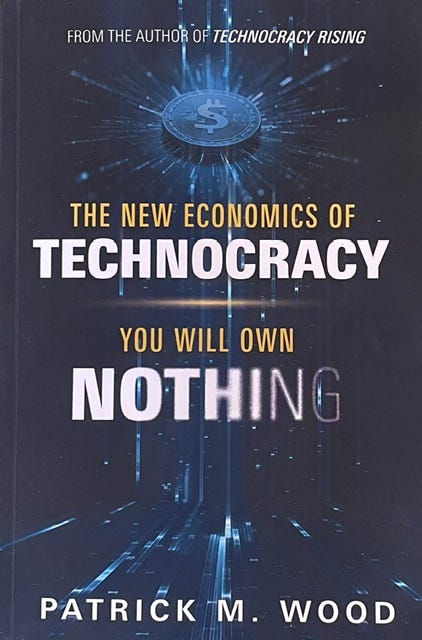
I have previously reviewed Iain Davis’s excellent book The Technocratic Dark State, and I strongly encourage you to get a copy if you haven’t already. The next book on your reading list to get to grips with the global Technocratic prison under construction is Patrick Wood’s The New Economics of Technocracy, also available on Amazon.
(I am not financially affiliated in any way to either of these book sales, so whether you click those links and buy or not makes no odds to me.)
These two books are highly complementary, each delving into the subject in a distinct way but with the same sobering conclusion.
Patrick Wood’s latest work is a compelling read. This series of articles will hopefully impart the nub of it, and encourage you to pick up the book to extract its full value.
When offering my own analysis and perspectives, I will make this clear by presenting my supplementary analysis in italicised paragraphs to avoid misrepresenting Wood’s ideas.
Taking a leaf out of the Technocrats’ accelerationist mantra, I will dispense with my customary desultory chit-chat and get stuck in. I’m going to attempt to draw out what I believe are the three most important themes in the book:
1. Part I covers the big picture – understanding the endgame, the route they’re taking, why, and how ‘they’ want it to work. Wood explains why the debt dilemma might be used to bring Technocracy’s plans to fruition. Most analysts bang on about how the debt bubble is going to burst in everyone’s faces, including the ‘geniuses’ that made it. Not so, according to Wood. It is a means to an end, and I confess to being heavily swayed by this thesis. Why else would they keep pumping it up with gay abandon?
The map for Part I is:
a) The birth of Technocracy.
b) Extremism and Technocracy.
c) How Brzezinski and the Trilateral Commission rejuvenated Technocracy in 1970.
d) The three layers of control – programmable money, asset tokenisation, and digital ID.
e) How the three layers of control converge into the Beast System.
2. Part II covers what Gaza’s got to do with it. We’ll also explore how the new economics of Technocracy provides a very convenient bridge for Islamic Finance to cross.
3. Part III delves into the emerging India-Middle East-Europe Corridor (IMEC) as a potentially pivotal factor in the US-Israel war on Iran. We’ll look at Iraq and Iran, and why a particular faction of the global plutocracy is desperate to see the Iran domino fall as neatly as Iraq appears to have. I’ll wrap up with big picture thoughts about the geopolitical lens through which to view the war on Iran.
How long has this been going on?
I’m aware there’ll be a fleeting repeat of material I covered in my review of Iain Davis’s book, but it’s necessary for a smooth progression to a pivotal moment in the history of Technocracy in 1970, which I did not cover previously – the formation of the Trilateral Commission with its mission to forge a New International Economic Order.
We can trace the birth of Technocracy to the publication in 1934 of its bible – the Technocracy Study Course. Operating out of the basement of Hamilton Hall at Columbia University, M. King Hubbert and Howard Scott produced a 280-page manifesto that proposed a scientifically managed society. Run by engineers and technicians, their vision advocated the replacement of private property, free markets (if such a thing ever existed), the price-based monetary system of economics, and representative government.[1]
Technocracy was, and is, utopian in the mind of a technocrat, and dystopian to more balanced minds. In 1937, Howard Scott explained the full sweep of Technocracy’s frightful ambition[2]:
“Technocracy is the science of social engineering, the scientific operation of the entire social mechanism to produce and distribute goods and services to the entire population… For the first time in human history, it will be done as a scientific, technical, and engineering problem. There will be no place for Politics, Politicians, Finance or Financiers, Rackets or Racketeers… Technocracy will distribute by means of a certificate of distribution available to every citizen from birth to death.”
Money was to be replaced by the issuance of energy certificates, the purpose of which was to track and record, in real time, the production and consumption of every single person within the system. To achieve this, it would be necessary to maintain “a record and description of the individual.” The Technocracy manual made it clear that the record and description of the individual were not incidental features. The record of the individual’s usage of energy certificates made it “a simple matter at any time for the Distribution Sequence [a management function within the centralised system] to ascertain the state of a given customer’s balance… With this information clearing continuously to a central headquarters we have a case exactly analogous to the control panel of a power plant”.
Thus, the idea of traceable energy certificates encapsulates the ability to control consumption at the individual level – what is consumed, how much is consumed, and when it is consumed. When we discuss the 21st century evolution of this aim, we will see how the combination of programmable money and digital ID replaces the energy certificate.
Fundamentally rooted in Scientism, this ideology held that the entirety of society’s problems was answerable by science and science alone. Following logically from this extremist viewpoint was that technicians, or Technocrats, alone were eligible to run society.[3]
Extremism and its relevance to Technocracy
I want to touch briefly on what extremism is, and who the extremists in our society really are because this is very relevant to Technocracy.
The Establishment’s nexus of corporate, political, academic, and media control would have us believe that all extremism and extremist ideology has its genesis in far-right politics or religious ideology, specifically Islam. Hence the term ‘Islamic extremism’. We have been conditioned to associate Islam with extremism, when in fact it has become increasingly clear that the most extremist ideologues are in fact running our so-called democracies in the West. While seeking to locate extremism on the periphery of mainstream society as something that seeks to usurp the Establishment status quo, academic Astrid Bötticher is unwittingly hoist with her own petard as she lists the characteristics of extremism[4]:
- It “understand[s] politics as struggle for supremacy rather than as peaceful competition between parties with different interests seeking popular support for advancing the common good”.
- It “seeks to conquer… by creating fear of enemies within and outside society.”
- It “is, due to its dogmatism, intolerant and unwilling to compromise.”
- “…viewing politics as a zero-sum game, [it] tend[s]… to engage in aggressive militancy, including criminal acts and mass violence in [its] fanatical will for gaining and holding political power.”
- “At the societal level, extremist movements are authoritarian, and, if in power, extremist rulers tend to become totalitarian.”
- “Extremists glorify violence as a conflict resolution mechanism and are opposed to the constitutional state, majority-based democracy, the rule of law, and human rights for all.”
All of the above features encapsulate: the entire Cold War and Operation Gladio; the baseless expansion of NATO after the end of the Cold War with the subsequent never-ending wars in the Middle East, using terror groups fomented by the US empire as the pretext; the violent and destructive neo-colonialism of the global financial empire, and; the way in which governments in the West have rolled out the New World Order since 2020. The extremist barbarians are not at the gates; they have been occupying the citadels of power in the West for a very long time.
The Covid psyop itself was extremist in all its elements: shutting down the global economy purportedly to pursue an unrestrainable virus, and making re-entry to normal life conditional upon coerced ‘vaccination’. The shutting down of, and policing of social media debate to silence all dissent to these extremist policies. The subsequent Ukraine war and genocide in Gaza, accompanied by the fomentation of Russophobia and the persecution of those protesting against genocide. The attempt to criminalise ‘climate denial’.
A recent and highly relevant example of Establishment extremism is the US government’s recent response to popular opposition to the proliferation of data centres across the US. If you need proof that the ruling class has prioritised the cultivation of data over the cultivation of human life and well-being, you need look no further than the current obsession with data centres. States with the greatest concentration of data centres will consume more electricity than the residents in those states, and in most cases will force the costs of energy up for residents. The demands on water resources present similar challenges.
There are few issues in the US that unite voters across party lines, but data centres is one of them. In a June Reuters/Ipsos poll, only 14% of respondents would support a data centre being built in their community. Reuters described Americans’ resistance to data centres as being “inseparable from broader unease about the future of AI and corporate power.” What is the Trump administration’s response? By Executive Order 14318, federally-owned land and resources are to be used for the development of data centres. In other words, taxpayers will foot a substantial portion of the bill for a project to which they are opposed. Aligning with Bötticher’s characterisation of extremism, Trump’s response to the resistance is: “You can’t fight it. You have to go with it”.
To the extent that extremism is a mental illness, the attempt to portray extremism as something confined to the Muslim world or the far right should be seen as a psychological projection of a disease that primarily infects the ruling class in the West. Crucially in relation to the premise of this article, Technocracy is merely another manifestation of Western ruling class extremism.
Brzezinski and the Trilateral Commission
Returning to the progression of Technocracy from its precarious beginnings in 1934, the ideology lay dormant for three decades in the absence of both the technology to implement its vision, and irrepressible ideologues to successfully proselytise a movement. That changed in 1970 when a new acolyte in the person of Zbigniew Brzezinski rekindled the fire. As a political strategist and professor at Columbia University, the alma mater of Technocracy’s founders, Brzezinski published Between Two Ages: America’s Role in the Technetronic Era. Eerily echoing the ideas of his predecessors, he explained that what he termed the “technetronic era” would herald a “New International Economic Order”. This era, he wrote:
“involves the gradual appearance of a more controlled and directed society. Such a society would be dominated by an elite whose claim to political power would rest on allegedly superior scientific know-how. Unhindered by the restraints of traditional liberal values, this elite would not hesitate to achieve its political ends by using the latest modern techniques for influencing public behaviour and keeping society under close surveillance and control.” [emphasis added]
Brzezinski did not merely write a theoretical treatise and then retire into obscurity to tend to his allotment. The vision he articulated is a work-in-progress nearing completion. David Rockefeller, the son of John D. Rockefeller Jnr, who not coincidentally donated the real estate to house the United Nations, was so enamoured of Brzezinski’s work that they co-founded the Trilateral Commission, the global think tank whose stated mission was to create the “New International Economic Order” to which Brzezinski had referred, and which was to be built on the bedrock of Technocracy[5].
By 1979, the Executive Branch of the US government had been virtually taken over by Trilateral Commission members, and its tenets are now firmly embedded in the UN Sustainable Development Agenda. Since 1973, six out of seven World Bank presidents have come from the ranks of the Trilateral Commission.[6]
“Unhindered by the restraints of traditional liberal values” in order to “keep society under close surveillance and control” – it is clear that Technocracy, as the intended “New International Economic Order”, is a core pillar of Western ruling class extremism.
So, what has 21st century Technocracy achieved towards the stated goals of its 1930s founders and Brzezinski’s vision of a technetronic dictatorship? 21st century Technocracy hinges on three layers of control and all of them are being built at a pace that ensures the architecture is erected much faster than accountability can follow. Most of it is either illegal or simply circumvents due process at the national level. And pretty much all of it is unethical. So the protagonists are fully aware that success lies in seeking forgiveness after it has been built rather than permission beforehand. They intend to make Technocracy a fait accompli, banking on the political cost of undoing it being greater than the political will to stop it.
The three layers of control
The three layers of control are not theoretical. They have not yet overtaken the economic and social landscape, but they have certainly arrived, and the controllers have ambitious plans for their ruthless entrenchment.
The three layers are programmable money, tokenised assets, and digital ID. All three layers of enslavement are glued together by appositely named blockchain technology, and the computational power driving its efficiency is AI.
We will discuss each layer in turn to show how their interaction will achieve Hubbert’s and Scott’s goals of tracking the production and consumption of every individual using a record and description of the individual. And indeed, we shall see how this achieves Brzezinski’s vision of “using the latest modern techniques for influencing public behaviour and keeping society under close surveillance and control.”
Layer one – programmable money
Two or three years ago, everyone concerned about liberty and privacy rights was banging on about the threat of Central Bank Digital Currency (CBDC), which virtually every single central bank within the Bank for International Settlements (BIS) family was developing and pilot testing. The concern, which is not a conspiracy theory but a verifiable fact confirmed by the BIS itself[7], is that every detail of every transaction is visible to the platform operator, which can embed conditions into the completion of the transaction based on the identity of the parties and anything else the platform operator deems fit. This programmable feature of digital money flips it from a medium of exchange into a medium of control.
Every transaction is visible, and digital ID will make every user identifiable. Programmability of the money makes rules enforceable at the moment of the transaction. “You do not need police action to enforce economic restrictions when the money itself refuses to complete a prohibited purchase. The enforcement mechanism is embedded in the medium of exchange.”[8] [emphasis added]
So, what happened to CBDC in the US? In a classic Hegelian dialectic progression from thesis (problem), to antithesis (reaction), and finally to synthesis (‘solution’), CBDC started out as the problem – full government control over surveilled money. To parry the popular objection, the Anti-CBDC Surveillance State Act was passed on 17 July 2025, representing the antithesis. One day later, the synthesis was heralded by the enactment of the GENIUS Act, garlanding the road to stablecoins – effectively privatised CBDC.[9] Stablecoins are “privately issued digital dollars, backed by government debt and regulated by federal law, but operating outside the constitutional protections that would apply to a government-issued currency.”[10]
Six months after taking office, Trump enacted the GENIUS Act, which Wood identifies as “the legislative framework that codifies the stablecoin as the successor instrument to the fiat dollar.”[11]
Trump makes an excellent case study in why it pays the plutocracy to have a fellow venal oligarch at the helm of the machinery of government. Here are some stunning facts revealed by Wood about how to use the White House to whitewash a banking operation.
- In September 2024, while still on the campaign trail, Trump announced that his sons would launch World Liberty Financial Inc. (WLF), the operating company that would issue a dollar-pegged stablecoin called USD1.[12]
- Through two companies further up the chain, WLF is effectively 60% owned by a Trump family entity that has strategic veto power over operational decisions.
- The initial founders included the sons of Steve Witkoff, the real estate mogul who would subsequently go on to act as Trump’s Special Envoy to the Middle East.
- The remaining 49%[13] is held by the UAE National Security Advisor, Tahnoun bin Zayed Al Nahyan, through his firm Aryam Investment. This tidbit will acquire further significance in Part II, when we examine What Gaza’s Got To Do With It.[14]
- In March 2025, barely two months into the Trump presidency, WLF began marketing the USD1 stablecoin.
- In July 2025, the Trump administration enacted the GENIUS Act, which is the stablecoin legislative framework.
- By February 2026, WLF had generated $1.4 billion in revenue. The entire WLF ecosystem, controlled by the Trump family, is valued at approximately $13 billion.[15]
Trump was put in office by the Zionist Paypal mafia, and the Zionist Private-Public surveillance partnership (Palantir). Not only is he being handsomely rewarded for services rendered, but he has so far proven to be the best US President that money can buy. Like children in a sandpit, the Left screams that Trump is stupid. The Left does not yet appear to have grasped the fundamentals of politics in the ‘free’ world. Trump’s apparent buffoonery is in fact a very effective decoy that distracts from his picking of Americans’ pockets and the construction of the digital gulag. And while the Left is clapping like a seal to celebrate the “end of the US empire”, the ultimate Financial Empire – the real global hegemon that hides behind geographical empires – is celebrating the beginning of the end of humanity as we know it.
And, if you’re interested in emerging patterns, here’s another fun fact for Reformers in the UK. Two thirds of Nigel Farage’s Reform funding (£22 million) comes from digital currency tycoon Christopher Harborne, who is one of the owners of Tether, the biggest cryptocurrency in the US. The golden rule of psychopathic rule is: if a trick works, rinse and repeat until it stops working. As I’ve said before, it would appear that Farage’s job is to Trump the UK – give the Right a party that will accelerate the journey to Technocracy, because the mainstream Left are pretty happy with, or oblivious to, that destination anyway. It’s the ‘freedom’ loving right that needs to be hoodwinked into loving Big Brother by a traditionalist, flag-waving, anti-immigrant regime.
And no doubt, like Trump, the business savvy Farage will figure out a way to profit from plugging the UK into the blockchain trifecta of programmable money, tokenisation, and digital ID. If he makes it to Number 10, he really has no excuses for fluffing it now that Trump has given him a blueprint.
Layer two – asset tokenisation and the death of debt
Before we discuss asset tokenisation, let’s start with debt, as it’s the logical lead-in.
Working on the principle that the purpose of a system is what it does, Wood turns the whole debt Ponzi scheme on its head by suggesting that it isn’t a problem for the financial mafia. Or rather, it is a fire that’s being stoked to justify the ‘solution’ on the hard road to technocracy. US government debt currently stands at an unfathomable $39.5 trillion, but by the time you read this article, there’s a fair chance that it will have hit the $40 trillion mark. Absurd as that seems, Wood invites us not to view it as a mistake as he asks: “What if the debt-based system is not simply failing, but is being deliberately driven to failure in order to justify its replacement?”[16] [emphasis added] But, to be replaced by what?, you ask. A tokenised asset-based system in which digital currency is issued as collateral against assets.
What assets? Well, all existing assets for starters. Tokenisation converts real assets into digital fractions on someone else’s platform.[17] Wood explains that[18]:
“When a company ‘tokenises’ a real-world asset, it takes that asset and divides it into thousands or millions of digital tokens, each representing a tiny fraction of the whole. These tokens can then be… traded on digital exchanges, just like stocks.”
However, Wood warns that “fractional ownership is not ownership in any historically or legally meaningful sense.”[19] He explains that[20]:
“What you hold is a speculative financial instrument that exists entirely within the rules of a platform you did not build and cannot influence. If the platform operator decided to delist the token, adjust the smart contract, or revoke access, your ‘ownership’ evaporates.”
Your ‘rights’ to that asset are determined by the conditions programmed into the contract on the blockchain ledger, and the stablecoin used to trade it. The true owners of the asset are the token and digital money platform operators. This is permission-based ‘ownership’, which is “a new feudalism in which the blockchain ledger replaces the land registry. In other words: ‘You will own nothing’.”[21]
There is a new class of asset that hasn’t yet found its way onto the pathocracy’s asset ledger. You will recall from my review of Iain Davis’s book that the plutocrats are licking their chops at the prospect of tokenising, and therefore monetising, Mother Nature herself. There’s a cool $4,000,000,000,000,000 – that’s four quadrillion US dollars, or four thousand trillion – in natural assets that has yet to be tapped.
And, fully sanctioned by the UN Sustainable Development agenda, these assets will be tokenised, which means having a financial value assigned to them on a blockchain ledger to facilitate trading in them, and profiting from the related income streams. Because that, don’t you know, is the best way to steward God’s creation. Perhaps if you look hard enough in the Bible, you’ll find a recommendation in Genesis about monetising natural assets.
These are the group of assets Wood labels as sovereign asset pools – token issuance against land, mineral rights, and inscrutable concepts like carbon sequestration capacity.
How might tokenisation solve the US’s $39.5 trillion government debt liability? Iain Davis posited that governments could trade away real assets, such as land, forests, and parks, in exchange for cancellation of debt paper.
Thus, in yet another classic Hegelian dialectic progression from thesis to antithesis to synthesis, the System controllers have allowed a problem (the thesis of debt-based fiat currency) to metastasise, thus provoking a reaction to unsustainable debt levels (antithesis), and they are now in the process of offering the ‘solution’ (the synthesis of programmable and tokenised digital money). And there is a toll booth at each step in the process where the gullible masses step up and pay for their own destruction.
Layer three – Digital Identity
The first two layers cannot work without digital ID. Recall that the founders of Technocracy in the 1930s were very clear on the goal to register the consumption of every individual, and that this would require a “record and description of the individual”. In 21st century terms, this requirement is met by digital ID. This is the final lock.
The digital money platform and the tokenised asset marketplace will not be accessible without biometric identification. Anonymous participation will be impossible, and every transaction will be linked to a verifiable individual.
The UN is speaking out of both sides of its mouth by promoting a charter of human rights that includes the right to privacy while also advocating digital ID for every person on the planet under Sustainable Development Goal 16.9. Digital ID, used in the way Technocrats envision, crushes the right to privacy. It is disingenuously marketed as ‘legal identity’, but the ID2020 alliance tasked with achieving the UN’s goal was more blunt in its communication[22]:
“In May 2016, at the United Nations Headquarters in NY, the inaugural ID2020 Summit brought together over 400 people to discuss how to provide a unique digital identity to everyone on the planet”. [emphasis added]
The idea that a “unique digital identity” could possibly play any role in poverty alleviation would be insulting to the intelligence of a newt. Before the digital era, did poverty alleviation champions suggest that having a government issued passport was the first step in putting food on the table?
Palantir is essentially the privatised arm of the Intelligence Services surveillance apparatus. Entities like Palantir specialise in taking data from disparate sources and fusing it into a single environment where patterns can be identified and individuals tracked. This essentially breaks down data information silos, and makes the information readable by identification systems like REAL ID cards, biometric wallets, and blockchain transaction ledgers.[23]
How the three layers converge into the Beast System
At the IMF Annual Meeting in October 2022, Bo Li, the then Deputy Managing Director spelt out what convergence of these three layers of control means[24]:
“By programming CBDC, the money can be precisely targeted for what kind of people can own, and what kind of use this money can be utilised.”
At the IMF Spring Meetings in 2023, Nandan Nilekani, the architect of India’s Aadhaar biometric identity system, which enrolled 1.3 billion people, said[25]:
“Everybody should have digital ID; everybody should have a bank account; everybody should have a smartphone. Then, anything can be done. Everything else is built on that.”
The convergence of the three layers is best summed up by Wood[26]:
“You need a digital identity to access the payment platform. You need the payment platform to buy asset tokens. You need the asset tokens to have any claim on property. And every step of the process is recorded, monitored, and governed by rules you did not write, on platforms you do not control, operated by entities you cannot hold accountable. Nothing needs to be confiscated because nothing [is] ever truly owned. The word ‘own’ simply loses its meaning.”
We come full circle to the Technocracy bible written in 1934. The concept of issuing a traceable “energy certificate” to everyone is fulfilled by the interaction of programmable money with Digital ID. Technocracy’s founders were obsessed with replacing money with energy certificates as the measure of consumption and production. Today, programmable money with embedded conditions of use, and traceable to the individual through digital ID, is the stand-in for the energy certificate. The control, monitoring, and recording of consumption as the means to total social engineering is no longer a theoretical aspiration. The destination has remained unchanged, and we are now years, not decades, away from it.
If you liked this article but don’t want to commit to a paid subscription, please consider rewarding my writing using the BuyMeACoffee link below. Thank you!
[1] Patrick M. Wood, The New Economics of Technocracy: You Will Own Nothing, Coherent Publishing, 2026, Ch. 1, Pg. 1-2.
[2] Ibid., Pg. 4.
[3] Ibid, Pg. 7.
[4] Astrid Bötticher, Towards Academic Consensus Definitions of Radicalism and Extremism, JSTOR Terrorism Research Initiative, May 2020, Volume 11, Issue 4: https://www.exit-practices.eu/uploads/1/3/0/4/130474014/_b%C3%B6tticher_2017__towards_academic_consensus_definitions_of_radicalism_and_extremism.pdf
[5] Wood, op. cit., Ch. 1, Pg. 10-11.
[6] Wood, op. cit., Ch. 2, Pg. 22.
[7] Wood, op. cit., Ch. 10, Pg. 181.
[8] Wood, op. cit., Ch. 10, Pg. 181.
[9] Wood, op. cit., Ch. 2, Pg. 27.
[10] Wood, op. cit., Ch. 2, Pg. 27.
[11] Wood, op. cit., Ch. 2, Pg. 27.
[12] Wood, op. cit., Ch. 4, Pg. 55.
[13] In explaining who controls WLF, Wood assigns the controlling interest of 60% to the Trump family and then describes “the remaining forty-nine percent” as being held by the UAE National Security Advisor. It’s irritating that this doesn’t add up, but the reason for the discrepancy is not clear. I went with 49% as the Wall Street Journal also reported the share held by the UAE official as 49%: https://www.wsj.com/politics/policy/spy-sheikh-secret-stake-trump-crypto-tahnoon-ea4d97e8
[14] Wood, op. cit., Ch. 4, Pg. 54.
[15] Wood, op. cit., Ch. 4, Pg. 54.
[16] Wood, op. cit., Ch. 2, Pg. 18.
[17] Wood, op. cit., Ch. 4, Pg. 68.
[18] Wood, op. cit., Ch. 3, Pg. 40.
[19] Wood, op. cit., Ch. 3, Pg. 41.
[20] Wood, op. cit., Ch. 3, Pg. 41.
[21] Wood, op. cit., Ch. 2, Pg. 21.
[22] https://web.archive.org/web/20180324022236/http://www.id2020summit.org/
[23] Wood, op. cit., Ch. 10, Pg. 180.
[24] Wood, op. cit., Ch. 10, Pg. 182.
[25] Wood, op. cit., Ch. 10, Pg. 182.
[26] Wood, op. cit., Ch. 3, Pg. 43.

Comments are closed.