
The Technocratic Endgame: Part II – What’s Gaza (and Islamic Finance) Got To Do With It?

Gaza is a blank slate for the “the first full-stack deployment of technocratic governance.”
Originally published on A Plague on Both Houses substack.
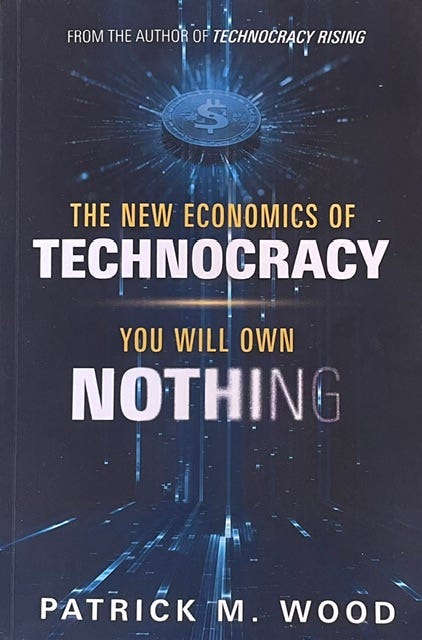
This three-part series of essays is intended to distil the essence of Patrick Wood’s latest book – The New Economics of Technocracy. Part I covered the essentials of the economics of the new Technocratic order being rolled out, and how the three-layered system of control is intended to work.
In this second part, I cover how the destruction of Gaza is laying the path for an unfettered Technocratic experiment that, if successful, will construct a complete Technate from the ground up. I also examine Wood’s analysis of the interplay between Technocracy and Islamic Finance, which may help to explain the apparent zeal with which GCC countries are embracing, and financing, Tech Finance infrastructure.
When offering my own analysis and perspectives, I will make this clear by presenting my supplementary analysis in italicised paragraphs to avoid misrepresenting Wood’s ideas.
Within a few weeks of 7th October 2023, it was already obvious that a genocide in Gaza was underway. So, in an attempt to appeal to those who were indifferent to the suffering of Gazans, I warned that if you claimed to be opposed to the New Normal techno-fascist agenda but were not calling for a complete ceasefire in Gaza, then you were complicit in accelerating the agenda you claimed to oppose. When you defend the freedom of those beyond your borders, you are also protecting yourself from the prison warden enslaving people outside your immediate boundary. In the case of Gaza, that prison warden is the global ruling Zionist mafia, which, as the word “global” denotes, operates everywhere. If you aren’t prepared to defend the freedom of others ‘over there’, then be prepared to enter your jail cell over here.
Patrick Wood’s book – The New Economics of Technocracy – has, sadly, provided me with the vindication I never wanted. With the destruction of Gaza complete, the world’s powers, including its GCC satraps, who either actively participated in the destruction or idly sat by, have found greater unity of purpose in how to profit from the ruins than in how to prevent the genocide.
In November 2025, the UN Security Council welcomed the Board of Peace, describing it as “a transitional administration with international legal personality”. [emphasis added] Subsequently, as if suffering from multiple personality disorder, the UN Human Rights Office issued a press release revealing that the UN’s own independent experts described the Board of Peace as “an illegal and illegitimate manoeuvre by powerful States driven by nostalgia and avarice”. [emphasis added] This article’s purpose, which will come as no surprise to readers, is to drop a few hints as to which of the two statements is the more believable one.
We will all be Gazans
The Board of Peace (BoP) is a body that will supposedly oversee the reconstruction of Gaza, whose destruction was entirely a matter of choice for the global Zionist alliance that committed this crime against humanity. The BoP’s charter names Donald Trump as its chairman[1]. The chairman is not the holder of an office, but an individual. There are no term limits, and he has sole authority to nominate his successor. He also has sole authority over membership of the body. As we shall see, this is the first sign that Gaza is to be converted from an illegally occupied territory into a private fiefdom. The UN – that wolf in sheep’s clothing – has welcomed this manoeuvre. China and Russia, alleged champions of justice and leaders of the mighty BRICS bloc set up to supposedly challenge the West’s economic dominance, meekly stepped aside in the UN Security Council and effectively gave it their blessing.
The BoP was not established by treaty or by any act of the US Congress.[2] Trump has pledged $10 billion of US taxpayer funds to the BoP, but Congress has not legally appropriated these funds.[3] To underline the status of the BoP as an investment vehicle, a permanent seat on the board costs $1 billion. Permanent membership is also at Trump’s discretion.
Notable founding members are Israel, Qatar, Turkey, Saudia Arabia, the UAE, Argentina, Hungary, India, Pakistan, Vietnam, Indonesia, Kosovo, Albania, Kazakhstan, and Morocco. Slovenia’s prime minister said it was “dangerously interfering with the broader international order”, and Italy’s prime minister said that participation was incompatible with her country’s constitution.
Beneath the Board membership, there is an Executive Board where Wood asserts the real power lies. It comprises seven individuals all appointed directly by Trump. Currently they are[4]:
– Marco Rubio (US Secretary of State)
– Jared Kushner (Trump’s son-in-law and ‘special envoy for peace’)
– Steve Witkoff (Trump’s special envoy to the Middle East and co-founder of his family stablecoin operation World Liberty Financial)
– Robert Gabriel Jr. (Deputy National Security Advisor)
– Tony Blair (Former UK Prime Minister)
– Ajay Banga (President of the World Bank)
– Marc Rowan (CEO of Apollo Global Management, which manages $600 billion in assets)
There is no Palestinian representation on the Executive Board.
Beneath the Executive Board is an operational layer called the Gaza Executive Board. Kushner, Witkoff, Blair, and Rowan appear again on this Board in addition to other high-ranking GCC, Egyptian and Turkish officials. There is a Dutch UN coordinator on this board.
There is no Palestinian representation on the Gaza Executive Board.
The only Palestinian representation in the whole BoP structure is in a committee beneath the Gaza Executive Board called the National Committee for the Administration of Gaza (NCAG). It is a committee of technocrats whose only permissible input relates to technical administrative issues.[5]
Kushner manages Affinity Partners, a $4.6 billion private equity fund backed by $2 billion of Saudi sovereign wealth fund money, and $1.5 billion from Qatar’s sovereign investment fund. He has outlined a $70 billion reconstruction vision for Gaza that creates “one economic bloc linking the port of Haifa in Israel to Muscat in Oman”.[6]
The presence of Kushner, Witkoff (World Liberty Financial stablecoin), Banga (World Bank President) and Rowan (Apollo Global Management) on the Executive Board signals that the BoP is not a humanitarian reconstruction committee, but rather, in Wood’s words, “an investment syndicate with governance authority over the territory it intends to develop.”[7]
To guarantee the security of the investment, the BoP has authorised the creation of an International Stability Force (ISF) of 20,000 troops drawn from Albania, Indonesia, Kazakhstan, Kosovo, and Morocco. They will be led by a general from the US Special Operations Command Central. The operational infrastructure – the Civil-Military Coordination Centre (CMCC) in Southern Israel – was set up in October 2025 before life was officially breathed into the BoP. Apart from giving investors confidence to purchase tokenised assets in Gaza, the CMCC will provide the muscle to enforce BoP governance decisions.[8]
At the drop of a hat, 20,000 troops have been provided to protect the infrastructure of a billionaire investment syndicate, but 20,000 troops were not available to intervene in a genocide.
In January 2026, Drop Site News obtained leaked CMCC documents that revealed the outline of plans in store for the already severely traumatised Gazans. These plans include:
- Biometric surveillance at checkpoints.
- Monitoring of purchases.
- Educational programs promoting normalisation with Israel.
- Maintaining a registry of Palestinian ID numbers.
- The use of electronic shekel wallets to “mitigate diversion of goods and funds to Hamas financial channels.” In other words, programmable stablecoin as the medium of exchange and control.
An Al Jazeera correspondent reviewing the plans called it “a laboratory for government surveillance”. While this goes some way to describing what the BoP has in store for Gazans, Wood’s assessment is closer to the mark. Gaza is the template for the development of Technocratic city states – Technates. Razed to the ground with virtually nothing left except a traumatised population, it is a blank slate for “the first full-stack deployment of technocratic governance.”[9] As Wood points out, “the scale of the destruction is not incidental to the reconstruction plan. … Gaza is a greenfield. Not because it was empty. Because it was emptied.”[10]
“No prior Technocratic initiative has simultaneously controlled the monetary layer, the investment layer, the governance layer, the surveillance layer, the connectivity layer, and the physical design layer within a single bounded territory, administered by an interlocking network of financially connected private actors, operating under the authority of one man. Until Gaza.”[11]
It is primarily the Left who have been at the forefront of protest in the West against the Gaza genocide, but they need to start seeing the bigger picture, which affects not just Gazans. There is still much work to be done, but they need to stop prematurely celebrating the “end of the US empire”; not because this would not be a good thing to celebrate – it definitely would – but because the US empire is not the empire we really need to be concerned about. It never was. Follow the Money because the Money is the Empire, and right now it’s laughing all the way to the bank. Look at what is happening in Gaza[12]:
“The people whose territory is being administered, whose financial system is being replaced, whose land is being tokenised, and whose daily transactions will flow through a privately owned stablecoin have no seat at the table where decisions are made.”
The choice we now face is to either toss the BoP on a bonfire before Gaza is forced into a new period of colonial subjugation, or we accept the same Technocratic fate for all of us.
Islamic finance and the Sharia bridge
Here are some statistics Wood presents for the unbanked in countries with predominantly Muslim populations[13]:
- Egypt – 85% unbanked
- Pakistan – 87%
- Afghanistan – 90%
- Yemen – 93%
- Turkmenistan – 98.2%
The percentages seem very high so I decided to sense check them against other sources. For example, The Banker claims that while Egypt’s unbanked percentage was 90% in 2011, it had dropped to 57% in 2024. That’s high, but still significantly lower than the 85% quoted by Wood. In a February 2025 report, Arab News claimed that 64% of adults in Pakistan had bank accounts in 2025, which would put Pakistan’s unbanked at 36%.
Wood’s source is World Economic Forum data from 2017, so perhaps the discrepancy is due to the figures not being updated. While I am less confident that his figures are current, further research using more recent reports confirms the general premise of his argument that the percentage of unbanked in these countries is significantly above average.
The extent to which these figures are driven by poverty or rejection of Western finance systems based on religious concerns is not clear, but either way, the System’s controllers are clear-eyed about the solution. Recall the words of India’s architect of the Aadhaar biometric identity system: “Everybody should have digital ID; everybody should have a bank account; everybody should have a smartphone. Then, anything can be done.”
Wood contends that[14]:
“The compatibility between Technocratic asset-based economics [covered in Part I] and Islamic finance is the most underreported story in global economics today. It is also the story that explains, more than any other single factor, why the Gulf monarchies are not merely funding the new system but actively building its infrastructure from the ground up.”
The Quran has a prohibition against riba. It forbids any “predetermined, guaranteed return on a financial transaction that is not tied to an underlying asset or real economic activity.”[15] Christianity once did the same – it proscribed usury, although the concept of riba is wider than usury in that it also forbids unequal exchanges between parties.
Wood notes that “the prohibition against riba did not soften to accommodate Western Banking.” Instead, “Western banking began to restructure itself to accommodate the prohibition. The result was the development of an entire parallel financial system… that operates not on interest-bearing debt but on asset-backed transactions, fee-based services, profit-sharing arrangements, and leasing structures.”[16]
Wood explains how three core Islamic finance instruments align with Trump’s BoP and World Liberty Financial stablecoin USD1:
- Murabaha is cost-plus financing. Instead of lending money to facilitate investment, the financier purchases the asset on behalf of the client and resells it at a disclosed mark-up. The profit-margin is embedded in the transaction as a fee, not a time-based charge on borrowed money. Wood posits that this is precisely how a stablecoin transaction using USD1 operates – “it settle[s] through fee-based mechanisms rather than interest-bearing instruments”.
- Ijara is leasing. “The financier purchases and retains ownership of an asset, then leases it to the client for a fixed rental fee.” Wood contends that in the tokenised asset Technocracy model, fractionalised assets generate revenue streams functionally equivalent to Ijara leasing.
- Sukuk, commonly referred to as “Islamic bonds”, represent “proportional undivided ownership in an underlying tangible asset, usufruct, or service. Money is not lent. The sukuk holder owns a share of something real.
Wood addresses whether tokenised asset-based economics fuelled by digital stablecoin money provides a bridge for Sharia to cross, and has concluded that they are a marriage made in heaven. The emerging Technocracy system using an “asset-based token…generating returns tied to asset performance rather than interest, transacted through fee-based platforms rather than interest-charging banks, recorded on an immutable blockchain ledger”, is the 21st century version of the Energy Certificate. However, he unequivocally states the gamechanger for onboarding the huge number of unbanked people in the Islamic world is that “the riba prohibition does not merely permit this system. It accelerates its adoption.”[17] Financial inclusion thus becomes a Trojan horse for Technocratic enslavement.
Before I read Wood’s book, I knew nothing about Islamic finance, so I am in no position to opine strongly on his conclusion, which may seem controversial to some. I did not get any sense of Wood courting controversy with an unseemly agenda, and I would not have engaged seriously with his theory had I thought so. On the contrary, he is ahead of the curve in sounding the alarm about the Technocratic agenda for Gaza, of which most Palestine activists seem to be unaware.
In any event, his thesis appears to be well-supported by the concrete steps many Islamic countries are taking to establish themselves as Fintech leaders, moving apace towards Technocratic infrastructure. Moreover, the GCC countries are collaborating fully with the plan for a Technocratic hellhole in Gaza.
In January 2026, Pakistan signed an agreement to explore Trump’s USD1 stablecoin for cross-border payments while nearly nine out of every ten Pakistani citizens (using Wood’s 2017 WEF data) is not plugged into the West’s financial system.
Recall from Part I that the UAE’s National Security Advisor, Tahnoun bin Zayed Al Nahyan, has a 49% stake in Trump’s USD1 stablecoin operation through his firm Aryam Investment. The leading nations in Islamic FinTech – Bahrain, Abu Dhabi, Dubai, Malaysia, and Saudi Arabia – are the nations building AI-crypto-energy infrastructure.
The title of a Forbes article cited by Wood – Fintech Is The New Oil In The Middle East And North Africa – dates back to 2017, and provides a strong clue to both the trend in the Middle East and that it did not begin yesterday. The article noted that “interestingly, Islamic banks are enthusiastic about the prospects and are investing in digital initiatives, according to a recent EY report”. [emphasis added] The founder and CEO of a Saudi-based payment processing startup added that “Fintech’s penetration into Islamic finance is still in its nascent stage, however, it could help Islamic banks become more efficient and scale up their operations”. [emphasis added]
Wind the clock forward to June 2024 and this Linklaters report sees “the Middle East emerging as an oasis for tech and fintech”. “Many Gulf Cooperation Council (GCC) countries have embraced the digital revolution by setting ambitious goals to diversify their economies away from oil and gas”. A key factor behind uptake in fintech activity has been supportive regulation.
Global Islamic finance assets are projected to rise from $5.98 trillion in 2024 to $9.7 trillion in 2029.[18] Trump positioned himself to ride that wave before he took office, and has continued to cultivate close ties with GCC money. Apart from investing in significant AI infrastructure deals, the UAE’s MGX fund purchased a $2 billion minority stake in Binance, the world’s largest crypto exchange. MGX is Binance’s first institutional investor, and the payment was made with World Liberty Financial’s USD1 stablecoin.
The UAE’s MGX fund “is also involved in Stargate, the United States’ major artificial intelligence infrastructure project, and a giant AI data centre to be built in France at a cost of up to 50 billion euros ($54 billion).”
When Trump toured the US’s GCC satraps in May 2025, included in his entourage were the oligarchs and their generals spearheading the digital Fourth Industrial Revolution: Sam Altman, CEO of Open AI; Elon Musk, CEO of Tesla and SpaceX; Jensen Huang, CEO of Nvidia; Andy Jassy, CEO of Amazon, and; Alex Karp, CEO of Palantir. In the immediate aftermath of the tour, deals worth over “$2 trillion were announced. These included the construction of a five-gigawatt AI campus under the UAE/Stargate banner[19].
All of which has led Wood to assert that[20]:
“The Gulf monarchies are not merely investing in a new technology. They are building the physical infrastructure of a new economic order – and they are doing it with American chips, American software, and American political patronage, in exchange for capital flows that benefit a remarkably small network of individuals.”
If you liked this article but don’t want to commit to a paid subscription, please consider rewarding my writing using the BuyMeACoffee link below. Thank you!
[1] Patrick M. Wood, The New Economics of Technocracy: You Will Own Nothing, Coherent Publishing, 2026, Ch. 5, Pg. 75.
[2] Ibid., Ch. 5, Pg. 77.
[3] Ibid., Ch. 5, Pg. 78.
[4] Ibid., Ch. 5, Pg. 80.
[5] Ibid., Ch. 5, Pg. 80.
[6] Ibid., Ch. 5, Pg. 81.
[7] Ibid., Ch. 5, Pg. 82.
[8] Ibid., Ch. 5, Pg. 82-83.
[9] Ibid., Ch. 6, Pg. 95.
[10] Ibid., Ch. 6, Pg. 99.
[11] Ibid., Ch. 6, Pg. 95.
[12] Ibid., Ch. 5, Pg. 80-81.
[13] Ibid., Ch. 7, Pg. 117.
[14] Ibid., Ch. 7, Pg. 118.
[15] Ibid., Ch. 7, Pg. 118.
[16] Ibid., Ch. 7, Pg. 119.
[17] Ibid., Ch. 7, Pg. 125.
[18] Ibid., Ch. 7, Pg. 122.
[19] Ibid., Ch. 8, Pg. 141-2.
[20] Ibid., Ch. 8, Pg. 142.
Comments are closed.