
The Technocratic Endgame: Part III – What’s Iran Got To Do With It?

If the contents of the dinner table are set, it is more likely that the current conflict is, for all sides concerned, a fight for a better seat at the table.
Originally published on A Plague on Both Houses
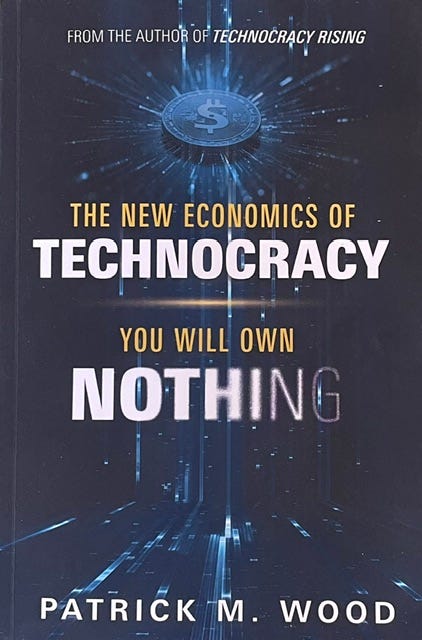
This three-part series of essays attempts to distil the essence of Patrick Wood’s latest book – The New Economics of Technocracy. Part I covered the essentials of the economics of the new Technocratic order being rolled out, and how the three-layered system of control is intended to work.
In Part II, I covered how the destruction of Gaza is laying the path for an unfettered Technocratic experiment that, if successful, will construct a comprehensive end-to-end Technate from the ground up. I also examined Wood’s analysis of the interplay between Technocracy and Islamic Finance, which may help to explain the apparent zeal with which GCC countries are embracing, and financing, Tech Finance infrastructure.
In this third part, I’ll explore Wood’s thesis on the meaning of the war on Iran. I’ll wrap up with my thoughts on how to fit this into the bigger geopolitical picture.
When offering my own analysis and perspectives, I will make this clear by presenting my supplementary analysis in italicised paragraphs to avoid misrepresenting Wood’s ideas.
India-Middle East-Europe Corridor (IMEC) and the war on Iran
IMEC, a planned trade corridor linking India to Europe via the Arabian Peninsula, was unveiled in September 2023 at a G20 summit in New Delhi. Framed as the West’s answer to China’s Belt and Road Initiative, if successful, IMEC would make China’s project obsolete. It is also an alternative to the Suez Canal. Wood contends that “IMEC promises to cut transit time between India and Europe by 40% compared to the Suez Canal route.”[1]
Wood asserts that[2]:
“IMEC is not just a trade route. It is a control corridor – a fully integrated system of rails, roads, shipping lanes, ports, fibre optic cables, energy pipelines, and data centres stretching from India to Europe. Whoever controls the architecture of that system controls the flow of goods, energy, data, and money across three continents. That is precisely why Technocrats want it”.
This is also an energy dependency architecture and not just a trade route. Wood explains that[3]:
“IMEC’s pipeline infrastructure is specifically designed to move that energy from India and the Gulf to European markets – filling the supply vacuum created by Europe’s deliberate decoupling from Russian energy after 2022.”
The IMEC project unveiled by Biden in 2023 was a state project. However, under the Trump administration, it has been “repurposed into a privatised artery connecting Gulf compute power to Indian digital labour… The corridor’s architects are not governments but sovereign wealth funds.”[4]
Gaza, the south-western terminus, is an important node linking the Middle East part of the corridor to the Mediterranean and Europe. The Board of Peace believes it has secured the Gaza node, now emptied, for unfettered development.
Another vital node is the Strait of Hormuz, which of course brings us to the current war on Iran:
“Trump’s version of IMEC is critically dependent on the Strait of Hormuz, which has been under the erratic and unpredictable control of Iran. Iran sides with China to keep Hormuz out of IMEC’s (and Trump’s) hands.”[5]
If we try to understand Gaza and Iran by following the money, this renders the BoP’s Gaza reconstruction project and clearing the obstacles in the Gulf corridor part of a single strategy, with the Gaza genocide and the war on Iran being integral components of that strategy. Wood asserts that regime change in Iran is a “strategic prerequisite for IMEC’s eastern corridor to function as designed. Iranian officials understand this perfectly. They have described IMEC as an instrument of strategic encirclement.”[6]
In a separate article, Wood reiterated the point that the war on Iran is fundamentally about reintegrating it into the global monetary and trade system. Iran “is the missing node between the India-Middle East-Europe Economic Corridor and the Iraq-Turkey Development Road. For as long as Iran is the system’s enemy, the system’s trade routes remain rival fragments that cannot be joined. Reintegrate Iran, and the fragments mesh.”
The MoU that failed in June put $300 billion of private investment capital on the table to consummate the reintegration. It failed because Iran refused to surrender control of the Strait of Hormuz.
Every single major negotiating break in the war has centred on, and indeed foundered on, control over Hormuz, not the totally phoney pretext of nuclear containment. A 5th August Reuters piece pretty much sums up the whole point of contention in this war:
“An agreement that gives Iran authority over traffic through the strait would mean the war launched by the United States and Israel in February had resulted in a major shift in the balance of regional power in Tehran’s favour. Before the war, the strait was freely open to all ships with no fees…According to the senior Iranian official, Iran is seeking fees of between 5% and 7% of the price of cargoes from ships using the strait. Oman is discussing fees of around 3%, while Washington wants no fees at all. The senior Iranian source said the text of an agreement already on the table envisioned Iran having control of ships heading into the Gulf through the strait, and one of the main sticking points was what role Iran would also have over ships heading in the opposite direction. In comments to Iran’s official IRNA news agency, Iranian Deputy Foreign Minister Kazem Gharibabadi said the arrangement was ‘designed in such a way that commercial ships will pass through Iranian territorial waters, both on the inbound and outbound legs.’ ”
The irony of this war is that if this is an oligarch’s war over Hormuz and the reintegration of a more servile Iran, and if Iran succeeds in holding its ground on control over Hormuz, then the IMEC syndicate will end up in a worse position than they were before the war.
The Abraham accords to normalise relations between Israel and the GCC – described by Wood as “the opening move in a sequence” – represented the recognition of a shared threat from Iran. What we are seeing now is the attempt to eliminate that threat to clear the path for the corridor.[7]
Witkoff, Trump’s Middle East envoy, explained to Tucker Carlson in March 2025 that the Gulf had been identified as a new frontier for AI investment and that it would need a US-backed “security wrapper” to make investments bankable. This aligns with CENTCOM’s role in Gaza, described in Part II. Witkoff envisioned a Gulf-Israel-US architecture that would be “much bigger than Europe”[8].
Wood’s clarification of the role of data centres is also illuminating up to a point[9]:
“Data centres are not neutral buildings. They are physical locations where data is stored, processed, and analysed. Whoever owns and operates a data centre controls the data that flows through it – determines what is stored, for how long, under what conditions, and who has access…[F]uture geopolitical influence will hinge not on territory or trade, but on compute power, data policy, and who trains the next generation of large language models.”
I would add that this does not capture the full scale of the ambition behind the manic investment in data centres. In the context of the digital panopticon, the eye-watering sums being invested are a down-payment on the total control of human perception and behaviour. I will expand on this in another essay, referring to a writer I have recently encountered.
Developments in Iraq are not unrelated. On 14 July, Trump met Iraq’s newly selected Prime Minister Ali Falih Kadhim al-Zaidi. Al-Zaidi, a man with gleaming Technocrat credentials, is being warmly welcomed by the Trump administration. He was not elected, but rather chosen by a committee of Iraq’s political parties. That decision was, in turn, forced by Trump, who made it clear that American support for Iraq would be cut off if al-Maliki, the other contender, got the job. Al-Maliki withdrew, leaving the way clear for the preferred candidate, al-Zaidi.
A young oligarch businessman and banker, al-Zaidi has already been labelled by the Atlantic Council as the “Trump of the Mideast”. Al-Zaidi walked away from his meeting with Trump with a pipeline deal, deals to rebuild and expand oil production, a pledge to release frozen funds, and assistance to connect Iraq to Turkey and Europe with road and rail links. It would appear that the core economic objectives underpinning the Iraq invasion are crystallising, and that the next domino to fall must be Iran.
I will make a brief but relevant detour through the Vietnam war, because it underscores the point about the Iraq war, and US wars more generally. The Vietnam war is typically framed as a defeat for the US, but Gloria Guillo’s analysis is white-hot:
“Let’s understand that even victories ultimately become losses because presently all economic systems remain tiny islands in a vicious sea run by transnational oligarchs… If we look at who owns and controls the means of production, the transnational predator class never really lost the war against the people of Vietnam; they just changed their weapons. The bombs stopped falling in 1975, but the real invasion began in 1986 with a single Vietnamese word: Đổi Mới, meaning ‘renovation’. That was the surrender document disguised as reform because it opened the floodgates to foreign investment… and when the infiltrated communist party passed the Foreign Investment law in 1987, the very first thing they sold was crude oil. It’s no surprise that they shipped it straight to refineries in Japan and Singapore owned behind the curtain by Mobil, Exxon, and others… By the time Bill Clinton normalised trade relations in 1995 with Vietnam, and signed the trade agreement in 2001, the trap was sprung.
Fast forward to right now, 2025: the US is Vietnam’s largest export market… Sounds like a potential victory – more exports than imports, right? Wrong. Who owns the factories? Intel, Nike, North Face, Samsung (on American designs). Who owns the intellectual property? Transnational corporations. Who takes the high value profits home? Transnational oligarchs as majority stockholders. Vietnam gets low wage assembly jobs, the toxic waste, the twelve-hour shifts, and the destroyed fishing villages turned into luxury golf resorts for foreigners – the same villages that survived Agent Orange now drown under concrete funded by Blackrock… America didn’t need to occupy Vietnam with troops. They occupied it with supply chains. They turned a battlefield into a balance sheet. Vietnam is the perfect colony – no US soldiers dying, no anti-war protests at home, just pure quiet extraction. This is the long game of Empire.
First you destroy a country with war, then you rescue it with investment. Then you own it forever through debt, trade dependency, and foreign-owned factories. This is imperialism on steroids… Ukraine is walking the exact same path right now. Soon the bombs will stop, Blackrock will arrive [it has already arrived], the IMF will dictate terms, and some future president will sign a trade agreement, while the transnational oligarchs toast another conquest. So when people celebrate Vietnam’s victory over America, ask this: who really won, then and now? Was it the Vietnamese people who can no longer afford to live on the coast their ancestors fished for a thousand years, or is it the same predator class that turned a war they lost on the battlefield into the most profitable colony they never had to govern?” [emphasis added]
This excursion into Vietnam has another relevance: Vietnam is a founding member of the Gaza Board of Peace. While Vietnam attempts to put a positive spin on this, it should be clear from this series of articles that occupying a seat on the BoP is an attempt to legitimise bare-faced international buccaneering. As a highly profitable colony of transnational capital, it is hardly surprising that Vietnam’s ruling class should now be playing its part in laundering Empire’s crimes.
The $300 billion of investment funds included in the aborted June MoU was not a gift. It was transnational capital telling Iran to open its doors in the same way that Vietnam eventually did.
The bigger picture
How does Wood’s analysis fit with my geopolitical lens? Quite well actually. The 30,000-foot view of my lens is that a fake form of multipolarity is serving as a vehicle for the institution of a global Technocracy dictated by transnational capital, the head of which snake is the Bank for International Settlements (BIS). This agenda is being ably abetted by that wolf in sheep’s clothing – the UN, together with other international policy-implementing bodies. It is a fake multipolarity because all the allegedly different poles are in agreement on the end destination – total digital enclosure, and the means of achieving it. The different poles are thus chimeric images of the same beast.
The three-layered control system for the new economic order to which all major powers are committed consists of programmable money, asset tokenisation, and digital ID. I got into a discussion about this very recently with a new friend. He argued that the global drive in this direction does not represent collaboration among major powers, but rather a technological arms race. This is partly true, but I believe it is a mistake to view it solely as such. Where technology is concerned, it is true that the major powers would compete strenuously in a technology race as a matter of principle since the perceived negative consequences of opting out, both military and economic, are too great. It is also true that all major powers view authoritarian population control as an integral component of managing their vested interests. Technocracy offers the enticing prospect of unfettered population control, and all governments, controlled as they are by the moneyed ruling class, are gleefully embracing this form of extremism as the answer to their managerial problems.
However, viewing the unified global approach to Technocracy as purely a technology arms race misses a fundamental point. The global monetary system is evolving to the described three-layered system, and this transition is a joint venture of all major powers. The joint nature of this transition is not seen as optional by the major powers because they are all inextricably intertwined in the current global monetary system. If the transition is to work, they all have to cross the bridge together to avoid a calamitous unravelling of the monetary system. The international economic order, both old and new, is what unites them. On this single point, they are all agreed – they must all move together in order to survive, or they may all sink together. This is the source of their unity of purpose in implementing the New International Economic Order, wrapped up in various international policy agreements such as Agenda 2030.
The countries whose central banks are BIS members, and who are committed to the digitalised monetary control grid, represent 95% of the world’s GDP. These countries include China, Russia, the US and its Western allies. Iran is not a BIS member, but even if its establishment were opposed to this global monetary system transition, it is not really in a position to resist it. I would add that given how comprehensively the Iranian establishment folded during the covid psyop, we have to question whether it would have any inclination at all to oppose the global monetary transition to controlled digital infrastructure. (There were a few governments in the global south that opposed the covid debacle, and they paid a heavy price.) So, if the contents of the dinner table are not in dispute, or at least not up for negotiation, it is more likely that the current conflict is, for all sides concerned, a fight for a better seat at the table. When that fight is over, it is more than likely that we, the People, will still be facing the digital dragon.
Iran’s ruling class, including its own oligarchy, controls a vital node in an emerging corridor from which the transnational oligarchy stands to profit greatly. Iran’s ruling class has calculated that it has sufficient leverage and military capability to resist playing second fiddle to the GCC-US-Israel transnational power nexus. Iran may be motivated by a complex mix of national and cultural pride, as well as local oligarchic interest. Which of these is the dominant factor is anyone’s guess. But Iran is fighting for its seat at the table.
A significant part of Iran’s calculus may also be linked to China’s assessment of what it stands to lose – the Belt and Road Initiative – by acquiescing to regime change in Iran. Thus, China may be using Iran as a willing proxy in its fight for a seat at the table. It is likely that we are seeing a confluence of Chinese and Iranian interests.
However, the transition to the global digitalised monetary system is in fact the war for Technocracy on humanity, and, as far as I can tell, all major powers are in agreement on this agenda. This makes the ruling classes of all major powers enemies of the people. To the extent that Iran’s resistance is successful, it will weaken Zionism. That is obviously to be welcomed owing to the inherent evil of Zionism, and because the global ruling class is, not coincidentally, Zionist – the West openly, China and Russia covertly.
Ultimately, cheering on the end of the US empire in this conflict is understandable but futile from the standpoint of the ultimate endgame – the Technocratic war on humanity. It is also futile from the standpoint of what the real empire is – it is global transnational capital and, from its perspective, the US is merely a temporary staging post on the map. So, while we can hope for Iran to deal a fatal blow to Zionism, I am not sure how, or if, it would change the BIS’s Technocracy endgame. And I am not sure how, or if, it would change the Board of Peace’s fascist agenda for Gaza.
If you liked this article but don’t want to commit to a paid subscription, please consider rewarding my writing using the BuyMeACoffee link below. Thank you!
[1] Patrick M. Wood, The New Economics of Technocracy: You Will Own Nothing, Coherent Publishing, 2026, Ch. 9, Pg. 161.
[2] Ibid., Ch. 9, Pg. 159.
[3] Ibid., Ch. 9, Pg. 166.
[4] Ibid., Ch. 8, Pg. 148.
[5] Ibid., Ch. 8, Pg. 148.
[6] Ibid., Ch. 9, Pg. 162.
[7] Ibid., Ch. 9, Pg. 162.
[8] Ibid., Ch. 8, Pg. 149.
[9] Ibid., Ch. 8, Pg. 150-1.


Comments are closed.