Originally published on A Plague on Both Houses where you can also access an audio version of this article.
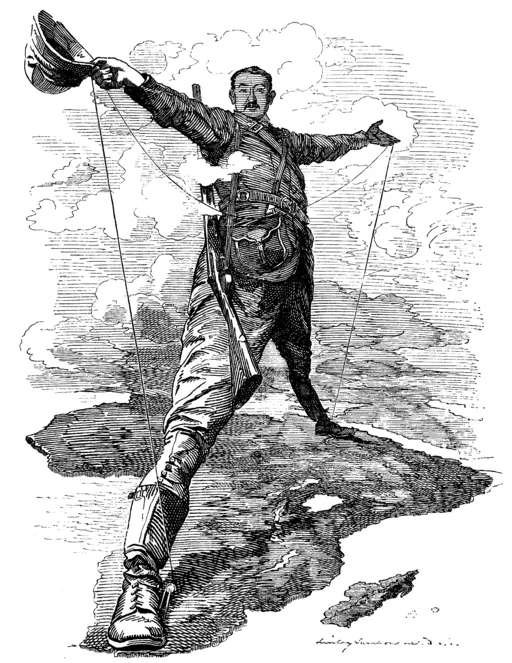
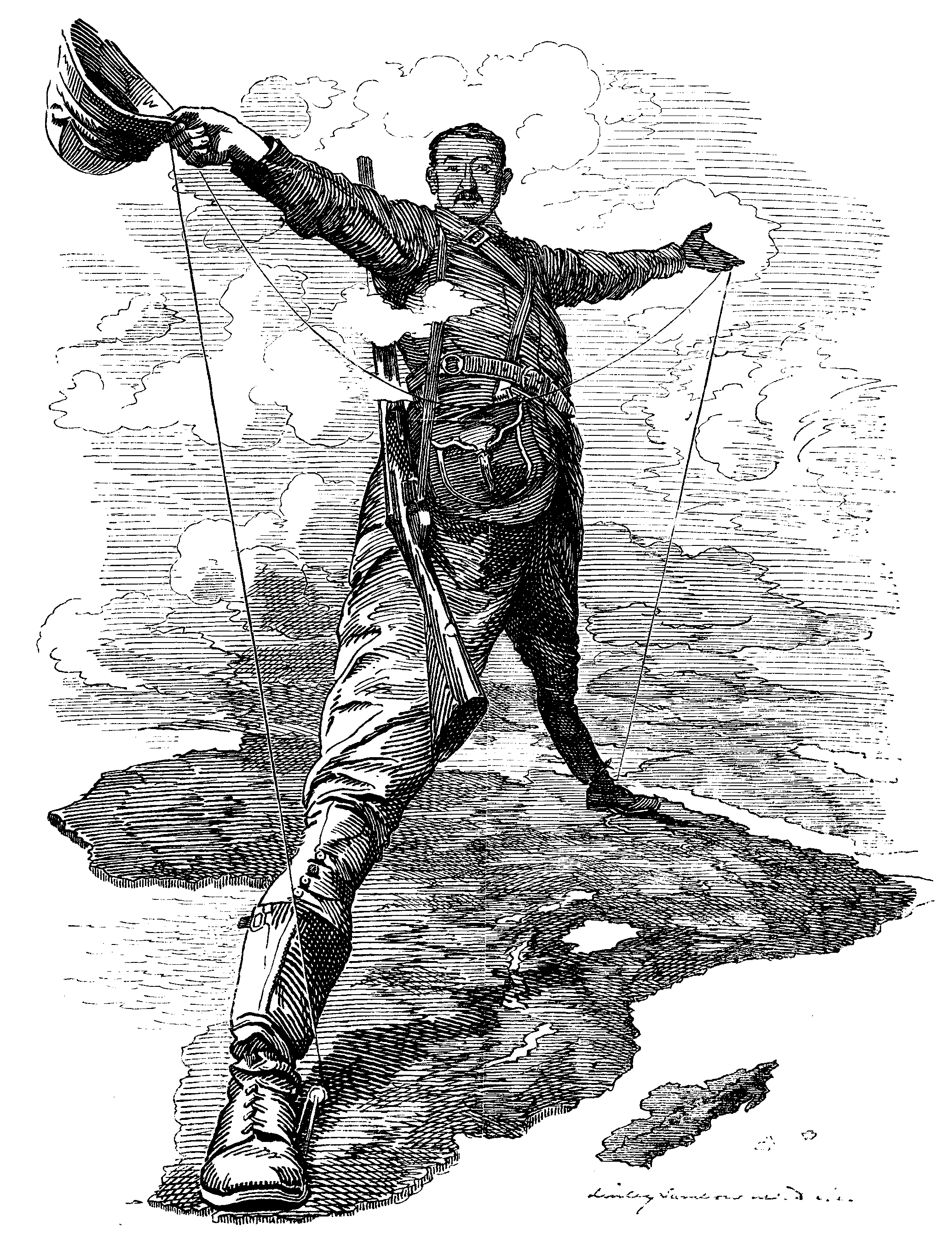
Edward Linley Sambourne, Public domain, via Wikimedia Commons: Caricature of Cecil John Rhodes, after he announced plans for a telegraph line and railroad from Cape Town to Cairo.
“The majority [of the 1890 Salisbury pioneers] had one thought uppermost in their minds—the gold depicted in such dazzling language by … early explorers. One of the Pioneers had brought with him a copy of Baines’ book containing fantastic accounts… of quartz reefs, miles in extent, bearing visible gold. These became familiar by repetition and aroused the wildest expectations. Hartley Hill and Mazoe were the localities indicated by Baines as the richest, and thither many of the Pioneers hurried with picks, drills and shovels supplied by Johnson and his partners, never doubting that a few months of simple quarrying would make them rich beyond the dreams of avarice.” – Hugh Marshall Hole, The Making of Rhodesia[1]
Open up a Wikipedia page about education in Zimbabwe and you discover under the History section that the British South Africa Company (BSAC) simply “arrived” in the 1890s, and started administering things. Things like missionary education and carpentry. Well! What right-minded person could object to such benevolent administration? After all, Jesus was both of those things – a carpenter and a missionary.
The choice of the neutral word “arrived”, particularly when paired with carpentry and education, conjures up the image of a cheerful British tourist today arriving at a beach resort to begin an adventure by mutual consent between the host and the tourist.
In Parts II, III, and IV of this series, we will explore the nature of the BSAC’s ‘arrival’ in Zimbabwe. In so doing, I hope to make a significant dent in the first claim of ‘The Rhodesia Myth’:
“Rhodesia wasn’t a racist apartheid state. European settlers transformed an undeveloped region into a prosperous society with justified causes, contrary to mainstream historical accounts.” [emphasis added]
And:
“European settlers … transformed a barbarous land with no written language or even the wheel into a prosperous outpost of civilization in merely a few decades.” [emphasis added]
In the Introductions to this series of essays, I pointed out that Unbekoming, in his defence of colonial Rhodesia, omitted a proper account of the precise nature of the settlers’ ‘arrival’ in Zimbabwe. This was remiss of him, and I hope the next three essays will go some way to correcting that error. So, consider this essay, along with Parts III and IV, as honouring Lewis Carroll’s famous advice for the proper way to tell a story: begin at the beginning.
The peopling of Zimbabwe: was it a no-man’s land?
“This is the story of the birth of a colony. In the strictest sense a colony consists of colonists, and there have been a few places in the world where colonists have planted themselves in a land empty of inhabitants, or nearly so. It is notorious that in Rhodesia this was very far from being the case. A community of white immigrants was superimposed on a vastly bigger indigenous black community.”[2] – Arthur Keppel-Jones, Rhodes and Rhodesia: The White Conquest of Zimbabwe 1884-1902
The archaeological evidence to support the peopling of Zimbabwe goes back some 100,000 years with the discovery of stone implements and arrowheads, as well as thousands of sites containing rock paintings throughout Zimbabwe. The evidence points to the hunter-gathering San people, whose descendants now live in the Kalahari Desert, being the first inhabitants. The San were either driven off the land or incorporated by incoming Iron Age Bantu-speaking groups around the tenth and eleventh centuries AD.
The arrival of Bantu-speaking people into the territory dates back more than 2,000 years. Archaeological estimates place the first arrivals of Bantu speakers from the North in around 150 BC. By the fourth century AD, Bantu-speaking people had established farming villages on the Zimbabwean Plateau south of the Zambezi River.
From about the 7th century we see the introduction of external trade with exchange of goods for gold and ivory. The next phase of development occurs in the 10th century with increasing trade volumes and villages showing signs of social differentiation. This coincides with the emergence of state structures, such as Mapungubwe, and further social stratification. These developments culminated in the establishment of the Great Zimbabwe state between 1270 and 1550.[3]
The rise and decline of the Mutapa, Torwa and Rozvi states coincides with the period 1450 – 1830. Thus, from 1100 through to 1830, a series of large and prosperous political entities or states occupied the area. In chronological order they were: Mapungubwe, Great Zimbabwe, Mutapa, and the Torwa/Rozvi states. All of these were established by the present Shona-speaking people of Zimbabwe.[4]
The 1830s saw the beginning of the demise of the last of the Shona states – the Rozvi Empire – at the hands of Nguni invaders from south of the Limpopo, or what is now South Africa. The period between 1816 and the 1840s was a period of continuous warfare and unrest in Southern Africa. These upheavals, known as the Mfecane (“the crushing”), or Difaqane (“the scattering”), began at the time of the rise of the Zulu Kingdom under King Shaka, and resulted in large-scale migration out of the area by groups such as the AmaNdebele under Mzilikazi. Boer migration and competition for space are two factors that played into this migration and saw the Ndebele people settling in the South West of Zimbabwe. Today, the Zimbabwe provinces of Matabeleland North and South cover the South West region of Zimbabwe.
Mzilikazi was a close ally of Shaka, but fell out with him and was forced to move northwards. In 1837, he eventually ended up in the south-west of Zimbabwe where the AmaNdebele, under his leadership, established a powerful kingdom, with its capital in Bulawayo,[5] now Zimbabwe’s second largest city.
Another Nguni group led by a woman called Nyamazana killed the Rozvi king in 1836, so the Rozvi Empire had already been severely weakened by other Nguni incursions before Mzilikazi’s arrival in 1837.
Mzilikazi’s son Lobengula inherited the Ndebele kingship and, since the AmaNdebele were the military power in the territory, it was Lobengula with whom Rhodes and his proxies decided to deal when the British South Africa Company annexed Zimbabwe and other neighbouring territories further north in 1890.
Today by ethnic composition, Shona-speaking people (comprising six main sub-groups) account for roughly 80% of the population, while the Ndebele and other groups represent 16% and 4% respectively.
Crude colonial narratives portraying the Ndebele as variously “heroic warriors”, “noble savages”, or “bloodthirsty savages” were crafted to justify colonial imperatives of military destruction and divide-and-rule propaganda. Needless to say, the truth about the relationship between the Shona and the Ndebele is more complicated. What cannot be disputed is that both groups very quickly realised the hostile nature of the colonial project from its inception, and both groups in the first few years of occupation put up heroic resistance to the invasion. Uprisings by both groups were brutally repressed, paving the way for 90 years of Rhodesian subjugation and exploitation, before both groups won their liberation from White minority rule in 1980.
A widely held belief, even today, based on misconceptions about African land tenure systems and practices posits that land not physically utilised and occupied was unspoken for. The irony of that misconception was that when the Africans remained on land that European settlers had taken from them after occupation and conquest but did not utilise, colonisers forcefully rejected the original inhabitants’ reoccupation of their own land. Nevertheless, Palmer attributes the misconception partly to the fact that the indigenous population was small at the time and, in the absence of written records maps and title deed offices, settlers viewed it as unclaimed. The reality was that:
“if there was much unoccupied land, there was very little which was unclaimed. Shona chiefdoms covered the greater part of the country and their boundaries are always contiguous and precisely defined . . . [so that] almost any European occupation of land would have resulted in the alienation of tribal lands.”[6]
The brief summary of the peopling of Zimbabwe presented above exposes the lie that Ian Smith (Rhodesian premier from 1964 to 1979), and Rhodesians more generally, sought to perpetuate in order to justify colonisation in 1890 – namely that the territory was a “no man’s land”. The description I have provided above is not even necessary to refute Smith’s lie since he does that himself with his contradictory arguments for colonial occupation. In 1997, fully seventeen years after Zimbabwean independence, Smith, who was allowed to continue living peacefully in Zimbabwe on his farm in Shurugwi until his death in 2007, claimed in his book, The Great Betrayal, that the invading colonisers were:
“going into uncharted country, the domain of the lion, elephant, … and the Matabele [sic], with Lobengula’s impis, the most deadly of all black warriors…But if the mission was to raise the flag for queen and country, no questions were asked. Moreover, their consciences were clear: to the west the Matabeles had recently moved in. . . . The eastern parts of the country were settled by a number of different tribes, nomadic people who had migrated from the north and east, constantly moving to and fro in order to accommodate their needs and wants. To the south were scattered settlements of Shangaans from Mozambique and Northern Transvaal. Clearly it was no man’s land, as Cecil Rhodes and the politicians back in London had confirmed, so no one could accuse them of trespassing or taking part in an invasion .”[7]
Constitutional and colonial law expert Claire Palley observed that even the colonial powers at that time acknowledged that they were not going into “no man’s land”, which is precisely why they convened in Berlin in 1884 to formulate the rules for collecting scraps of paper to legitimise occupation and conquest:
“International Law of the period did not acknowledge the rights of chiefs beyond recognising that their territories could not be acquired by occupation or settlement but only by cession, prescription or conquest, and that their territories were not territoria nullius.”[8]
In the Introduction to these essays, I covered some of the many contradictions in Unbekoming’s defence of colonial Rhodesia. In Smith’s description of colonial occupation, we see the genesis of those contradictions.
In the sentence in which he asserts that tribes to the East were nomadic, he also acknowledges that the land was “settled”. Clearly that’s a contradiction. People were definitely there when Europeans arrived, but Smith uses the word “nomadic” to disingenuously imply that they were just passing through. Exactly where they had just come from, where they were going to, and how long it would take them to pack their bags and grant vacant possession to the newly arrived Europeans is not made clear.
And, reminiscent of the ‘discovery’ of already inhabited places by European adventurers, there is the cliched use of “uncharted”. Uncharted by whom? Again, the implication is that a place that was not yet ‘charted’ by European explorers was ripe for the picking. And then there is the unequivocal declaration of a “no man’s land” despite having acknowledged the presence of “Lobengula’s impis, the most deadly of all black warriors.”
As Palley points out, Smith’s declaration of a no man’s land in Rhodesia is not based on the understanding of International Law at that time. His conception of a no man’s land appears to hinge on a landscape devoid of factories, roads, and railways and, crucially, inhabited by people who were unable to defend their land against the maxim gun and the cannon.
For a politician writing in 1997, it’s incredibly backward. But a comment made by Lord Rea in November 1965 in the House of Lords, clearly indicates that it was a backward view to hold even in 1965. Referring to the unwillingness of Smith and Rhodesians to realise that, insofar as attitude to race was concerned, the world was changing for the better, Lord Rea said[9]:
“The fault…lies in the reluctance of the late Rhodesian Government to accept the speed of world development which in some cases, as in Rhodesia, outstrips the ability and the competence of those in power to control it or to guide it. This backwardness in Rhodesia, this failure to keep up with world opinion, may well be in part our own responsibility in this country for having failed somehow to educate people like Mr. Smith and his colleagues in the inevitability of progress from racialism to human co-operation, quite irrespective of all old traditional barriers, which I need not name.” [emphasis added]
No decent person would argue with the sentiments expressed by Lord Rea, but I am under no illusion about the British establishment’s conversion in 1965 to fighting the good fight against colonial racism. If the good Lord Rea had undergone a transformation from an imperial guardian to lecturing imperialism’s foot soldiers in colonial Rhodesia on racial brotherly love, we must give some credit for this to the untenable contradictions of imperialism itself. After all, the rise of Germany at the turn of the 20th century led to two world wars and Hitler, which in turn led to African soldiers, some from Rhodesia, serving with working class British soldiers against the great Satanic European racist. These African soldiers had received an education on empire’s hypocrisy that no university could offer, and when they returned home to the cold comfort of Rhodesian racism, they gleefully threw the hypocrisy of it all in the metropole’s face.
A note about colonial legalism
As we start to delve into the subterfuge behind the occupation of Mashonaland and Matabeleland, an important point must be made about legalism generally, and colonial legalism specifically.
When slavery was legal, there would have been statutes governing the purchase and management of slaves, and slave owners would have considered themselves upright citizens for upholding those statutes. When I refer to colonial legalism in this article, I am referring to the overarching legal architecture developed in the metropole and the prevailing international law, such as it was, at the time that sanctioned colonial occupation. I am also referring to the legal structures created within colonial territories to create racialised economies and societies. Like slavery, colonialism was one of the most brazen, large-scale criminal enterprises undertaken by empires in the last 500 years, and invocation of the empire’s legal, and often arcane, colonial architecture cannot change that.
Therefore, to the extent that I refer to colonial legalism, it will be to simply indicate one of two things: even on the legalistic terms of the barbarous coloniser, their forced occupation of the Zimbabwean people’s land was illegal, or; that the legal structures erected by the coloniser were for the purpose of setting the ‘Native’ apart from the coloniser in order to control, pacify, and exploit them, and the land they had stolen.
I will demonstrate that these legal structures are therefore clear evidence of the existence of an apartheid system that is denied in Unbekoming’s defence of Rhodesia.
The key point to emphasise is that moral law protects all parties to an agreement, including the community affected by it. Colonial legalism was only designed to protect the strong parties who were taking from the weak. It was in fact designed to legitimise violations of Natural Law.
The European colonial powers met in Berlin in 1884 to lay the ground rules for the second great wave of colonial conquest – the infamous scramble for Africa. A key objective was to avoid a situation in which all the powers ended up slitting each other’s throats in the mad rush for territory. A thieves’ bargain was therefore struck, under which each power would declare its intention to claim lands, thus enabling others to make good on their claims should they so wish. Furthermore, under this ‘gentleman’s’ agreement, no country should interfere with another’s ‘sphere of influence’. A ‘sphere of influence’ was defined as an area that was ‘effectively occupied’, and ‘effective occupation’ was defined as military conquest and/or the establishment of a colonial administration.
The Berlin Conference architecture was therefore essentially an International Law book for conducting industrial-scale banditry on the continent of Africa. Making crime legal is of course a contradiction in terms but, as we shall see, contradiction is a prevailing theme of this series of essays because contradiction is inevitable when justifications are sought for violations of Natural Law. The indigenous people of Africa were to be violated, but as long as the colonising powers were able to trade scraps of paper among themselves, the powers undertook not to violate each other.
Colonial legalism therefore served a social Darwinian ethos of “the strong do what they can and the weak suffer what they must”. In Rhodesia, this was underscored by the Privy Council’s 1919 Judicial Committee ruling on land, where the stronger parties – the Crown and BSA Company – fought over the land they had stolen. The Crown, being the stronger party, won the fight on the grounds that it had performed the most important deed in the power play, namely that of conquest, and that the BSAC was merely a proxy in this action.
In Part VIII, we will return to an examination of how colonial legalism in Rhodesia reached its logical and farcical end point in 1965-1968 following the Southern Rhodesian White minority’s Unilateral Declaration of Independence (UDI) from Britain, when the settlers fought with the mother country, and eventually lost.
Scraps of paper – the Berlin Conference etiquette of occupation and conquest
There could be no successful globalisation project today without the global colonial conquests that began in the Americas in the 16th century and peaked with the scramble for Africa in the late 19th century. It is perplexing that this self-evident truth seems lost on opponents of globalisation, some of whom nevertheless have a penchant for fetishising the colonial era.
A serious interrogation of Unbekoming’s “justified causes” of the transformations undertaken by colonising powers in Rhodesia might begin with the anxiety that German expansion in Africa was causing in the British Colonial office. German ambitions in Africa were viewed as a threat to the balance of power in Europe, and British imperial planners in the late 19th century began to focus their energies on establishing a ‘sphere of influence’ as far north of the Limpopo as possible.
Other aspects of the “justified causes” impelling the European settlers into Zimbabwe can be gleaned from the words of Cecil John Rhodes, the most influential colonial architect of his era, and the founder of Rhodesia itself. To quote Rhodes himself:
“I contend that we are the finest race in the world and that the more of the world we inhabit the better it is for the human race. Just fancy those parts that are at present inhabited by the most despicable specimens of human beings what an alteration there would be if they were brought under Anglo-Saxon influence… Africa is still lying ready for us, it is our duty to take it. It is our duty to seize every opportunity of acquiring more territory and we should keep this one idea steadily before our eyes that more territory simply means more of the Anglo-Saxon race more of the best, the most human, most honourable race the world possesses.”[10]
That is an extract from Rhodes’ infamous ‘Confession of Faith’ in which he also declared: “At the present day I become a member of the Masonic order”. The entire document is the ramblings of a megalomaniac articulating a mission statement for the formation of a Secret Society, which was to be a “Church for the extension of the British Empire”. Brimming with handy tips for oligarchic control, he advocated that “the Society should inspire and even own portions of the press for the press rules the mind of the people.” That tip certainly seems to have paid dividends for today’s Owners and Controllers of Global Financial Capital.
The last time I checked, the freedom movement wasn’t supposed to be terribly keen on the Masonic Orders that have wreaked havoc in the world, so I’d be interested to know what grounds they have for making the delightful Cecil Rhodes, and his pet project Rhodesia, an exception. The quest for an African colonial occupation that might garner sympathy for the coloniser is not a project that a serious person would undertake, but choosing Rhodesia for such a project is, to put it mildly, and as I will continue to show, a fool’s errand.
Britain’s true “justified causes” for colonial occupation in Southern Africa are summed up by Claire Palley in her monumental treatise – The Constitutional History and Law of Southern Rhodesia 1888 – 1965:
“She [Britain] desired to prevent penetration from German South West Africa and a possible linkage between Germany and the anti-British South African Republic. Similarly, Portuguese pretensions in South Central Africa were also to be thwarted lest Portugal should join with the Republic in attempting to diminish British influence. This consideration was reinforced by the demand of her Cape colonists that Portugal should be kept out of the area which they aimed to take for themselves.”[11]
With the exception of a relatively large Rip Van Winkle’s corner in the ‘freedom’ movement, virtually the entire world now understands that the “justified causes” for Rhodesia’s conquest boiled down to a dog fight for Southern Africa.
In March 1888, Maurice Heany, a prospector in Matabeleland, wrote to James Dawson, a prominent trader in Bulawayo, conveying some juicy gossip to which he was privy:
“Rhodes is said to have a grand scheme on with regard to Loben’s [Lobengula’s] country—some view of purchasing the whole box of tricks and a big thing generally . . . for the present let this be confidential.”[12]
Rhodes had met with the Secretary of State for Colonies in London[13] to lay the groundwork for conquest North of the Limpopo, and the upshot of that meeting was that a piece of paper, specifically a mining concession, would be most beneficial to advance the goal. A scrap of paper that London could wave around to formalise its acquisition in accordance with colonial Queensbury rules formulated in Berlin.
The vehicle Rhodes would use to establish a colony between the Limpopo and the Zambezi was a Royal Charter Company.[14] Quoting relevant imperial government sources, Palley eloquently describes the purpose of this vehicle:
“A Chartered Company could ‘to some considerable extent, relieve Her Majesty’s Government from diplomatic difficulties and heavy expenditure’. Continuous appeals for funds to a reluctant Treasury and Commons could be avoided, while the Empire could be expanded at the expense of the private shareholders of the Company.”[15]
A Royal Charter company was Empire on the cheap – an overtly commercial route to colonising a territory without incurring government expense. The Crown provided the political support and endorsement to the directors of the company to execute the colonisation of a territory. It essentially treated colonisation as a high-risk business venture under which the risk was borne by the company stakeholders who would ultimately benefit. It worked for the British state, which stood to save money while also serving the economic interests of the ruling elites it works for, and it worked for the ruling class, whose most powerful members formed syndicates to dominate the company and thereby monopolise commerce in the colonised territory. If the venture proved a commercial failure, the taxpayer, as guarantor of last resort, would pick up the tab, which is exactly what happened in 1923 when the BSAC formally transferred its administrative responsibilities in Southern Rhodesia to the Crown.
For Rhodes, the concession and the Royal Charter were stepping stones to total conquest of Zimbabwe, the territory between the Zambezi and the Limpopo, and then territory further north. In an exchange of letters between Rhodes and his associate Sir Sydney Shippard, Shippard expressed his view that the cat-and-mouse game with Lobengula would, of necessity, lead to all-out war:
“For my own part I can see no hope for this country save through the purifying effects of war.” [emphasis added]
Shippard was serving in the highest levels of colonial administration in Southern Africa, and was listed in Rhodes’ first will as a trustee of all his “worldly goods” in furtherance of the formation and aims of his Secret Society. Another named trustee was “the Secretary for the Colonies at the time of my death”.[16] In reply to Shippard, Rhodes expressed the need to continue with the Concession ruse as an opening gambit for a more comprehensive conquest:
“he [Rudd] will try and obtain what he desires for our Companies whose trust deeds I shall use for the objects I have in view … If we get Matabeleland we shall get the balance of Africa. I do not stop in my ideas at Zambezi and I am willing to work with you for it.”[17] [emphasis added]
The Rudd Concession, named after a primary grantee and Rhodes agent, was signed on 30th October 1888. Written in English, and couched in the turgid language of the Inns of Court, it gave the grantees a “complete and exclusive charge over all metals and minerals situated and contained in [the] kingdoms, principalities, and dominions” of Lobengula. In defining these dominions, the document falsely represented Lobengula as the “King of Matabeleland, Mashonaland, and other adjoining territories”.
While Lobengula could rightly be recognised as the ruler of the Ndebele kingdom, his putative sovereignty over “Mashonaland, and other adjoining territories” was a fiction invented by the British concession hunters. Edward Fairfield, the assistant undersecretary at the Colonial Office, suggested amaNdebele incursions into Mashonaland were more in the nature of kidnapping and theft than of government. His superior, Sir Robert Herbert responded: “whatever maybe the actual truth about Lo Bengula – and I certainly doubt his being anything like as bad as Mr Fairfield makes out – it will never do for us to admit any doubt of his right over Mashonaland, or to open the door one inch to Portuguese claims.”[18] [emphasis added]
The Shona people, though harassed by raiding Ndebele impis, did not consider themselves subject to Lobengula’s rule.[19] Keppel-Jones points out that “independent Shona chiefs were a diplomatic liability; if they were acknowledged to be independent of the Ndebele, they would be claimed by the Portuguese.”[20] The intention behind the expansive definition of the territory reputedly under Lobengula’s rule is obvious: the British were keen to establish as wide a ‘sphere of influence’ as possible. However, the concessionaires also gave themselves expansive powers to enforce their rights. The document granted “full power to do all things that they may deem necessary to win and procure the same [rights]”.
Before signing the concession, Lobengula sought assurances from an interlocutor, Reverend Helm of the London Missionary Society (LMS), as to exactly what he was giving away. To understand whether he was opening his kingdom up to an invading force, Lobengula asked how many White men would be actively engaged in the mining undertaking at any given time. In his subsequent account of the negotiations, Helm wrote that it was:
“explained to the Chief that what was deemed necessary to get out the gold was to erect dwellings for their overseers, to bring in and erect machinery—use wood and water. They promised that they would not bring more than 10 white men to work in his country, that they would not dig anywhere near towns, etc., and that they and their people would abide by the laws of his country and in fact be his people. But these promises were not put in the concession.”[21] [emphasis added]
Smaller concession hunters who were disgruntled at having been outmanoeuvred by Rhodes and his proxies took great pleasure in bringing to Lobengula’s attention the clause in the Rudd concession that granted “full power to do all things… necessary”. One such Cassandra was a man named Tainton who warned Lobengula that he “had in fact sold his country, [and] the Grantees could if they so wished bring an armed force into the country; depose him and put another chief in his place; dig anywhere, in his kraals, gardens and towns.”[22]
Tainton’s fateful warning played a role in focusing Lobengula’s mind and, in due course, Lobengula dictated a repudiation of the Concession to Tainton, which was published in the Bechuanaland News and Malmani Chronicle on 2nd February 1889. Referring specifically to the Concession, Lobengula’s published repudiation stated in plain terms:
“As there is a great misunderstanding about this, all action in respect of said Concession is hereby suspended pending an investigation to be made by me in my country.”[23]
What emerged in the lengthy indabas that ensued over the Concession was that Lobengula had placed great store in oral promises, which should come as no surprise given that he was not literate. Tainton and his supporters explained to the King that verbal agreements were worthless when a written one in express terms existed. During the indabas that led to Lobengula’s formal repudiation of the Rudd mining concession, records of the proceedings reveal that when Concession hunters tried to assure Lobengula that they were interested only in minerals and metals, the King’s advisor who had seen the vast diamond fields in South Africa rejected this on the grounds that the minerals were in the land and control of the minerals entailed control of the land.[24]
Lobengula formally repudiated the Concession again on 26th April 1889. Another letter, this time to the Queen, was dictated by Lobengula to the “oppositionists” as they came to be known – the group of White rebels who had lost the concession hunting game to Rhodes’ party and wanted to see the Concession repudiated. Lobengula’s repudiation, addressed to the Queen, stated:
“I have since had a meeting of my Indunas, and they will not recognise the paper, as it contains neither my words nor the words of those who got it [the Grantees]… I write to you that you that you may know the truth about this thing, and may not be deceived.”[25]
It reached London on 18th June 1889. There were strenuous attempts by Rhodes’ proxies to discredit the letter, insisting that it was faked and not authorised by Lobengula. Part of the payment to Lobengula for signing the Concession consisted of 1,000 Martini-Henry rifles, which Rhodes’ agents tried desperately to deliver to Lobengula to prove that the deal had been consummated. However, Keppel-Jones points out that there are at least two facts that point to Lobengula’s intention to repudiate:
“he refused then, and continued for years to refuse, to accept the rifles; and less than four months later he repeated his repudiation in a form which left no room for doubt.”[26]
Lobengula had succeeded in sending a two-man delegation to London to see the Queen and to communicate his concerns. On 26th March 1889, the Colonial Secretary, Lord Knutsford, wrote to Lobengula on the Queen’s instructions, conveying her reply to the concerns expressed to her by Lobengula’s emissaries:
“Lo Bengula is the ruler of his country, and the Queen does not interfere in the government of that country, but as Lo Bengula desires her advice, Her Majesty… now replies as follows: In the first place, the Queen wishes Lo Bengula to understand distinctly that Englishmen who have gone out to Matabeleland to ask leave to dig for stones have not gone with the Queen’s authority, and that he should not believe any statements made by them or any of them to that effect. The Queen advises Lo Bengula not to grant hastily concessions of land, or leave to dig, but to consider all applications very carefully…”[27]
Keppel-Jones observed that the letter had been crafted before Rhodes’ strenuous lobbying in the colonial office had taken effect.[28]
Having returned from London with the letter, Lobengula’s emissaries translated it to him on 6th August 1889, in the presence of John Smith Moffat, whose son was to become a future premier of Southern Rhodesia, and was also one of the subscribers to the British South Africa Company that was to occupy Mashonaland in September 1890. Lobengula was greatly comforted by the letter and he dictated his reply, which Moffat signed as witness, on 10th August. As Keppel-Jones remarked: “there could be no pretence that this one was “faked” or “concocted.” Lobengula stated:
“The white people are troubling me much about gold. If the Queen hears that I have given away the whole country, it is not so. I have no one in my country who knows how to write. I do not understand where the dispute is, because I have no knowledge of writing… I thank the Queen for the word which my messengers give me by mouth, that the Queen says I am not to let anyone dig for gold in my country, except to dig for me as my servants.”[29] [emphasis added]
A series of calculated delays resulted in the King’s letter reaching London on 18th November 1889, twenty days after the Charter had been signed and sealed. The King’s letter was routed through Shippard, a loyal ally of Rhodes.[30]
The official record shows that the repudiation by Lobengula was received but simply ignored. Lord Knutsford, the Colonial Secretary informed Lobengula that Queen Victoria had approved the Rudd Concession. Lobengula’s objections were diplomatically dismissed.[31]
In short, Rhodes’ agents deceptively negotiated with Lobengula, orally re-interpreting legal contracts that he could not read, as part of a stratagem to delay military confrontation for as long as they could, while simultaneously beating other European powers and the independent Boer republic to the prize by producing the necessary scraps of paper demanded by the Berlin Conference etiquette for occupation and conquest. Lobengula’s intransigence continued to make military conquest a likely event, but they needed to occupy Mashonaland before some other power did, and the Rudd Concession, which breathed life into the Royal Charter, was the ticket. The dance of wearing Lobengula down by subterfuge and diplomacy would continue until such time as force was both convenient and necessary.
It is not unreasonable to ask why Lobengula continued to talk to the British if he never intended to relinquish control of his people’s land. The answer lies in the reality that the race for Africa was on, and the British were certainly not the only ones hounding him. The European powers initially sought to gain what they could by peaceful means, but if they failed to achieve ‘effective occupation’ with cheap bribes and scraps of paper, they would get it with blood and conquest. That had been articulated by Rhodes and his associates – refer to Shippard’s analysis above – and it was understood by Lobengula.
Lobengula was not naive, and although there was much to which he could not have been privy insofar as the subterfuge deployed by Rhodes’ agents and the imperial government was concerned, he was not living in a complete vacuum. He understood the military might of the British. Moreover, the Boers were sending emissaries to him as well, and being farmers who wanted farm land, they were viewed by Lobengula as more dangerous than the British gold hunters. If he could get some rifles by giving up a bit of gold in the ground, so be it. But he wasn’t going to willingly surrender his kingdom. Surrounded by devils on all sides, he was desperately buying time, trying to play one devil off against another, and trying to judge which one was the lesser of the evils. History shows that it was never going to work, but that was the bind he was in.
There is also no question that Lobengula’s impis were chafing at the bit to expel all of the Europeans who had come to plunder. So not only was Lobengula walking a tightrope with the various colonial powers, but he was walking a tightrope with his own warriors. To allow them to expel the Europeans in the way they wanted to would only have hastened the demise he was trying to avoid – all-out military confrontation.
At the same time that Lobengula was repudiating the Concession, plans for the approval of a Royal Charter granting the British South Africa Company (BSAC) powers to administer and govern in the territory that was to become Southern Rhodesia were at an advanced stage. Of course such plans were a flagrant breach of the terms of the concession – a concession which in any case had been repudiated by Lobengula. But ten men scratching around with rusty pans for some gold was never the plan. Lord Gifford, who petitioned alongside Rhodes for the Royal Charter and subsequently became a director of the Company, wrote to Knutsford, the Colonial Secretary on 30th April 1889, spelling out the aims of the Company. The fourth aim was related to the mining Concession, but the first three aims were entirely in breach of the Concession, and were nothing short of an explicit expression of occupation and colonisation:
“The objects of this company will be fourfold: 1. To extend northwards the railway and telegraph systems in the direction of the Zambesi. 2.To encourage emigration and colonisation. 3. To promote trade and commerce…”[32]
Beneath Unbekoming’s transparent fig leaf of “justified causes” for “transforming an undeveloped region into a prosperous society” lay the naked plunder of colonialism, and the corporate vehicle in the shape of a Chartered Company gave expression to that undisguised intention. The subscribers to the capital of the Company included the great and the good of the British Establishment – the Duke of Abercorn, the Duke of Fife, Lord Gifford – with the pirates sailing the ship getting the lion’s share. As Keppel-Jones noted:
“the main significance of the list is the dominant position of the promoters themselves… Rhodes, Beit, Rudd, their associates, and the companies they dominated subscribed not much less than half the total capital”. [33]
Occupation for Queen and country, for gold and land
Rhodes’s persistence was legendary. Following approval of the Charter by the Colonial Office at the end of October 1889, efforts to ram the Charter and the Concession down Lobengula’s throat continued. Efforts now turned to pacifying him in order to ensure that the planned occupation of Mashonaland would go off with as little fuss as possible. Another Rhodes party presented itself to Lobengula on 29th January 1890 with a letter from Knutsford dated 15th November 1889. The letter advised Lobengula that since the White men of all nations were determined to get gold in his land, it would be “impossible for him to exclude white men, and, therefore, the wisest and safest course for him to adopt, … is to agree, not with one or two white men separately, but with one approved body of white men…”. This was punctuated by the statement that the Concession had been approved and that the Queen had approved of Lobengula’s wisdom in “carrying out his agreement with these persons.”[34]
Keppel-Jones records that Lobengula was not deceived. In his formal reply of 15 February 1890, he stated that: “The Chief Lo Bengula has received the Queen’s letter. He has heard the words contained in it. As he understands the words brought by Babyane and Umshete [the King’s emissaries], there is a difference in the words that have come to-day… He is still listening to the words brought by Umshete and Babyane and thinking about them.”
Deploying customary British diplomacy, Shippard felt that “in the main the reply is not unsatisfactory”, but that it nevertheless confirmed “the expediency of steadily persevering in the policy of conciliation … with Lo Bengula and his people.” That expediency was driven by the strong possibility that “the fighting strength of the Matabele has been underestimated, and that it cannot be reckoned at less than from 15,000 to 20,000 men.”[35]
In November 1889, while Lobengula was constantly reminded of “the strength of anti-European feeling among his subjects”, he wrongly believed that the immediate danger did not come from the Europeans now in the country. Given what he knew about other powers who were hounding him, he thought that expelling Rhodes’ concession hunters would increase the risk, not remove it. And that is because Lobengula was deliberately deprived of an understanding of the Charter, and nor was he aware of the negotiations that had taken place in London, and which were igniting the occupation by the BSAC. The deception is revealed in many documents, one of which is a letter written by Moffat on 13 November 1889:
“…whilst informing the Chief that the Charter had been signed by Her Majesty… It would be neither desirable nor easy to give him a detailed translation of the text of the Charter throughout. A native cannot understand the prominence given to certain contingencies which may never arise, but for which provision has to be made.”[36]
Edward Maund, initially a concession hunting rival of Rhodes who would later support him once Rhodes had acquired the Charter and consolidated the rival factions under the BSAC, wrote to Rhodes in October 1889. In the letter, he “suggest[ed] the invasion of the country about May [1890]: to employ 500 Boers, giving farms as compensation and to form a police of 1,500 men to protect the diggers. Soon as spot has been [ap]pointed wherein to commence operations two invading columns to enter country by way of Tuli and one by the main road”.[37] [emphasis added]
Days later, Jameson wrote to Rutherfoord-Harris, the BSA Company Secretary: “I have spoken freely to Helm and Carnegie, and they with Moffat are convinced that Rhodes is right in his decision that we will never be able to work peaceably alongside the natives, and that the sooner the brush is over the better. There is a general idea here that if this advance is not made in the coming winter, the Boer filibusters will make it then, and that will be an additional incubus.”[38] [emphasis added]
Keppel-Jones notes that “Rhodes … was determined to take possession of Mashonaland in the coming season, to plant colonists—not merely miners—in it, and to forestall both Boers and Portuguese. The obstacles he faced were Lobengula and the Colonial Office. In the last months of 1889, he intended to remove the former by force, and he decided to entrust the job to Frank Johnson.”[39]
On 7th December 1889, Frank Johnson, a 23-year old adventurer, and Maurice Heany, signed contracts with Rhodes to raise a force of 500 men for service under the BSAC and “to carry by sudden assaults all the principal strongholds of the Matabele nation and generally to so break up the power of the AmaNdebele”.[40]
However, the contracts and the plans were cancelled after they were leaked, and Rhodes opted for a different approach: a more peaceful trek to Mashonaland by a smaller column, comprising a mix of civilians and men with military experience, steering well clear of Ndebele towns and posts.
Under the new plan, every European member of the expedition was to receive 1500 morgen of land (approximately 3,000 acres) and fifteen mining claims.[41] This detail is yet another clue to the inherent piracy of colonialism, and goes some way to getting a better understanding of the “justified causes” animating the European settlers’ desire to “transform an undeveloped region into a prosperous society”.
In May 1890, a Pioneer Column representing “a military formation with civil potentialities”[42] was assembled in Mafeking. Commanded by Major E.G. Pennefather from the 6th Inniskilling Dragoons, and guided by Frank Johnson, 380 men comprising 180 sons from wealthy families and 200 Company policemen equipped for protection were placed under military discipline. Among them was Leander Starr Jameson, who carried Rhodes’ power of attorney and was instrumental in the initial administration of the Company in Mashonaland.
Frederick Selous was a guide with extensive knowledge of Mashonaland, and his job was to cut a route to the heart of Mashonaland that avoided conflict with Ndebele forces. In successfully guiding the colonists to Mashonaland, Selous played an important role in the BSAC and British annexation of Mashonaland. He was appointed and paid £2,000 (£300,000 in today’s money) by Rhodes partly because of his experience, but also “to prevent him from publishing more articles asserting that the Shona were independent.”[43]
The column reached Fort Salisbury on 12th September 1890 and raised the Union Jack to claim Mashonaland for the Queen. And, “in a loyal gesture which had, however, no legal effect, the lands included in the Rudd Concession were annexed to the British Empire. After three cheers for the queen the men dispersed.”[44]
September 1890 was a turning point in Zimbabwean history:
“White men had been moving about the country for decades. A few missionaries and traders had settled on an almost permanent basis. But the arrival of the Pioneers had a very different implication: conquest, occupation, an alien society and government to be superimposed on the indigenous, white on black.”[45]
That the deceptions leading up to the occupation of Mashonaland, and the occupation itself, were violations of Natural Law is not in question. I will now try to show that the occupation failed the colonial legalists’ own test of legitimacy using scraps of paper as fig leaves for savagery.
A fraudulent annexation ceremony was enacted at Fort Salisbury and celebrated every year thereafter as ‘Occupation Day’. As Austin correctly observes, “it was without legal basis in the concession or charter, and was not ratified by the British Government. Thereafter the company proceeded to do precisely what the Colonial Secretary, Lord Knutsford, had warned it against—‘to govern [Lobengula’s] country without his permission’. It appointed an ‘Administrator’, a political supervisor (Dr Jameson) and an officer-in-command of the police.”[46]
“The British South Africa Company did not exist until it received its charter, and its promoters at that date had not acquired, by concession or treaty, governmental powers of any kind. That Rhodes’s aim was to found a colony was well known. The only source from which the Company could acquire land and the right to colonize and govern it was Lobengula, or other legitimate rulers in its immense sphere of operations.”
Claire Palley’s monumental work – The Constitutional History and Law of Southern Rhodesia 1888-1965 – is a scholarly dissection of the Rhodesian settler state’s legal foundations. Palley notes that the Charter Rhodes had obtained gave the BSAC governing powers which it might obtain in the future and that the Company could only seek such power from the sovereign of the country who was, according to the Charter, King Lobengula. Furthermore, “the Privy Council subsequently made it clear that ‘Queen Victoria recognised Lobengula as sovereign of both peoples (Matabele and Mashona)’, and that Lobengula’s sovereignty was ‘the starting point’.”[48]
Putting aside the fiction that Lobengula was sovereign over Mashonaland, a fiction calculated to enhance British territorial claims, the colonial legalist reality is that “neither the Charter nor the Rudd Concession… gave powers of government or administration to the Company” and the Colonial Office itself had acknowledged that such powers “had to be obtained on a ‘proper and favourable’ occasion from Lobengula and his consent was a prerequisite to Company governmental activities.”[49] The upshot is that:
“Any exercise of governmental or legislative powers by the Company was, if it relied on the Charter or the Rudd Concession, therefore ultra vires. Nor could such power be conferred on the Company by the Crown as the Matabeleland Kingdom was at that time a foreign country in which the Crown exercised no power or jurisdiction.”[50]
Another curious fact that does colonial legalists no favours is that the BSAC was purporting to exercise rights derived from the Rudd Concession, which did not belong to the Company. Through an ‘oversight’ on the part of the Concession party, it continued to belong to an entity called the Central Search Association, which was a syndicate formed by Rhodes to consolidate various interests of claims in the Rudd Concession. The financial arrangement between the BSAC and Central Search was that the Company would bear all the costs, but share half the profits with Central Search. There was no risk to Rhodes’ syndicate. If the mining operation proved a flop, the Company would bear all the costs. This is important to bear in mind when we come to discuss The Character of Rhodes and Rhodesians in Part IV. Nevertheless, if this glitch in ownership of the concession had been disclosed, “the charter would certainly have been refused.”[51]
Another important factor that exposes the farcical nature of the legalisms deployed to justify occupation, conquest, and seizure of land was that the British government, while purporting Lobengula’s sovereignty in granting the Charter, did not recognise it in its deeds. How so? Because, as Critical Legal Thinking points out, when Lobengula realised that he had been duped and repudiated the agreements, his “putative sovereignty proved insufficient to rescind the agreements in the eyes of the company or the Crown.” [emphasis added] In other words, Lobengula’s ‘sovereignty’ was a gift from the Crown, granted and withdrawn when expedient.
With the benefit of hindsight, it is tempting to condemn Lobengula’s judgement for allowing himself to get sucked into the whole farce of trading in false promises and pieces of paper that he relied on his enemy to interpret. However, it was a gambit for survival, for buying time. He understood the game the British were playing and the danger he was in, and he let his interlocutors know it. “Did you ever see a chameleon catch a fly?”, he asked Helm, a missionary and interpreter posing as a neutral party. “The chameleon gets behind the fly and remains motionless for some time, then he advances very slowly and gently, first putting forward one leg and then another. At last, when well within reach, he darts out his tongue and the fly disappears. England is the chameleon and I am that fly.”[52]
Why the mad rush to occupy Mashonaland on legalisms that fell at every hurdle? Because the colonial office and Rhodes “felt that in view of a probable Boer occupation of the territory it was dangerous to delay action by the Company any longer.” The Imperial secretary justified the occupation on the pretence that it was done with Lobengula’s permission.[53]
Even after the occupation of Mashonaland in September 1890, the bureaucrats in the Colonial Office continued to tie themselves up in knots over the legality of occupation, notwithstanding the fact that they had barged their way into the country without the consent of the inhabitants or their rulers. It was understood that the Charter did not confer any governmental powers, and that such powers could only come from powers which Lobengula or other legitimate Chiefs might concede. The answer to this dilemma was, unsurprisingly, another scrap of paper. On 9th May 1891 an “an order-in-council” simply proclaimed a protectorate over the territory that was to fall within the boundaries of the future Southern Rhodesia.[54]
The Mashonaland Order-In-Council of 9th May 1891 usurped on a grand scale whatever sovereignty the Company had pretended to acknowledge was Lobengula’s. According to Sir Robert Herbert, “the chief reason for [its] passing…was the necessity of having some jurisdiction to which we could refer foreigners and others in support of our claim to control the country under the protection of the Queen.”[55] [emphasis added] The Berlin Conference’s ‘sphere of influence’ ground rules were always uppermost in the minds of the senior colonial bureaucrats.
The Lippert Concession
To complete the discussion of scraps of paper as fig leaves for colonial theft in Zimbabwe, we will discuss the Lippert concession for land rights. As you read this account, hold in the back of your mind Lobengula’s repeated and unequivocal statements refusing to give any of his land away, and that the Lippert Concession dealings were concluded after Britain formally annexed Mashonaland on 9th May 1891.
In Keppel-Jones’ account, in April 1891, Eduard Lippert, a German adventurer, sent his agents to needle Lobengula with a message to the effect that Rhodes’ Charter Company was now taking land. The agents undertook to go and contest the matter with the Company on Lobengula’s behalf, but asked for a concession as compensation for their services.
The agents left the meeting with two pieces of paper – one a blank sheet with the King’s elephant seal and the agents’ signatures on it, and the other had a contract in layman’s language that was to be put into a proper form and then transposed to the blank sheet. The result was:
“Either the contents of the second paper were written by Renny-Tailyour [a Lippert agent] and not shown to his colleagues or to the king, or what was transposed to the signed and sealed paper in Johannesburg was very different from what the second paper had contained when it left Bulawayo.”
When the final signed copy, hitherto blank, reached Moffat (an associate of Rhodes), he showed it to Acutt, one of Lippert’s agents present at the meeting with the King, and also a signatory. Acutt remarked that, “it contains a great deal more than what was specified on that occasion.”[56]
Rhodes had in fact already started making gifts of land to colonial brigands in Mashonaland. As we have seen, land was promised to the pioneers as an incentive to risk their lives to hoist the Union Jack at the Kopje in Mashonaland. But the legalists required yet another piece of paper to give the crime an air of propriety.
In June 1891, Lippert managed to entice a small group of Boers into beginning a trek to Mashonaland to buy land titles from him under the fraudulent concession I have described above. They were stopped and turned back by BSAC and Bechuanaland Border police, but the gambit focused Rhodes’ mind on the need to solve the Lippert problem.
The dubious concession began to do the rounds, and when Lobengula got wind of it, he inferred a conflict between Rhodes, Lippert, and the Trekkers, and decided he would try to play them off against each other. Accepting that Rhodes’ Company was now in Mashonaland, he thought to make a game of being friendly towards Lippert, lumping him in with the Boers. He was, however, completely unaware of Lippert’s absorption by Rhodes, which was well underway.
Sensing that the ‘original’ dubious document would not hold up to scrutiny at Colonial office levels, Rhodes agreed to buy the Concession from Lippert on the proviso that it was put before Lobengula again, and given an improved air of credibility; one that would gain approval in London. Rhodes signed a contract with Lippert to this effect on 12th September 1891, and Lippert was dispatched to Bulawayo to obtain Lobengula’s agreement.
When Lippert met Lobengula in November, he and Rhodes’s agent, Moffat, concealed all evidence of his collusion with Rhodes. Keppel-Jones notes that the Company “had acquired not the land, but the right to confer title to land on Lobengula’s behalf.” Lobengula’s sole reason for granting such a dangerous concession was to thwart Rhodes; “to throw the affairs of the white invaders into a disarray which would slow down their operations and win precious time for him.”[57] Lobengula had repudiated the Rudd mineral concession precisely owing to its threat to his control over his territory. This simply cannot be squared with the Lippert concession that supposedly gave everything away.
Moffat was ordered to conceal the collusion between Lippert and Rhodes, but his conscience bothered him sufficiently to write to Rhodes telling him: “I feel bound to tell you that I look on the whole plan as detestable, whether viewed in the light of policy or morality. When Loben finds all this out, as he is bound to do sooner or later, what faith will he have in you?”[58] Moffat may have had a conscience of sorts, but he was mistaken in thinking that Rhodes might be troubled by one.
The imperial threat from British, German, Portuguese, and Boer Republic interests made Lobengula a cornered rat. Lobengula was certainly no saint. He was the ruthless leader of a powerful kingdom whose foundations were built on rigid social structures and military supremacy. His harassment of his neighbours earned him no friends in the territories where the British and others were gaining a foothold, and the British were masters in exploiting the divisions that existed between African rulers in the region. But his decision to deal in scraps of paper he could not read and did not fully understand elicits some pathos, and underscores the futility of his attempts to stave off the inevitable denouement. Rhodes and his band of concession hunters were convinced they would find their Eldorado beneath the ground of Zimbabwe; if scraps of paper could not elicit Lobengula’s cooperation, guns would.
Lobengula’s perplexity at the difference between words spoken by the concessionaires and the words that subsequently found their way onto pieces of paper highlights a stark psychological difference between the old and the new world, and a depravity that had crept into the latter. The absence of the written word, by definition created complete reliance on the spoken word which, in turn, required simple agreements. A simple agreement is one in which it is easy to determine whether a bargain has been struck. A corollary of this is that it is equally straightforward to judge dishonesty should a party break the agreement. By contrast, a written concession in the hands of the coloniser was simply war by other means. The relative disparity in the strength of the parties rendered the agreements insidious expressions of subjugation, and putting one’s seal to them signified acquiescence. Subsequent repudiation signified a casus belli. Lobengula tragically mistook concessions for negotiating positions.
The meaning of colonial legalism
The sham of legalism prompts the comic imagining of a Monty Pythonesque sketch in which a gang of infuriatingly pedantic bureaucrats commanding armed militias wanders the African continent conquering its people by force. Under strict instructions to issue the proper certificate to validate each key milestone of pillage and murder, vociferous arguments ensue over the proper wording and form of the certificates, all taking place against the backdrop of massacres of indigenous people using the latest weapons of European warfare.
Concession hunting as a precursor to violent conquest must be seen in the context of the framework of rules constructed at the Berlin Conference. The pieces of paper were not intended to serve as just and fair contracts with ‘the native’. JS Moffat made this clear when he opined that “a Native cannot understand the prominence given to certain contingencies” in contracts.
Colonial legalism served the dual purpose of facilitating the barbaric subjugation of indigenous people’s while insulating the competing European powers from their own barbarism. The two world wars of the first half of the 20th century demonstrated conclusively that this barbarism could not be contained. When Germany proved itself to be a threat to British dominance on the world stage, the Anglo-American Establishment dispensed with the pretence of a civilised European continent.
In the manner of a snake eating its tail, disingenuous claims of good-faith attempts to obtain genuine mutual agreement with written contracts are ruled out by the presence of the very condition Rhodesian sympathisers proffer as justification for colonialism – the societies encountered had no reading and writing. It could not be proved that the contracts had been properly explained, particularly in light of repeated repudiations, but nor was such a proof desired, given the stated intent of occupation and conquest. Furthermore, Lobengula and the Shona Chiefs were not party to the highly consequential chain of papers that flowed from the concessions purportedly agreed to. These papers include, but aren’t limited to, the Royal Charter granted to the BSAC, and orders-in-council under which the British government effectively placed the people of Zimbabwe in bondage.
The need for pieces of paper as fig leaves for violence and theft also betrays a schism in the psyche; a composite personality of a savage that cannot be contained while yearning to be something better. Detailed and precise contracts are, after all, one of the hallmarks of a civilised culture, are they not? We see in the colonial bureaucrat the composite character of a savage who does not want to be contained, yet is compelled by societal norms to appear civilised. Thus, the savage who cannot be contained feels obliged to present the image of a wounded party who was compelled to address a ‘breach of contract’. Provocations are manufactured in order to accelerate the inevitable violent conclusion of alleged breaches.
Of course, the assumption of a split personality in which an angel battles a devil that is always destined to win gives the arch-imperialist the benefit of the doubt. There may simply be only a devil who uses legalism, not for its own absolution, but as a device to deceive the population on whom it relies for consent of its wrongdoing. In the same way that the devils running America seek to stage a show-trial of the President of Venezuela, the legal show is not for the benefit of the devils themselves; it is for the millions of idiots who vote at elections for the same devil dressed in a different colour cape, and need to be convinced that their devil has the right to kidnap world leaders on whatever pretexts it concocts. And so there is a clever and psychically undivided devil in the ruling class, and a ignorant devil beneath it granting consent to the destruction of others, and ultimately to their own destruction.
Psychological analysis aside, while writers like Claire Palley and Arthur Keppel-Jones have concluded that colonial legalism in Rhodesia failed on its own terms, academic strictures appear to have prevented them from saying that, as far as our ability to judge the morality of what was done, the farce of legalism simply didn’t matter. In the final analysis, nothing that was done in the colonisation of Zimbabwe stood the test of Natural Law, which is the immutable and final arbiter of a truly moral law, and a truly moral people.
In recognising this fundamental fact, as most of humanity has now done in both the countries from which colonisation emanated and the countries that were victims, we can begin to understand the ruling British class psychosis manifested in their relentless pursuit of legalistic cures for the disease of conquest by deception and force. Legalism served as absolution from violations of Natural Law. It was a way of obtaining fictitious consent to criminality from the societies in whose name it was done, not from its victims.
An irony of arriving at this conclusion is that one has to cut through the dense forest of legalism in order to arrive at a clear patch of ground signposting its elaborate deception! Another irony of colonial legalism is that its elaborate artifice fed the designers’ delusion that they were civilised. They clearly were not.
In Part III, we will examine the inevitable conclusion to the artifice of concessions as fig leaves – conquest and uprisings.
If you liked this article but don’t want to commit to a paid subscription, please consider rewarding my writing using the BuyMeACoffee link below. Thank you!
[1] Hugh Marshall Hole, The Making of Rhodesia, Macmillan and Co. Ltd., 1926, Pg 175.
[2] Arthur Keppel-Jones, Rhodes and Rhodesia: The White Conquest of Zimbabwe 1884-1902, Kingston and Montreal, McGill-Queens University Press, 1983, Ch. 9, pg. 343.
[3] Alois S. Mlambo, A History of Zimbabwe, New York, Cambridge University Press, 2014, Ch. 2
[13] Arthur Keppel-Jones, Rhodes and Rhodesia: The White Conquest of Zimbabwe 1884-1902, Kingston and Montreal, McGill-Queens University Press, 1983, Ch. 2, pg. 63.
[19] Reginald Austin, Racism and apartheid in Southern Africa: Rhodesia, Paris, The Unesco Press, Ch. 1, Pg. 23.
[20] Arthur Keppel-Jones, Rhodes and Rhodesia: The White Conquest of Zimbabwe 1884-1902, Kingston and Montreal, McGill-Queens University Press, 1983, Ch. 4, pg. 160.


Comments are closed.