
Blowing the Whistle on the Rhodesian Dog Whistle: Part VI – Employment, Income and Education

Originally published on A Plague on Both Houses substack where an audio version is also available.
“The native should be trained not so much as a competitor with the white man in the business of life, but as a useful auxiliary to help in the progress of the country.”[1] Chief Native Commissioner of Southern Rhodesia, Herbert Taylor, in 1918
In this essay, I will explore two claims made by Unbekoming in his defence of colonial Rhodesia. The first relates to income and employment:
“Black Rhodesians enjoyed among the highest living standards in Africa (second only to South Africa). This prosperity attracted substantial immigration, with approximately one-third of Rhodesian blacks being immigrants from neighboring countries.”
The second claim relates to education:
“Ian Smith claimed that ‘by the break-up of the federation in 1963 our black people enjoyed the best educational facilities on the African continent.’ He acknowledged the historical challenges, noting that ‘when the pioneers arrived in the country as recently as 100 years ago there was no written language and no schools,’ making education ‘a long and tedious’ process with many blacks initially being ‘reluctant participants’.”
Understanding African employment, income and education conditions is essential to appreciating their role in the economy and, crucially, how income and education disparities excluded the vast majority of Africans from participating in the “merit-based” voting system whose qualifications were based on income and education. Armed with this background, we can then critically assess the voting franchise itself in Part VII.
Before we begin to understand how the labour market operated in Southern Rhodesia, we need to remember that the claim made by Unbekoming invites you to prove or disprove whether Black Rhodesians were better off than their Black counterparts in other countries. To accept that invitation is to accept the fundamentally racist premise that the wage differential between Blacks and Whites in Rhodesia is outside the scope of examination, and that segregation in Rhodesia was beyond criticism on the grounds that White Rhodesia’s Helots were better off than colonial Helots in other territories. By avoiding a comparison that might highlight racial disparities within Rhodesia – the only relevant one – the claim is therefore both devious and meaningless. The same principle applies to the claim made with respect to education, which is structured in exactly the same way.
What I will cover here
In this essay, I will examine racial income and education disparities within Rhodesia to understand whether economic, employment and educational policies were structurally racist.
To the extent that it is necessary to address the claim regarding Black migrants into Rhodesia from other countries, it will be to merely show that the primary driver of this migration was not attractive conditions in Rhodesia, but rather an imperative to address labour shortages, and to depress the price of Black labour by ensuring that supply exceeded demand.
Below, I will discuss:
- Why the colonial capitalist pyramid in Rhodesia was all White on top and Black at the base.
- The racist legislative framework that underpinned the socio-economic structure.
- Social class statistics providing evidence of the racial structure of the colonial capitalist pyramid, and a government report that expressed White fears of African competition.
- Wage levels and the income disparity between Europeans and Africans in Rhodesia.
- The causes of the income disparity between Africans and Europeans.
- Disparities in education and the causes thereof.
Understanding why the Rhodesian economy was destined to be built on black labour, supervised by a White managerial class
It is undoubtedly the case in Rhodesia that “whites maintained a rigid social barrier against the blacks and excluded them both from the white society and from the citadel of power.” This obviously translated into barriers to income and wealth. In Part V, we looked at African land impoverishment. We will now see how the effects of land impoverishment cascaded into employment, income, and education to create a comprehensively segregated society.
As far as the development of colonial societies is concerned, there are far more similarities between South Africa and Rhodesia than there are between each of these countries and, say, North America and Australia. White societies of colonists in North America and Australia established themselves by “pushing the original inhabitants aside”, which is historian Arthur Keppel-Jones’ euphemism for genocide. However, Keppel-Jones explains that South Africa and Rhodesia[2]:
“developed societies in which white and black became interdependent economically – parts of a single economy – while the whites maintained a rigid social barrier against the blacks and excluded them both from the white society and from the citadel of power. Of all the courses open, this was the only one sure to lead sooner or later to a revolutionary explosion.”
So, why was this route chosen as the solution to what many historians of colonialism have framed as the “indigenous problem”? The answer, as I believe Keppel-Jones correctly points out, lies in the South African background. To Rhodesia’s south, the Boer Republic and the British Cape Colony were well established. The Cape Colony was given oversight responsibility for the Southern African region and it had always been envisaged that Rhodesia would eventually form part of a union with the Cape Colony. By a kind of political and cultural osmosis, ideas and structures seeped naturally from South Africa into the newly conquered territories to the north. With Rhodes and the Cape Colony leading the charge northwards, it could almost not have happened any other way. As Keppel-Jones explains[3]:
“Patterns of thought and behaviour in the context of race had been evolving in South Africa for two and a half centuries before the white settlement of Rhodesia. That they were brought to Rhodesia by people of South African origin can be demonstrated ad nauseam.”
This is not to imply that Rhodesia and South Africa remained joined at the hip until 1980. Rhodesian loyalty to Britain was a constant until 1965, and Anglo-Afrikaner tensions in South Africa were to a significant extent mirrored in Rhodesia, which from its inception has had a large minority Afrikaner population whose influence waxed and waned with developments in the wider Southern African region.
By the 19th century, the association of menial work – given the racist label of “Kaffir work” – with social degradation was deeply ingrained in White South African minds. Thus, no European would work for the same wage that Africans were being paid. This social conditioning merged with colonial capitalism to ensure that the economy could not have functioned without cheap African labour on farms and mines, which in turn drove the imperative to use African labour to produce economic output as cheaply as possible.
Once a modern economy was gradually superimposed onto African traditional societies, the skilled and unskilled classes became differentiated by colour. The initial cohort of skilled workers would inevitably have to be imported from Europe. However, with a large and cheap indigenous labour pool available, the position of the skilled European manager and official became entrenched, and was ruthlessly protected.
In 1895, a White miner, who was typically a ‘foreman’, was paid between £20 and £25 per month. A Black miner received between 10s. and 25s. per month – twenty times less than a White miner.[4] This income differential played a large part in keeping the White population in Southern Africa low relative to the indigenous population. The colonial capitalist pyramid was therefore White at the top and Black at the base.
The segregation was self-perpetuating. To retain their dominant position in the economy, Whites were incentivised to ensure that the African remained uneducated and poor.
Robert Vavasseur, J.S. Moffat’s nephew, having acquired a farm in Mashonaland, wrote to a friend in June 1893, describing early White Rhodesian farm life[5]:
“Once established there I can work out from it provided we can get labour and sinews of war in sufficiency … I can’t get enough boys to work, that is my main difficulty . . . It’s a very tiring life with countless petty worries occasioned by the contrary behaviour of the cheerful ‘boy’ or Kafir on whom one depends for labour.”
The devastating hardships exacted upon the White Rhodesian farmer by their “cheerful boys” would persist throughout Rhodesia’s history.
It would be difficult to improve on Keppel-Jones’ description of both the economic and social relationships that evolved in Rhodesia:
“The basic fact of race relations in Rhodesia was the dependence of the whites on black labour… The unwillingness of Africans to offer their labour was seen as a threat to the survival of the white community and its economy. This was one reason for the monotonous denunciations by the whites of the black race and all its members, but it was not the only reason. Before the rebellion, ideas of white superiority, derived from the pseudo-scientific notions of the time, had been universal among the Europeans. After the rebellion these ideas took on a blood-red tinge.”
It would be equally difficult to find a more comprehensive corroboration of that analysis than from the Rhodesia Herald itself, writing in December 1896:
“[In Rhodesia]… We have a worse class of native to deal with than can be found throughout the whole length and breadth of South Africa. They are cowardly, cruel, treacherous and without an atom of gratitude in their nature. The Matabele are not much better. The vice of cowardice, however, cannot with equal truth be attributed to them . . . The natives are children in everything but vice and therefore ought to be treated accordingly. We should treat them with firmness but justice, always impressing upon them the wholesome fact that they are our inferiors, morally, socially, and mentally, and can never hope to be otherwise.”[6]
Keppel-Jones also reminds us that “the opinions of the [Rhodesia Herald] readers were commonly more immoderate than those of the editors.”[7] While spouting the brand of fiery nonsense that was to become the hallmark of the Rhodesia Herald, the editors also found time to wistfully imagine a “time when the Government here shall be by the people for the people through the people”.[8] Again, Keppel-Jones’ wry observation captures the Rhodesian concept of Liberté, Égalité, Fraternité: “People, as always, had a special meaning in Rhodesia.” The Rhodesian definition of “People” did not include the majority; it did not include the “cowardly, cruel, treacherous” ‘native’.
The Immorality Suppression Ordinance of 1903, although unrelated to labour and the economy, underscored the impossibility of White Rhodesia treating Africans as equals. The law[9]:
“made extra-marital intercourse between a black man and a white woman illegal, the maximum penalty for the man being five years hard labour, the woman two. There was however no corresponding penalty for a white man engaging in relations with a black woman, and the frequent efforts made by various [White] women’s organizations… to ‘equalize’ the law ended in failure. The truth is that Rhodesia was a white male-dominated society. Affairs with black women might be censured – mentioned with ‘a shrug of the shoulders, or at most a smile of contempt’ – but there were too many going on for white men to feel inclined to make them illegal”.
In January 1961, the New York Times[10] reported on a campaign, led by the Church, to have the ‘immorality’ law repealed. It was still, in 1961, being enforced as the NYT reported that the Church had initiated the campaign “after a European woman and an African man were sent to prison recently under the act, which prohibits such associations.”
We see then that from the very beginning, the problem for Rhodesians stemmed from conquering a people whom they had grown to fear and hate, but whom they nevertheless needed to put to work in a modern cash economy. The African, on the other hand, had over centuries become accustomed to self-sufficiency by living off the land, and “did not in the least want to work for the white man. He, therefore, had to be compelled indirectly by fiscal pressure.”[11] Again, the trusty settlers’ voice, the Rhodesia Herald, opined on this vexing issue[12]:
“Could our natives, by any arts of persuasion, be induced to work for us, then to compel them to do so would decidedly be wrong. Persuasion has hitherto utterly failed, and, therefore, compulsion becomes an imperative duty.” [emphasis added]
Note again the use of the possessive pronoun in relation to “the native”, which Rhodesia’s Prime Minister was still deploying some 70 years later.
This subordinate position of Black labour to White control and supervision was a fundamental pillar of Rhodesian society and the economy, even in the most liberal White sections of Rhodesian society.
Legislative and administrative framework
In 1938, Southern Rhodesia’s Prime Minister, Godfrey Huggins, used a stark analogy to articulate his characterisation of the threat to European dominance in Rhodesia[13]:
“The Europeans in this country can be likened to an island of white in a sea of black, with the artisan and tradesmen forming the shores and professional classes the highlands in the centre. Is the native to be allowed to erode away the shores and gradually attack the highland? To permit this would mean that the leaven of civilisation would be removed from the country, and the black man would inevitably revert to a barbarian worse than before.” – Bulawayo Chronicle, 31 March, 1938 quoting Southern Rhodesia’s Prime Minister Godfrey Huggins.
To the extent that the African was able to sustain a living from independent agriculture and sale of produce to a growing settler market, he remained outside the industrial labour market whose demands came chiefly from the mining sector. The process of squeezing out Africans from independent farming began in earnest with the White Agricultural Policy in 1908, culminating in the Land Apportionment Act of 1930. This squeezing-out process in relation to land and agriculture was supplemented by an equally coercive labour legislative framework.
As illustrated in the introduction to this essay, the hue and cry from White miners and farmers for a steady supply of labour was a consistent feature of early Rhodesian life following the occupation of Mashonaland in 1890. In the earliest days, these demands were crudely met with a coerced labour system called Chibharo, under which African males were pressganged into private and public works for no pay.[14]
Forced labour in some areas, such as the Selukwe district, was the main factor in the uprisings of 1896 discussed in Part III. It is hard to overestimate the brutality of the system and its determination to subdue Africans. Phimister (Department of History in the University of Rhodesia) notes[15]:
“Forced labour in particular and the mining industry in general were thus perceived as the symbol and the cause of the African’s colonised position; indeed BSA Company officials bluntly informed African leaders that ‘they might as well understand once and for all that this is a white man’s country and that the white man’s object was to get the gold out of the ground.’”
In 1898, it was recorded that Rhodesian Africans would use mines there as “half-way houses” where they could obtain work and feed themselves for a few days before moving on to better conditions and pay in the Transvaal. Armed guards were deployed to prevent them leaving before their contracts were up. A British visitor to the territory was told that[16]:
“if a boy will not work, or tries to run away, the usual thing is to take him to the native commissioner, and have him given twenty-five (lashes) and I found that the word ‘twenty-five’ said in English to any of the boys was sufficient to make them grin in a sickly way – they quite understood what it meant.”
Keppel-Jones describes the methods used in 1900 by Native Commissioners to ‘attract’ Mashona and Ndebele people into the misery of working mining claims[17]:
“In the Ndanga district, a few months later, three messengers trying to recruit labour became impatient. They seized wives and cattle, flogged headmen, and killed fowls.”
Legalising compulsory labour was mooted by the BSAC administration, but was barred by the High Commissioner in Cape Town. Instead, Labour Boards were set up to import labour from surrounding areas like Mozambique and the Cape, where colonisation of the indigenous populations had preceded the colonisation of Zimbabwe.
A hut tax had already been imposed in 1894, but in 1901, the administrators decided it needed tightening up in order to catch “unmarried male natives who hitherto by herding together in one hut have practically escaped taxation.”[18]
The first major pieces of legislation to deal with African Labour management by the settler regime were the 1901 Masters and Servants Ordinance and the 1902 Natives Pass Ordinance. They were introduced at a time when Africans were still able to use the land, had assessed employment in mines, and rejected it in favour of peasant production to supply new markets generated by settler activity. Not all Africans had this option, and it was to be severely curtailed by the introduction of the White Agricultural Policy in 1908, discussed in Part V. These two pieces of legislation were designed to “divert migrants to Southern Rhodesian mines and, once there, to control and hold them for the duration of their contracts.”[19]
At the time that the International Commission of Jurists issued a report in 1976 on Racial Discrimination and Repression in Southern Rhodesia, the 1901 Masters and Servants Ordinance was still applicable to most African workers in Rhodesia. These are the highlights of that “remarkable” Act[20]:
- No minimum wages or conditions were regulated under the Act.
- It provided for one day of leave per week.
- It set a maximum workload of 10 hours/day.
- There were 11 classes of misconduct by servants which constitute criminal offences punishable on a first offence by a fine of £4 or up to one month imprisonment in default ‘with or without spare diet’.
- On a subsequent conviction the maximum penalty was raised to two months’ imprisonment (without the option of a fine) ‘with or without spare diet or on spare diet with or without solitary confinement’.
- Offences included absence without leave, intoxication, careless or improper performance of work, disobedience, abusive or insulting language, or quitting his master’s service without lawful cause.
Writing in 1976, the International Commission of Jurists (ICJ) noted that “the conditions of service of the mass of the African labour force are backed up by criminal sanctions, a practice akin to slavery, and they are excluded from the limited protection and relatively favourable provisions of the Industrial Conciliation Act.” [emphasis added]
To the extent that Rhodesian Africans had been drawn into the mining labour pool, if they were experienced, they preferred to work in South African mines, where pay and conditions were better.[21] This led to legislation designed to restrict the movement of labour.
The 1902 Pass Law under the Natives Registration Ordinance ensured that “no African would be able to leave his district without a travelling pass or permit to seek work”. If already employed, he could not “leave his place of work temporarily without a pass from the employer, or permanently without a discharge.” The effect of these laws “was to direct labour to where the most influential employers wanted it, and to keep it there in defiance of the workers’ preferences.”[22]
Blake notes that “even before the rebellion, passes had been required for Rhodesian Africans. By 1910 every male African was obliged to carry a registration certificate and produce it when asked. If he went outside his own district he had to have a visiting pass. It lasted twenty-one days and thereafter had to be renewed. If he sought work in an urban area he had to have a special pass for the purpose.”[23]
The 1936 Native Registration Act “regulated the movement of African males into the urban centres by requiring that, in addition to the registration certificate introduced earlier in the century, the African male had to have either a pass authorising him to seek work in town, a certificate to prove that he was employed in the town, a certificate signed by a native commissioner testifying that he was “earning a living in the town by lawful means, or a visiting pass from his employer if employed outside town.”[24]
The Industrial Conciliation Act of 1934 was enacted partly in response to a strike by European workers within the building industry who felt threatened by competition from African workers. The Act provided for the establishment of trade unions and industrial councils for employers, but excluded Africans from the definition of employees, and therefore made it unlawful for them to be members of trade unions. Apprenticeships were also restricted to Whites under the Act.[25]
Thus, Africans were excluded from wage and industrial agreements negotiated under the Act. European trade unions could not accept Africans as members, which meant Africans could not engage in a union to bargain for higher wages or wages equivalent to those paid to Whites. Rhodesia’s skilled labour shortages were alleviated through White immigration from abroad, not by recruiting and training Africans.
Up until 1959, the ICA excluded Africans completely “from trade union protection by the simple expedient of including in the definition of an ‘employee’ the words: ‘but shall not include a native’.”[26] [emphasis added] Even after the amendment to the Industrial and Conciliation Act 1959, ‘skilled’ unions remained predominantly White, and succeeded in keeping wages high by keeping Black competition out, which in turn created an artificial shortage of skilled labour.
The spirit of the 1959 Act was confirmed by the registrar in a speech he made in October 1959 saying, “The power of the unions must be placed in the hands of the higher skilled workers, and this would be insisted upon…”.[27]
The ICA 1959 applied only to workers in the industrial and commercial sectors. The majority of African workers were employed in domestic service, mining and agriculture, and were thus excluded from all trade union activities. These workers’ labour relations continued to be governed by the Masters and Servant Act of 1901.
Writing in 1960, economist Michael Faber noted that the Industrial Conciliation Act of 1959 proverbially gave with the left hand while taking with the right by inserting loopholes that White-only unions could exploit. For example, it decreed that “registration [of African workers] should be refused if another trade union already exists which ‘sufficiently represents’ the interests seeking representation.”[28] The ICJ noted in 1976 that while the 1959 Act prevented trade unions from excluding membership on the basis of race or colour, it authorised the division of membership into branches on the basis of “class of work… or the race or colour of the members”. Additionally the Act empowered the Registrar to amend the constitution of unions to protect ‘skilled and minority interests’.
In this way, the Registrar was able to step in to ensure that the voting strength of the white minority controlled decisions. For example, the Registrar could: “weight the votes in favour of the skilled workers and then provide that if there is still a preponderance of the unskilled (who are usually Africans) over the skilled (usually whites) the votes of the unskilled must never count for more than one-third of the skilled members vote.”[29]
Faber’s conclusion on the ICA 1959, aligned with the findings of the 1976 ICJ report:
“There appears therefore to be strong reason to believe that the underlying purpose of the legislation is, at present, to contain the nascent force of African unionism within European-controlled trade unions, in much the same way as an attempt was made to contain African political expression within existing European-run political parties. If this is so, no radical change is to be expected in the distribution of wage-rates between the races.”
Mlambo also notes that “the Public Services Act of 1921 had already excluded Africans from employment in the civil services, meaning that Africans could not work as foremen, telegraphists, postal sorters, salesmen, typists, printers, dispensers, or even mechanics employed by Government or industry.”
You might wonder how the 1960 Law and Order Maintenance Act affected working conditions in Rhodesia. The primary purpose of the Act was to regulate African political activities, but it included provisions that made it illegal to incite strike action in ‘essential services’. The definition of essential service included a catch-all of ‘any other service declared by the President by notice in the ‘Gazette’ to be an essential service for the purposes of this Act.’[30]
The Act also included a section that made it a criminal offence simply to make a statement that would imply the desirability of ‘unlawfully’ ceasing work. One could also be a ‘terrorist’ in the workplace, since included in the definition of an act of terrorism was ‘an act which has or is likely to… endanger, interrupt or interfere with the carrying on of any essential service…’. Thus, under the Act, African workers who took strike action in ‘essential services’, as arbitrarily defined, could be sentenced to death or imprisonment for life. A strike by 400 bus drivers in 1972 led to the mass arrests and charges under the Law and Order Maintenance Act for inciting strike action.[31]
The colonial capitalist pyramid and the White fear of African competition
A Commission appointed to enquire into Native Education in 1925[32] was forthright in expressing the chief anxiety of Whites at the time:
“some witnesses expressed alarm at the gradual intrusion of the trained Native into certain trades and occupations which at the outset had been largely in the hands of the white.”
A trade union representative provided the following written evidence:
“The training and employment of Natives in skilled trades is seriously detrimental to the interests of the white worker and Rhodesia in general. Rhodesia has a healthy climate where the white worker can thrive even under laborious conditions and Rhodesia, as is well known, needs a greater population to be prosperous. It consequently needs an increase of employment, instead of which various sections of the building trade have been encroached upon by the Native… But for the Natives now being employed in skilled trades, Rhodesia might have had a far greater number of emigrants from overseas…, and with the rising generation the difficulty will be greater to find employment if the white worker continues to be supplanted by the Native in the skilled trades.”
Aligning with the sentiments expressed in 1918 by the Chief Native Commissioner of Rhodesia, Herbert Taylor, in the opening quote to this essay, the report stated that:
“the younger white generation is growing up in an environment where the Native is regarded as a sort of trouble saving and labour saving device.”
The complaints raised by trade unionists in the 1925 Native Education Report help to shed light on the subsequent White artisan protectionist measures introduced by the Industrial Conciliation Act of 1934.
Legislation and policies on immigration, employment, and education ensured that successive generations of White Rhodesians remained comfortably at the top of the colonial capitalist pyramid, doing virtually no manual labour in that economy.
A 1951 analysis of the Southern Rhodesia European labour force by social class revealed that of a total of 57,810 economically active persons, only 238 (0.4%) were in unskilled occupations, and 1,799 (3.1%) were in partly skilled occupations. Thus the bottom two social classes comprised 3.5% of the total European workforce[33]. In Britain, these two social classes made up 29.4% of the total workforce in an economy with a higher capital : labour ratio.
Professional and intermediate occupations – the top two social classes – in Rhodesia comprised 40.4 % of the total White workforce, whereas these classes in Britain made up only 18.1% of the total.
The above statistics, though unusual when compared with the metropole’s economy, would have been defensible if the White proportions had been representative of the population as a whole, but they were not. The African semi- and unskilled labour force at this time was nearly 500,000[34], and the African proportion of skilled workers in social classes I and II is so insignificant that I cannot find any statistics analysing the African workforce by social class. All available academic publications simply refer to the total African labour force as unskilled and semi-skilled, and any other analysis is by industry sector, not class. It was tacitly understood that the African labour class was the Helot class.
As late as 1959, Colin Leys in his analysis of European Politics in Southern Rhodesia, was discussing “the qualification of the first African doctor and the first African lawyer”[35]. In other words, in 1959, the achievements of Southern Rhodesian Africans in the skilled sectors were being discussed in single digits.
This virtually complete absence of Africans from the skilled and semi-skilled working classes was first officially confirmed in a summary of a 1930 report on industrial relations in Southern Rhodesia. The summary outlines the prevailing skilled and semi-skilled wage rates applicable to White Rhodesian workers, but saw no reason to delve into unskilled labourer’s rates, explaining that[36]:
“There are no rates corresponding to the labourer’s rate in British or American industry, because labourer’s work in Rhodesia is done by natives. The European manual worker in Rhodesia is roughly in the same economic position as the clerical and commercial worker, and has similar opportunities of advance to supervisory and managerial posts. In both respects the relation is different from that obtaining in England and Europe generally, a difference no doubt attributable to the fact that natives far outnumber whites in manual work, and some element of supervisory work enters into most white employment.”
The skilled wage rate in Rhodesia across four industries was found to be 2.25 times higher than that prevailing in London.
Wage levels and the income disparity between Europeans and Africans in Rhodesia
Below is a summary of African wages by key industrial sector in 1954 and 1963[37]:
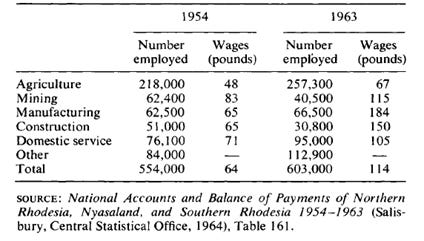
Faber’s 1959 analysis of income disparities estimated the creation of jobs for White immigrants at £1,000 per annum, ten times greater than the 1959 average African wage of £100 per annum.[38]
Bowman reported that[39]:
“The 1958 report of the Plewman Commission (the most comprehensive study ever made of housing, tenure, wages, rents, and administrative controls in urban Rhodesia) reiterated the earlier themes. It revealed that 26.8 percent of single males in Salisbury had wages (and rations) which left them below the poverty datum line, while fully 47.2 percent of Salisbury families were “extremely impoverished” and only 34.5 percent of the African families had incomes within or above the poverty-datum-line limits.” [emphasis added]
A key weapon at the disposal of exploited workers has historically been the complete withdrawal of their labour or passive resistance in the workplace. In 1938, Rhodesian employers in the Umtali district complained of “inefficiency, deliberate slowness, insolence and a changed attitude of lack of respect for the European (on the part of Africans), many of them are not prepared to do a fair month’s work for their pay.” The compound inspector who recorded these management grievances noted that “there is another side to this question, and that is the morality of the employer”, before going on to list employer abuses.[40]
We now come to an analysis of the income disparity between White and Black Rhodesians, which was reported on by Michael Faber in 1960, five years before White Rhodesia unilaterally declared itself independent of Britain, and six years before the African liberation struggle turned into a civil war [41]:
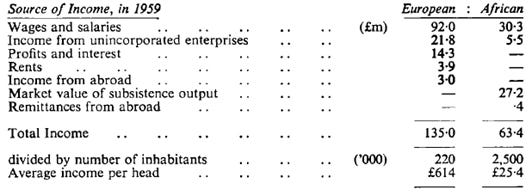
The average annual income per capita of the Southern Rhodesian European in 1959 (at £614) was greater than that of the Southern Rhodesian African (at £25) by a multiple of 24.5.
A 1976 report by the International Commission of Jurists (ICJ) on Racial Discrimination and Repression in Southern Rhodesia recorded the income disparity in 1974 as follows[42]:
“In 1974 there were 927,000 Africans employed in the European areas, representing 88.7% of all employees. They earned R$372,100,000, representing only 41.3% of total earnings. Their average earnings were R$401 a year (or R$33.42 a month) compared with R$4,480 a year for the 118,200 ‘European’ employees (including Asians and coloureds). In the mining and quarrying industry the contrast is even greater. African earnings averaged R$437 a year. European earnings were 14 times greater at R$6,370 a year.” [figures in Rhodesian dollars]
The average European wage in 1974 was thus 11 times greater than the African wage, which was relatively consistent with Faber’s 1959 multiple of ten.
The monthly Poverty Datum Line (PDL) wage in 1974 for the average family was R$73.52 in Salisbury and R$70.04 in Bulawayo, putting the average wage for that year well below the PDL.
We can also see a gaping disparity in the ratio of employed numbers to the total population for each group, at approximately 15% (927,000/6,000,000) and 42% (118,000/277,000) for Africans and Europeans respectively. This disparity explains the even greater chasm in income per capita as illustrated by the 1959 income per capita numbers.
Causes of the income disparity: Land impoverishment, education, immigration and trade unions
With respect to land impoverishment (discussed in detail in Part V of this series), the deeply ingrained attitude infusing Rhodesian government policy was that[43]:
“the African should be born and raised in the Native Reserves and should return there for retirement and death, coming into the ‘European areas’ only to earn his living on a ‘migratory labour’ basis.”
African land impoverishment was the key driver for creating a cheap labour supply, and was therefore a primary cause of the disparity. However, having created the cheap labour supply by squeezing Africans off the land, this land impoverishment was reinforced by barring Africans from admission into the skilled and semi-skilled labour classes, which were protected for Whites.
Discrimination in education became the second most important tool of segregation in cementing the income disparity. This will be dealt with in more detail under the heading Education below, but the education policy is briefly summarised below:[44]
- State schools were rigidly segregated into Black and White.
- Education was compulsory for Whites but not Blacks.
- The Rhodesian government, based on figures available between 1969 and 1975, spent at least 10 times more on the education of a White child than it did on a Black child, although Faber’s 1959 analysis showed that the amount spent per European school child was £26 compared to £1 spent per African school child.
- The African education spend was focused on primary school, and then tapered off severely at the secondary school level, ensuring that a very small proportion of children who finished primary school were actually able to find secondary school places. The emphasis on primary school education was to ensure that Africans were able to function only at the most basic level in the bottom stratum of unskilled labour that was reserved for Blacks.
- The pattern was similar in technical education. The Technical colleges in the two main industrial centres, Salisbury and Bulawayo, simply did not admit African students.
The third critical factor in income disparity was the immigration policy. Faber notes that “the [immigration] policies applied to the two races are not simply different, they are diametrically opposite.” With respect to White immigration, we saw from Part IV that the White population more than tripled in the post-war period, from 69,000 in 1941 to 218,000 in 1960, making it impossible to contest Faber’s assertion that:
“It has been the policy of all Rhodesian governments to increase permanent European settlement as fast as possible, preferably with immigrants from other (white) Commonwealth countries.”
Faber notes that the reason Rhodesian governments gave for this policy was to “speed the economic advance of the territory, but “subconsciously there has always been a strong desire to bolster the European community against the threat posed by African advancement.”
In order to attract European immigrants, the Rhodesian economy offered much higher wages to the White immigrant than they were receiving in their countries of origin. This was made economically possible by far lower wages being paid to the African worker in Rhodesia relative to their working-class counterparts in the countries from which the White immigrant originated. The idea that the higher level of European incomes in Rhodesia represented superior productivity was candidly dismissed by Professor Henry Clay in 1930 in his report to the Legislative Assembly on industrial relations in Southern Rhodesia[45]:
“The individuals who come out from England to double the wages they received in England are no more efficient than they were before they came out, and not obviously less efficient than the other Rhodesians among whom they now find themselves.”
Faber’s articulation of the African immigration policy aligns with the history I have related so far. He observed that:
“There have never been sufficient Southern Rhodesian Africans willing to do all the jobs that white farmers, mining companies, and housewives wanted done. The reactions to this shortage have been of two main kinds. The first has consisted of attempts to induce or force more ‘indigenous’ Africans out of the subsistence economy and into the money economy.’ The second has been an encouragement of the influx of ‘non-indigenous’ African labour particularly from Moçambique and Nyasaland, on a strictly temporary basis.”
We have seen in Part V that in 1905, Southern Rhodesia’s total estimated Black labour requirement was 25,000 labourers, but by 1910, the mines alone were demanding 39,000 and the farmers 23,000. We also saw that a key condition negotiated with Smuts in 1922 for a possible entry into the South African Union was the restriction of movement on Black labour from Rhodesia to South Africa.
This offers a timely segue into Unbekoming’s claim that the cause of the influx of Black migrant labour into Rhodesia was attractive working conditions. In reality, the perennial problem facing the colonial authorities was how to corral the Rhodesian African into horrendous working conditions in mines and on farms. This persistent shortage of labour had to be ameliorated by importing migrant labour from outside the territory to maintain a steady supply of cheap labour.
A peculiar irony of this migrant labour supply was that South Africa, the place more associated with harsh apartheid policies, consistently provided better conditions and pay than Rhodesia. Phimister informs us that[46]:
“By 1937, a concerned [Southern Rhodesian] Government estimated that over twenty-seven thousand Africans, including migrants, who had worked their way through Southern Rhodesia, were ‘clandestinely’ emigrating to South Africa each year… Migration of this magnitude produced a labour shortage which affected the great majority of Southern Rhodesian mines.” [emphasis added]
The Secretary of Mines warned that correcting the wage differential was essential to addressing the “insatiable” labour requirements of the mines on the Rand [South Africa]. However, “few local mines were able to respond significantly to the Secretary’s warning and as a result the labour shortage continued unabated.” This labour shortage persisted until 1953.
In looking at the migration of labour from a region like Nyasaland one has to take into account the relative state of the economies affected. Nyasaland’s economy was so underdeveloped in all respects that by the time of Federation in 1953, it was an embarrassment to the British government. In relative terms, Rhodesia’s economy was far more advanced and, during the post-war boom, a federation that included Nyasaland provided a way of utilising labour there to address shortages in growth areas in Northern and Southern Rhodesia. The idea propagated by Unbekoming that labourers from Nyasaland were flocking to a land of milk and honey is not a mature analysis.
Black Rhodesians’ resistance to entering the settlers’ cash economy and their determination to subsist on shrinking allocations of land forced the settler economy to draw on migrant labour with a view to addressing the shortage and keeping wage levels depressed. This is the genesis of migrant labour into Rhodesia from places like Mozambique and Malawi.
Faber’s summary of the Black and White immigration policy and its effect on income disparities is:
“African immigration policy, through providing the maximum supply, has tended to keep down the equilibrium wage, especially upon the mines and farms. On the other hand there has been a conscious effort to maintain European wages at a high level, specifically so as to increase the flow of white immigrants.” [emphasis added]
From an economic perspective, we can see the African immigration policy of depressed African wages as a subsidy of the European policy to maintain high European wages.
The fourth factor in the gross income disparity was trade union participation and activity. Under the heading Legislative and administrative framework, we have noted the role of the Industrial and Conciliation Acts (ICA) of 1934 and 1959 in creating White-only trade unionism to protect the White worker.
Summary of employment and income factors in producing gross racial income disparities
Segregation was therefore the overarching factor in both the supply and demand of labour insofar as it determined what colour that labour was, its skill level, and its wage level. Trade union legislation and organisation added another layer to segregation of the labour market.
The effect of all these policies was to:
- Increase the supply of unskilled African labour, and restrict the supply of African skilled labour – achieved through: the racial population demographic favouring supply of unskilled labour from Africans; African land impoverishment to squeeze Africans off the land; African educational deprivation relative to Whites.
- Ensuring that European labour remained skilled relative to the African population – achieved through: immigration policy to fill skilled jobs from Europe; superior education spend and policies for European education; creating quantitative and qualitative land inequalities between Europeans and Africans (see section on Land).
Education: A deeper look at the inequalities
There was always consensus in the Southern Rhodesia government on the essential issue of limiting African education. The debate centred on how much education should be given and in what areas education would be most beneficial to serve White interests in a segregated economy. At the core of the debate was the anxiety over the threat to White dominance that increased African education would pose. It is in this context that we can understand the opinion expressed by many employers that the “raw native” was regarded as more honest and dependable than his educated brother.[47]
While there was some sympathy in the 1920s for providing industrial education, resistance from White artisans to African competition nullified any meaningful debate in this direction and, as we have seen, the Industrial Conciliation Act of 1934 was a clear statement of policy in favour of the White worker in this regard. So fearful was the Chief Native Commissioner (CNC) of the educated “mission spoiled” native, that the government gazetted regulations in May 1923 that gave the CNC powers to revoke a mission lease if the missioner promoted “feeling of ill-will or hostility towards the State” or incited Africans to disturb the public peace.[48] The CNC encouraged his subordinates to avail themselves of their right to conduct surprise checks at mission schools to guard against the introduction of subversive propaganda in kraal schools.
No secondary school was set up for Africans until the end of the 1930s. The government argued that it was not prepared to finance education at this level as its “products” could not be absorbed in either Black or White areas.[49]
In Rhodesia, it was not only possible to extract statistics on how much public funding was spent on a Black child versus a White child, but it was normal for the government to do this, because, like everything else in Rhodesian life, education was segregated. It does not take a mathematical genius to realise that in a civilised society, where children of all colours rub shoulders together in school, a statistic for spending by colour of child might be available, but it would yield the same result for all children regardless of ethnicity because the money is poured into the whole school system. If the kids are spread relatively evenly throughout the system, the statistic is rendered meaningless. Rhodesia was not a civilised entity.
The education policy was geared towards educating the African “only to the level where they will be able to serve the labour needs of the white minority without threatening the privileges of the white skilled and semi-skilled classes, and without enabling the Africans to qualify for the electoral register in numbers which would threaten the whites politically.”[50]
I have noted above that education was compulsory for White children but not for Africans. Looking at educational apartheid in more detail, the International Commission of Jurists reported in 1976 that[51]:
“The public [state] schools are totally segregated. Members of another race are not even permitted to enter these school grounds for sports events.”
Private schools in European areas admitted a small quota of African students. The total number in 1972 was 400, and there were complaints that church-run schools had exceeded the 6% quota.
In 1975, Rhodesian government statistics showed that “the amount spent on the education of each African child [was] less than one-twelfth of that spent on his ‘European’ counterpart”[52]:
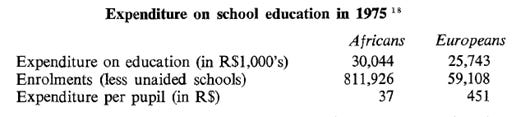
All African schooling was fee-paying, and failure to pay the fee resulted in children not being able to go to school. By contrast, non-payment of fees did not prevent a European child from attending school.
As outlined earlier, African education spend was focused on primary school, and it tapered off severely at the secondary school level, thus ensuring that the skilled economy remained White. Below, we can see this dramatic tapering off between primary and secondary enrolment figures for 1975[53]:
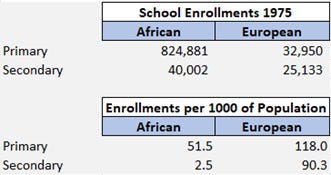
Mutiti, writing in 1965 noted that “in forty years of African education in Rhodesia only 10,000 have attained ‘O level’ [GCE equivalent] education [250 per year].”
Unbekoming’s claim in defence of colonial Rhodesia attributes the education disparity to a “reluctance” on the part of the African children. Not long after Zimbabwean independence in 1980, the new government’s policies began reaping dramatic improvements, with Zimbabwe achieving one of the best literacy rates in Africa within 10-15 years, an achievement that eluded successive White Rhodesian governments for 90 years. In response to this post-independence success story, Unbekoming shamelessly repeated Ian Smith’s (former Rhodesian premier) brazen attempt to take credit for this, stating that: “Smith emphasized that the “tremendous impetus to education” after 1980 was only possible “because of the foundation and infrastructure they inherited” from the white government.”
As I think about the chutzpah it takes to behave in the way Smith did, one of the goals I have committed to achieving with these articles is to coin a widely accepted new definition of the adjective Rhodesian:
– Rhodesian
– Adjective
– displaying the ability to combine psychopathic levels of deviousness, vacuousness, victim-blaming, and brazenness in a single act; to be incapable of seeing the wood for the trees at all times and in all situations.
– Examples: “Starmer’s denial of knowledge about Mandelson’s involvement with Epstein was Rhodesian.”
– “Lammy had sunk to Rhodesian levels in his insistence that eliminating trial-by-jury would serve British justice.”
Smith had forgotten that he told the Rhodesian electorate in 1965 that: “It was not Rhodesia’s policy to educate her people for the purpose of assisting them to vote.”[54]
Before independence in 1980, Smith was accustomed to blaming the lag in African education on the pupils, who were in his Rhodesian opinion “reluctant participants”. The reality is that Africans understood how important education was, and why White Rhodesia was rationing its delivery to them. Quoting from the 1975 work titled Education Race and Employment in Rhodesia, the International Commission of Jurists (ICJ) noted[55]:
“With the expansion of European settlement and influence it became apparent to the African people that education was the only medium through which the younger generation would be able to understand and cope with the new society that had been introduced to the country. Education provided the main avenue to European type occupations and ways of living which became increasingly valued among the African people as traditional conceptions of social status were replaced by criteria of occupation, education and the extent to which one had adopted European patterns of living. The African expected education to enable him to obtain a job in the European community and to enjoy a standard of living different from that of his father. Any education which did not purport to do so was viewed with dismay and a suspicion that he was being purposely consigned to an inferior status. Even the government, when it began its first school for Africans in 1920 and 1922, specifically to give Africans industrial and agricultural training (which they felt was lacking in mission education), found they had to give in to African student demands for increases in academic instruction.”
One of the attributes that made Robert Mugabe so popular at the polls in the 1980 elections was the seven university degrees he had acquired while languishing as a guest in Smith’s prisons, which were notorious for the disproportionate amounts of space they reserved for Black political activists who were demanding “an excess of democracy” in Rhodesia. They associated his confidence and poise with something they were hungry for, and had associated with opportunity in employment – education. Many of Zimbabwe’s liberation fighters took to the bush because they had been denied it.
The book referenced by the ICJ summarised the European attitudes to African education which aligned with policies enacted by successive governments:
“A very few Europeans believed that it was in the best interests of the country and everyone in it to reduce the social and economic gap between the races but the majority preferred a type of education which would inculcate a bare literacy ‘without breeding inconvenient ambitions’, thus ensuring them a mass of unskilled labour to form the basis of their pyramid.”
Surprisingly, the picture was somewhat different at the University of Rhodesia, where, in 1972, the total of 978 students comprised 510 Europeans, 400 Africans (41% of the total) and 68 ‘other races’. In 1975, there were 652 African students out of a total of 1,895 (34% of the total). However, the picture changes when we add the large number of White Rhodesians – 1,908 in 1972 – receiving government assistance to study at South African White universities. The percentage of Africans going through the University system then drops to 14%, despite making up 95% of the population.
The ICJ report noted that “50% of qualified white school-leavers receive state-aided university education, one of the highest figures in the world. The privileged position of the white students is thus maintained”, particularly when one takes into account the lack of employment opportunities for the Black graduate.[56]
Another factor contributing to the increasing number of places available to Africans at the University of Rhodesia was the escalation of the bush war from 1972. In order to avoid the draft, an increasing number of White students completing secondary education opted to leave the country.
Conclusion
Racial disparities in employment, income, and education were structurally embedded through legislation and policies that had their genesis in the colonial structures put in place from the 1890s. As we will see in Part VII, these disparities formed the basis for exclusion from democratic participation in voting, which was the final nail in the coffin of African political and economic advancement in colonial Rhodesia.
In Part VII, we will deconstruct this final nail in the coffin of African advancement in colonial Rhodesia – the so-called merit-based voting franchise. The system had an uncanny knack of granting merit to White voters while de-meriting virtually the entire Black population.
If you liked this article but don’t want to commit to a paid subscription, please consider rewarding my writing using the BuyMeACoffee link below. Thank you!
[1] Victor Machingaidze, Company Rule and Agricultural Development: The Case Of The BSA Company in Southern Rhodesia, 1908-1923: https://sas-space.sas.ac.uk/4075/1/Victor_Machingaidze_-_Company_rule_and_agricultural_development%2C_the_case_of_the_BSA_company_in_southern_Rhodesia%2C_1908-1923.pdf
[2] Arthur Keppel-Jones, Rhodes and Rhodesia: The White Conquest of Zimbabwe 1884-1902, Kingston and Montreal, McGill-Queens University Press, 1983, Ch. 9, pg. 377.
[3] Ibid., Ch. 9, pg. 379.
[4] Ibid., Ch. 9, pg. 378.
[5] Ibid., Ch. 9, pg. 378.
[6] Ibid., Ch. 13, pg. 533.
[7] Ibid., Ch. 14, pg. 553.
[8] Ibid., Ch. 14, pg. 553.
[9] Robert Blake, A History of Rhodesia, Eyre Methuen Ltd, London, 1977, Ch. 11, pg. 159
[10] https://www.nytimes.com/1961/01/22/archives/rhodesia-considers-morals-law-change.html
[11] Blake, op. cit., Ch. 11, pg. 156
[12] Keppel-Jones, op. cit., Ch. 13, pg. 535.
[13] Alois Mlambo, Racism in Colonial Zimbabwe, Springer Singapore, 2019: https://doi.org/10.1007/978-981-13-2898-5_28
[14] Alois S. Mlambo, A History of Zimbabwe, New York, Cambridge University Press, 2014, Ch. 4, pg. 70.
[15] I.R. Phimister, African Worker Consciousness: Origins and Aspects to 1953, 1976: https://sahistory.org.za/sites/default/files/archive-files/LaJul76.0377.5429.003.001.Jul1976.5.pdf
[16] Ibid.
[17] Keppel-Jones, op. cit., Ch. 15, pg. 613.
[18] Keppel-Jones, op. cit., Ch. 15, pg. 616.
[19] I.R. Phimister, op. cit.
[20] International Commission of Jurists, Racial Discrimination and Repression in Southern Rhodesia: https://www.icj.org/wp-content/uploads/1976/01/Southern-Rhodesia-Racial-discrimination-and-repression-report-1976-eng.pdf
[21] I.R. Phimister, op. cit.
[22] Keppel-Jones, op. cit., Ch. 15, pg. 617.
[23] Blake, op. cit., Ch. 11, pg. 163.
[24] Alois Mlambo, Racism in Colonial Zimbabwe, Springer Singapore, 2019: https://doi.org/10.1007/978-981-13-2898-5_28
[25] Ibid.
[26] International Commission of Jurists, op. cit.
[27] Michael Faber, The Distribution of Income between Racial Groups in Southern Rhodesia, Sage Publications, April 1960: https://journals.sagepub.com/doi/10.1177/030639686000200205
[28] Ibid.
[29] International Commission of Jurists, op. cit.
[30] International Commission of Jurists, op. cit.
[31] International Commission of Jurists, op. cit.
[32] Report of the Commission appointed to enquire into the matter of Native Education in all its bearings in the Colony of Southern Rhodesia, 1925
[33] Colin Leys, European Politics in Southern Rhodesia, Oxford University Press, 1959, Pg. 82.
[34] Ibid.
[35] Leys, op. cit., Pg. 294.
[36] International Labour Review, Vol.22(3), pp 358-363, 1930, Report on Industrial Relations and Wages in Southern Rhodesia: https://s3.eu-central-1.amazonaws.com/eu-st01.ext.exlibrisgroup.com/41ILO_INST/storage/alma/FC/12/42/C3/EB/DB/66/3A/22/EA/CB/43/F7/2A/88/6E/09602%281930-22-3%29358-363.pdf
[37] Larry W. Bowman, Politics in Rhodesia: White Power in an African State, Harvard University Press, Cambridge Massachusetts, 1973, Ch.3, Pg. 48.
[38] Faber, op. cit.
[39] Bowman, op. cit., Ch.3, Pg. 48.
[40] Phimister, op. cit.
[41] Faber, op. cit.
[42] International Commission of Jurists, op. cit.
[43] Faber, op. cit.
[44] Faber, op. cit.
[45] Leys, op. cit., Pg. 281.
[46] Phimister, op. cit.
[47] Murray Cairns Steele, The Foundations of a “Native” Policy”: Southern Rhodesia, 1923-1933, Simon Fraser University, 1972, Pg. 331
[48] Ibid., Pg. 333
[49] Ibid., Pg. 339
[50] International Commission of Jurists, op. cit.
[51] International Commission of Jurists, op. cit.
[52] International Commission of Jurists, op. cit.
[53] International Commission of Jurists, op. cit.
[54] Aaron Benjamin Mutiti, Rhodesia and Her Four Discriminatory Constitutions: https://journals.co.za/doi/pdf/10.10520/AJA00020117_159
[55] International Commission of Jurists, op. cit.
[56] International Commission of Jurists, op. cit.
Comments are closed.