
Blowing the Whistle on the Rhodesian Dog Whistle: Part VIII – The ‘Great Betrayal’ and Other Red Herrings

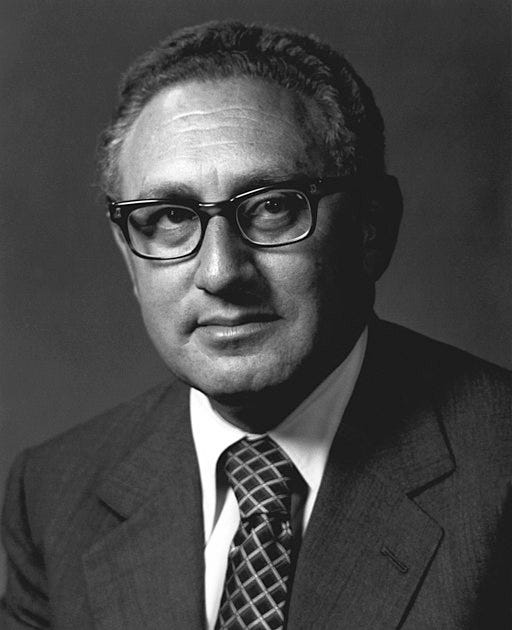
“We don’t give a damn about Rhodesia.” – Henry Kissinger, 1976

Originally published on A Plague on Both Houses substack.
This essay begins with a quote from Father Mukonori, Robert Mugabe’s go-between on the international stage in the lead-up to independence in 1980. While the betrayal myth has its true origins in weakness of character, the quote helps to explain why White Rhodesians who have never reconciled themselves to the truth of the causes of the war found it so easy to wear the betrayal mantle[1]:
“Despite the war having been fought, the whites were never told the truth about its causes. They did not ask the right questions and nobody gave them the right answers. They had no interest in knowing. They were told it was a fight against Marxist communists and terrorists in order to safeguard Western Christian civilization. That’s what they believed. Nobody told them that their ancestors had grabbed the land and killed people in the process. Their psychological backwardness and lack of factual knowledge were a major part of the problems that gave rise to the war and that later arose to torment them again more recently over control of the land. But they never learnt. They thought all their rights and supremacy came with the colour of their skin.”
In Parts I to VII of these essays, I have attempted to provide reasonably robust evidence for what colonial Rhodesia actually did to the indigenous population it encountered between 1888 and 1980.
Here is a recap:
- using written legal contracts couched in the turgid language of the Inns of Court, it deceived a people with no written language;
- it refused to acknowledge repudiation of those contracts when the people realised they were deceived;
- it forcefully occupied territory on the basis of a ‘Royal Charter’, to which the people being occupied were not signatories, and that relied on a repudiated agreement;
- the basis for occupation was ultra vires even under the colonial legalism concocted to legitimise Natural Law violations involving occupation and conquest;
- it conquered Matabeleland by war;
- it violently suppressed uprisings against the occupation across the whole territory;
- it passed legislation to divide the country into ‘European’ areas and ‘African’ areas, taking the best arable land for White settlers, and removed the indigenous people to “reserves”, later restyled as “tribal trust lands”;
- it implemented pass laws to regulate the movement of the Black population in order to regulate a cheap labour supply, treating the African population as a ready-made proletariat for the settler mining and farming industries;
- it passed constitutions in which only the White settler population had a say;
- it kept the indigenous population at levels of education and income designed to exclude Black participation in a cynically constructed “merit-based voting system”;
- it banned African political parties as soon as they began agitating for a universal franchise and for reforms against discrimination;
- when Britain pressured it to accept an independence settlement based on a universal franchise that would lead to majority rule, it unilaterally declared itself independent in order to maintain a Constitution that entrenched White minority rule, and;
- it imprisoned, assassinated and deported its political opponents and fought a civil war against African nationalists, costing the country over 30,000 mostly Black lives.
Having undertaken a detailed deconstruction of the four main claims made by Unbekoming, I hope that enough evidence has been provided to show that Rhodesia was a racially segregated society, constructed to prioritise the economic interests and political domination of a White minority settler population established in the occupation and conquest of Zimbabwe in the last decade of the 19th century.
With this final essay, I hope to achieve two further objectives:
First, I will deconstruct the ‘betrayal’ myth, which is central to the defence of colonial Rhodesia now being propagated online. Exposing this particular aspect of the Rhodesia Myth sheds light on a pivotal moment in the country’s history – the settlers’ last stand with an illegal Unilateral Declaration of Independence (UDI). It also sheds light on the character of the person responsible for the origin of the myth – Rhodesia’s former Prime Minister Ian Smith – and indeed those who perpetuate it. When an immoral project finally collapses under the weight of its own depravity, it is common for those who supported it to fall back on the crutch of blame, as opposed to growth through self-examination.
Second, I hope to use this essay as an opportunity to zoom out and try to capture Rhodesia in a nutshell. I’ll try to answer questions about why its White minority clung on so desperately in the face of mounting pressure towards what seemed like the inevitability of majority rule, and a universal franchise. What made them so bloody-minded? Part of the answer lies in the fact that to the settlers, majority rule did not seem so inevitable, but the question is why?
The structure of this essay is therefore:
- Deconstructing the myth of the ‘great betrayal’.
- When Rhodesians do blame, they do it properly, so we will examine what I call the ‘betrayal within the betrayal’ – the claim that Britain covertly supported the guerilla movement that opposed and fought White minority rule. Examining both of these hypothetical betrayals provides fertile ground for understanding a little about White Rhodesian politics and a change in geopolitical realities that a narrow-minded and mediocre politician serving White parochial interests failed to grasp.
- Summarising Rhodesia in a nutshell – the ideology at the heart of this racist political project. Understanding the colonial capitalist pyramid, which in turn helps to appreciate the undeniable fact of a racialised economy and society, and why race demographics was always at the centre of White Rhodesian policy.
A brief tangent first: What about ‘I told you so’?
Before we get stuck in to the main menu, a brief note on why I refuse to engage with the I-told-you-so arguments attached to the defence of colonial Rhodesia. In the Introduction to the Introduction, I touched briefly on the moral and intellectual bankruptcy of using Zimbabwe’s present predicament as a vindication of White Rhodesia’s determination to maintain White minority rule.
The primary objections to this argument are based on Natural Law and elementary logic. It’s not tenable to argue that it is just for a man to steal a car because he feels he can make better use of the car than its rightful owner. If the rightful owner succeeds in repossessing his car, it is patently absurd for the thief to try to justify his criminality on the basis that the owner, having repossessed the car, fails to treat it in a way the thief approves of.
This analogy does not imply that I believe White Rhodesians were not entitled to a say in Zimbabwe after 1980. They were, and obviously are, entitled to participate in the nation, provided they became White Zimbabweans, and they would had to have accepted that their voice and power would be diluted in accordance with the way in which civilised democracies are supposed to work. But ex-Rhodesians still dreaming of a Rhodesia that should never have been, and bleating “I told you so” from the sidelines in Canada and Australia, should just shut up and be grateful that they found what they were looking for – colonies that succeeded where Rhodesia had failed by solving the ‘indigenous problem’ (more of which later). If they’re living in the US, they must be absolutely delighted with ICE fascism. They should enjoy it while they can because that same fascist police state will eventually be treating them as domestic terrorists.
So, I have absolutely no obligation in these articles to engage in a defence of Zimbabwe’s record after 1980 because this rebuttal is a proof of the crimes that took place before 1980 – crimes under colonial Rhodesia that Unbekoming defends. And it is both intellectually and morally bankrupt to defend a crime based on how the victim lives their life after restitution is made. We must be able to condemn the crime of colonialism, and separate it from how the victim has lived subsequently.
In short, Zimbabwe’s post-colonial record is a straw man erected to justify the execrable attempt to present colonial Rhodesia as a Good Thing. I could choose to make excuses for Zimbabwe’s record, but that would end up being a fool’s errand on too many fronts, even if I could cite mitigating factors, one of them being the legacy of colonialism itself, and another being its continuation in a new guise! But that would be very different to defending Zimbabwe’s record, because that is about understanding as opposed to condoning. But I do not wish to do that either, because that approach involves placing Zimbabwe in the role of victim, and that is equally distasteful to me. I am of the view that there is no way Smith could make excuses for the mess he got the country into by blaming others, so I can’t exactly offer blame as a get-out-of-jail card for Zimbabwe. That would be a contradiction, would it not?
What I am prepared to say about post-independence Zimbabwe is that revolutionaries face two key inter-linked problems in fighting a struggle to regain both their dignity and what was stolen from them. The first problem – one that is peculiar to uprooted traditional societies – is that you cannot go back to where you were before the brigands arrived. And in some respects, going back is not desirable. So the challenge is to find the balance between the best of modernism, and the best of traditional societies before they were rudely interrupted. But here’s the thing: that problem today actually applies to the entire planet!
The second problem flows from the first – the revolutionary very rarely has time during the struggle to formulate a clear vision of what society should look like when they have won the war. I call it the ‘then what?’ problem. You win the war and ‘then what’? And if revolutionaries do not have a clear vision and a clear programme of action to address this, the immoral idiots who oppressed them turn around and say, “I told you so.” And as immorally and intellectually bankrupt as that is, it appeals to people hard of thinking. Zimbabweans did not have an answer to the ‘then what’ problem.
As far as I can tell, the only group of people who understand the imperative of addressing the ‘then what’ problem is a small clique of psychopaths who have stolen most of the world’s financial resources and are now implementing Grand Theft World via a techno-fascist prison for us all – the Owners and Controllers of Global Financial Capital. Naturally I want to see Zimbabwe prosper, but the question that I believe lies on the horizon is: will ‘prospering’ entail surrendering, again, to the colonising force? The implication being that such a ‘prospering’ will not be long-term by nature. If that’s a valid fear, then real victory in Zimbabwe means real victory everywhere. If the colonising force is the ultimate enemy – and it is – then we either all get out of this mess together, or we all sink together.
I plan to talk more about the ‘then what’ problem in the not-too-distant future, because it is the major stumbling block to a people’s revolution in the West, and indeed everywhere.
The great non-betrayal
The root of the ‘betrayal’ myth is the break-up in 1963 of the Federation of Rhodesia and Nyasaland, or the Central African Federation (CAF), comprising three colonial entities at the time – Southern Rhodesia, Northern Rhodesia (now Zambia), and Nyasaland (now Malawi).
Unbekoming begins his explanation of the Federation with an error, claiming that “Rhodesians had been given the choice to either join a union with South Africa or form this federation, and the British “strongly suggested” the latter option.” It now seems petty to begin by correcting that error given that his whole piece is a dog’s breakfast from start to finish, but let’s do it anyway.
Unbekoming appears to have confused events in 1922 with those in 1953. The Rhodesians were not, and could not have been, given a choice in 1953 to join a union with South Africa, as South Africa became a fully sovereign nation state in 1934. Rhodesians were given that choice in 1922 when they were still under Company rule, and when South Africa was a self-governing dominion. They rejected the union option in 1922, not 1953, in favour of Responsible Government and were formally annexed by the Crown as a colony.
It was in fact the defeat of General Smuts in 1948 at the hands of the Afrikaner Nationalists led by Dr Malan that served as a primary driver of Federation, and was intended to act as a counterpoint to Afrikaner nationalism.
At any rate, Unbekoming’s explanation of why things between Southern Rhodesia (SR) and the British Government turned sour is as follows:
“This political project lasted only ten years before dissolving, with blame placed on the British who “went back on their promises” by allowing Northern Rhodesia and Nyasaland to obtain their independence while denying Southern Rhodesia the same right. The dissolution conference became a pivotal moment where Deputy Prime Minister Rab Butler made promises to Southern Rhodesia about independence that were subsequently betrayed, setting the stage for the later unilateral declaration of independence…. Instead of granting independence as promised, the British “simply turned around” and demanded that Southern Rhodesia must be governed by its majority African population. This reversal is portrayed as a fundamental betrayal that forced Rhodesia into an impossible position.”
The 1961 Constitution, along with its so-called “merit-based” voting franchise that effectively guaranteed indefinite White domination, was at the centre of the negotiations of the terms of independence, and so the fundamental unfairness of the 1961 Constitutional franchise to Black voters must first be understood from a reading of Part VII.
Additionally, before getting to the so-called ‘betrayal’ at the Federation dissolution conference, I will provide some background into why Rhodesians believed they were so special that they could insist on terms of independence that were very different to those offered to other countries in the region, and why they then believed they could defy the imperial government by unilaterally declaring independence. This is also key to understanding the dynamics between the SR government and the British government. To simply state the other two colonies were granted independence and SR wasn’t is a vacuous statement.
The other two colonies were rightly granted independence under a universal franchise (the consequence of which was majority rule), while SR rejected a universal franchise because it would in all likelihood lead to the dissolution of White minority rule. We need to understand why White Rhodesians thought they were entitled to something they weren’t.
The peculiarity of Rhodesian settler power in relation to the imperial authority has its roots in the founding of the colony by the BSA Company. The insertion of the Company in between the Colonial Office and the settlers led, from the outset, to the metropole’s consistent refusal to assert its authority, which in turn created a vacuum that the settlers quickly filled. By 1903, the settlers had already gained parity in seats on the Legislative Council and by 1907, they had a majority.
Despite being annexed as a colony under Responsible Government in 1923, the settlers consolidated their power even further. This is explained well by Blake as follows[2]:
“From the very beginning the Legislative Assembly [in Rhodesia] behaved, and was treated by the UK Government, as the competent body to pass laws for the whole population, not simply for the minority who had the vote. The Parliament at Westminster never exercised its right to legislate, nor did the British Government use its power to issue orders-in-council or proclamations, even in areas from which the Southern Rhodesian Assembly was excluded from legislating. If it was deemed desirable to encroach on those areas, the procedure was to amend the Letters Patent so that the Legislative Assembly could pass an acceptable local measure. The British Government could, of course, block anything that it did not consider ‘acceptable’, and the fact that it never used its power to disallow laws enacted in Salisbury did not mean that Salisbury could get away with anything. The power was not used because it became the custom for the Southern Rhodesian Government to submit measures to Whitehall before introducing them in the Assembly and to drop them or amend them if the UK Government objected.
The important point was that the initiative always originated from Southern Rhodesia, and a convention, so strong and so important that it came to be known as ‘The Convention’, was established, under which the British Parliament never legislated for Southern Rhodesia except by agreement with, or at the request of the Southern Rhodesian Government. The existence of this convention was one of several features which made Southern Rhodesia’s status far closer to that of a self-governing Dominion”. [emphasis added]
Although the British Government had the right to legislate for Southern Rhodesia, and thus bring it to heel if it chose to, “[p]ractically… it was certain that no government, Conservative or Labour, would try to legislate for Southern Rhodesia unless asked to do so by the Southern Rhodesian Government.”[3]
Blake makes the point about ‘The Convention’ in order to forcefully dismiss what he terms as “more ridiculous canards” that were put about by the Smith regime in the run-up to its Unilateral Declaration of Independence in 1965 – namely that Harold Wilson’s government intended to pass an Act of Parliament imposing majority rule on Southern Rhodesia. That this could have happened was inconceivable under The Convention, which had hardened over the years since 1923. Blake politely sums up the integrity of the Smith regime: “The credulity of those who believed the story is only matched by the disingenuousness of those who spread it.”
But Rhodesians were also congenitally paranoid. The political evolution of the colony from Company administration, with an emphasis on shareholder value, to Responsible Government, had contributed to a sense of victimhood. They regarded the Company with suspicion and wrangled successfully with its directors to achieve majority settler representation in the Legislative Council by 1907. But neither did they believe their salvation lay with the metropole. Their eye was always on Dominion status and full sovereignty. The settlers were convinced that they “were merely pawns in a bigger game, pawns that the players would not hesitate to sacrifice.”[4] And they were right. But the settlers were not innocent pawns. The ceaseless and contemptible whining over a ‘betrayal’ for which Rhodesians deserve no pity is in fact proof of the fallacy of the aphorism that there is honour among thieves. There really is no honour among thieves.
As early as September 1896, the settler’s mouthpiece – Rhodesia Herald – believed they had the measure of their political masters when they declared[5]:
“We are asking ourselves whether we are not in precisely the same position as the American colonies, and whether Mr Rhodes and his capitalistic and official allies are not merely a new version of the crushing oligarchy that blundered and bullied under the sceptre of George the Third.”
Thus, as early as 1896, the Rhodesian Unilateral Declaration of Independence had been foreshadowed by a dreamy and paranoid band of colonial brigands endowed with a sense of self-importance that far outweighed their true talents and abilities, but which had nevertheless been fortified by a heady cocktail of bloody conquest and survival in a spartan outpost, against all the odds. If ever there was a perfect recipe for creating a bunch of detestable paranoid jingoes, Rhodesia was it.
Blake characterised the hubris of Rhodesians by referring to what he termed the Victorian Chancellor’s Dictum – “‘We can never govern from Downing Street any part of [Southern] Africa in which the whites are strong enough to defend themselves.”[6] They were not strong enough in 1896 when they needed Imperial reinforcements to save them from the Ndebele and Mashona uprisings, but their confidence had grown since then, and with it, the appetite for more independence. This confidence would turn to conceit in 1965, and ultimately capitulation in 1979.
The Establishment line in 1922 was for Rhodesia to be incorporated into the Union of South Africa, and it is no coincidence that those who were on the winning side of the vote for Responsible Government in 1922 were more inclined to be anti-establishment. Another factor playing into the rejection of union with South Africa in 1922 had been the Rhodesian fear of an alien people – the Afrikaner. They feared “poor Whites who nearly all were Afrikaners migrating [from South Africa] to the north [Rhodesia] and undercutting the standards of living of English-speaking artisans, and railway workers.” And they disliked the South African bilingualism which would have had to have been accepted if Rhodesia had become a province of South Africa. Loyalty to Britain won the day.[7]
An interesting aside to this chapter of Rhodesian history is that its incorporation into the South African Union had become part of a grand vision of the South African Prime Minister, Jan Smuts, who dreamt of a greater South Africa ‘with borders far flung into the heart of the continent’. The incorporation of Rhodesia was to be the first bold step in this grandiose plan, and the Rhodesian settlers’ thwarting of it in 1922 is perhaps the only thing for which Zimbabweans can thank them. As Smuts bitterly noted: “I get scores of letters from all sorts of people who say that it is indeed a paradox that Rhodes’ country should have stood in the way of Rhodes’ ideal being accomplished.”[8]
Very similar social and emotional forces produced the settler Unilateral Declaration of Independence in 1965. In 1965, as in 1922, there was a revolt against the establishment – the people who had for so many years been ruling the country. In 1962, when Edgar Whitehead’s government began merely signalling an end to racial discrimination, the newly formed reactionary Rhodesian Front (RF), capitalising on White Rhodesian fears, offered continuity of White minority rule. The RF won.
In 1965, as in 1922, there was racialism at play. In 1922 it was fear of the Afrikaner. In 1965, it was fear of African advancement that threatened the security and standards of the white artisans. In an ironically poetic volte face, “the same forces which in 1922 propelled a majority of white Rhodesians to proclaim their loyalty to a Britain still believed to be on the side of the settlers, forty-three years later propelled them into breaking with a Britain which palpably was not.”[9]
In November 1963, the UK Government declared that it accepted “the principle that the majority should rule” in Southern Rhodesia, and the opposition Labour Party reiterated this principle by stating that it would not agree to Southern Rhodesian independence “except on the basis of democratic majority rule in that country.” By this, they meant that Britain had agreed that all the people in Rhodesia should enjoy the rights that British citizens had in respect of voting – universal suffrage.[10] Britain was merely insisting that the terms of independence granted to the country had to be “acceptable to the people of the country as a whole”.
This is crucial to understanding the so-called ‘betrayal’. Whatever you may think of Britain’s role in the world as a colonising empire up to that point, and whatever theories you may care to advance for its motivation in granting colonies independence on these terms, these were proposals which no sane person would gainsay. These were the conditions which, in theory, were in operation in all Western democracies.
In February 1964, the Southern Rhodesian (SR) government rejected these terms as “extravagant”, and declared that it would cease discussions with the UK Government. A five-point plan was proposed by the British government. Points 1 – 4 involved steps that would increase African involvement in political participation such as widening the franchise and including Africans in government, as well as ending racial discrimination, which would involve among other things, repealing the Land Apportionment Act. The fifth step crucially involved granting independence on terms acceptable to the country as a whole, which meant getting agreement from representatives of the African majority as to what independence would look like.[11]
Unreconstructed Rhodesians and their sympathisers claim that Rhodesia had been promised independence during the Federation dissolution conference held in June-July 1963. It is true that Britain sorely needed SR’s attendance at the conference in order to dissolve the Federation and grant independence to Northern Rhodesia (Zambia) and Nyasaland (Malawi). The RF government of SR therefore considered using its needed attendance as leverage to secure, in advance, a promise from Britain to grant independence on the terms of the 1961 Constitution and unfair franchise. It relinquished this plan and attended anyway, but the claim propagated by Smith, and perpetuated by Rhodesian sympathisers, is that the guarantee was obtained verbally during the conference itself.
Ian Smith claimed that Rab Butler, the British Government’s First Secretary of State with responsibility for overseeing the dissolution of the Federation, gave an undertaking to grant Southern Rhodesia its independence on successful conclusion of the Dissolution Conference. He further claimed that Britain reneged on this promise, and that the RF was therefore justified in declaring UDI. Butler emphatically denied this and no one else on the British side or the Rhodesian civil servants involved recall such a pledge.[12] Blake offers compelling arguments as to why Smith, and his PM Field, were not necessarily lying, but that they misunderstood the discussions which took place. In other words, Blake wishes to be kind to the Rhodesians and give them the benefit of the doubt. Now, if I thought Blake’s slightly more generous interpretation of a communication breakdown was relevant to understanding the fundamental issue, I would elaborate on it. Thankfully there is no need to.
It will come as no surprise to readers that my personal view of Smith is that he was as trustworthy as a wet bar of soap, and I will provide evidence of his treacherous tendencies in due course. That said, the fact remains that if Smith and his representatives failed to obtain a guarantee that could be independently verified as ironclad, it is politically immature and irresponsible to insist that one was given. Important claims require proof, and if you fail to obtain the proof, you are not entitled to cry foul since your failure to obtain the proof is evidence of incompetence. Crying foul only draws attention to one’s incompetence and immaturity, which in turn raises questions about honesty and integrity.
What is crucial to understanding whether Rhodesians were betrayed is to understand what they were asking for in the first place. If I ask you to steal for me and you say No, am I entitled to claim later that you ‘betrayed’ me? The sole focus for people who are concerned with the moral rectitude of the parties involved must be directed towards a straightforward question – which party acted more honourably? Was it the British government who insisted on settlement terms that were acceptable to the country as a whole, and which also included increased African participation and the roll-back of racial discrimination, or Smith for rejecting those terms? As any fool can see, to ask the question is to answer it.
The simple fact of the matter is that, whether or not Butler made a promise of independence to Smith and Field is a deliberate obfuscation of the real issue, and therefore a complete red herring.
The issue is not independence per se, since that was always on the cards. It is: on what terms would independence be granted. Rhodesians cited the independence granted to the other Federation members (Zambia and Malawi) as proof that Rhodesia had been unfairly treated. But those countries were granted independence precisely because they were able to transition on the basis of a vote under universal suffrage, whereas the Rhodesian Front regime in SR was rejecting these conditions. The RF wanted independence under the terms of the 1961 Constitution and franchise since White Rhodesians understood that they would be voted out of power under universal suffrage.
Rhodesians were therefore seeking an ‘independence’ that excluded the 95% Black majority and ensured that a White minority electorate would continue to elect White governments in perpetuity. The adding of “in perpetuity” is not an exaggeration. We saw in Part VII the repeated statements Smith made in relation to the goal of permanently stalling majority rule, and I will outline later why this was always a strategy of the White Rhodesian minority.
A recorded conversation between the British PM, Harold Wilson, and the Rhodesian PM, Ian Smith, on the eve of UDI, provides indisputable evidence of the British government position. Wilson stressed the point at least four times, at one point saying that the continuation of the 1961 Constitution had not been ruled out, “but it would not be a basis for independence.”[13] Wilson tried to do a deal with Smith in which a Royal Commission, after it had tested African opinion, would determine whether the 1961 Constitution was acceptable to the people as a whole. If the Commission found against the 1961 Constitution, Smith would have to drop his insistence on independence on the terms of that Constitution. The RF took the path of UDI because it was understood that the likelihood of the commission endorsing independence on terms that promoted the continuation of White minority rule were slim to nil.
In adopting the most aggressive strategy of taking independence on their own terms, the RF was simply adhering to a colonial stratagem that had served settler interests since 1890. The narrowly defined ‘independence’ of a White minority seeking to maintain dominance would be taken without negotiation on the basis that possession is nine-tenths of the law.
The narrative of a ‘betrayal’ is a Rhodesian propaganda canard to divert attention from this simple truth, to which we must add that people who behave this way will always blame anyone else except themselves for failure. Even if the British government had in fact offered independence to Rhodesia on terms that would have been satisfactory to the RF alone, a withdrawal from that position, far from being a ‘betrayal’, would redound to the British government’s credit! The fact remains that when serious talks began, the terms on which both Britain and Rhodesian Africans insisted represented the only morally defensible terms on which to proceed, and these were rejected by the RF and the majority of White Rhodesians.
The intransigence of this reactionary element must be seen in the light of a sense of entitlement authored by the British government, first through laissez-faire Company rule, and then through laissez-faire ‘Responsible Government’ since 1923. It was this bloody-minded intransigence nurtured by a sense of entitlement that drove the country into a 14-year bush war costing thousands of lives.
The ‘betrayal’ myth also serves to mask the perversity of the White Rhodesian position. It is an inversion of the truth, which is that White Rhodesians sought to betray Black Rhodesians by denying them independence on the basis of a universal franchise, which is how other African colonies were rightly setting sail on Macmillan’s Winds of Change.
UDI was also a foreign policy power play informed by regional considerations in maintaining White rule. Despite having been granted a new Constitution in 1961, SR remained a colony under White minority rule. It did not have the freedom to operate its own foreign policy, which White Rhodesians saw as crucial to its survival in Southern and Central Africa. Surrounded by the spectre of African nationalism, White Rhodesia was anxious to forge ties with South Africa and Portugal, the latter having colonies in Angola and Mozambique. This is not something that Britain would have readily acquiesced to.
And, notwithstanding the operation of The Convention, Britain still retained the formal legal right to interfere in Rhodesia’s internal affairs.[14] Buoyed by the success of the reactionary Rhodesian Front in the 1962 elections, UDI was now firmly on the cards. If the Queen was not going to grant White Rhodesia minority rule in perpetuity – the RF’s version of ‘independence’ – it would have to take it without Her Majesty’s permission.
In 1965, the settlers, led by Smith’s Rhodesian Front party, attempted to emulate American independence by re-enacting a second-rate tawdry version of that play. Confusingly, the Rhodesia Front’s proclamation, “couched in slightly absurd archaic language intended to echo the American Declaration of 1776”, betrayed a discomfort with breaking the umbilical cord by signing off with “God Save the Queen”. If I’ve said it once, I’ve said it a thousand times – Rhodesians were, and are, the masters of self-contradiction.
Nevertheless, the peculiar brand of Rhodesian obstinacy was foretold in the spilling of blood in the Matabele War and the subsequent crushing of the uprisings of 1896-7. On 15 June 1897, about 500 settlers met with Rhodes to demand more representation in the government of the Company. They passed a resolution in Matabeleland explaining their reasons why the body of settlers were entitled to a voice. This is the wording of the resolution itself – the voice of the settlers, not a historian’s interpretation[15]:
“…Rhodesia was essentially theirs [the settlers’] by right of conquest. If ever that was true of a land in the history of the world it was true of both Matabeleland and Mashonaland. Many of the people had laid down their lives or had been murdered in its acquisition and retention, and if anything in the world entitled a large body of men to have a voice in the government of a country, it was that they had fought for it and their friends and relations had died in its defence.”
And again, “people” meant the settlers. A similar resolution was passed in Salisbury (in Mashonaland) the following day. That message was transported, through the chambers of time, to the year 1965. Rhodesians never abandoned this sense of entitlement through blood sacrifice, and they were prepared to do it all again to keep ‘their’ colony. As far back as 1899, the “little white community of some 13,000 people had its epic, its heroes and honoured dead, and now also its struggle for political liberty.”[16] Political liberty as a theme for the settler had always meant the political subjugation of ‘the native’. These were inseparable and interdependent. The one could not exist without the other.
The implacable hatred and fear of the African was embodied in the words of Len Idensohn, a Rhodesian extremist, who condemned Smith as a traitor for talking to the ANC in 1975. He explained why he had called Smith a traitor:
“Mr Smith has guaranteed this country to go under Black majority rule…Anyone involved in the Victoria Falls Conference is a traitor to the White man’s cause in Rhodesia, in Southern Africa, and perhaps even the world…The concept of majority rule in Rhodesia is out as far as I am concerned…”
The obvious question of course is: what was “the White man’s cause” in the world in Idensohn’s mind? Whatever it was, he clearly thought that a majority Black government ruling in a country whose population was 95% Black would be detrimental to the White man’s cause in the world. It’s easy to say that this man was clearly not rational, but, in 1975, most White Rhodesians chillingly agreed with him, only four years before a peace settlement was agreed at the end of 1979. Those who didn’t agree with Idensohn, or thought the “White man’s cause”, whatever that was, could not be successfully defended in Rhodesia, simply left.
What is more perplexing than Idensohn’s irrationality is that there are White Rhodesians who voted for that White supremacist tomfoolery, then jumped on a plane in April 1980, and will today look you in the eye and tell you that they weren’t racist in 1975, and that race relations with ‘their’ Africans were excellent.
Colonial legalism reaches its farcical end point
Colonial legalism in Rhodesia reached its logical and farcical end point in 1965-1968 following the White minority’s UDI from Britain. Britain immediately declared the 1965 UDI to be an illegal act of rebellion against the Crown, and revoked the legislative power of the Southern Rhodesian Legislative Assembly. The Rhodesian courts in 1966 and 1968 granted recognition to the Smith regime on the basis that it was the only effective government, and that there was nothing that the mother country could do to alter its unilateral declaration of independence. This represented the application of the doctrine of effectiveness – namely that the effectiveness of a revolution determines its legality.
Thus, in the same way that the Crown, through its proxy BSAC, had thuggishly challenged the inhabitants of Mashonaland in 1890 by simply occupying it without permission, Smith’s UDI government thuggishly took its independence from the Queen in 1965 without asking for permission. Both the BSAC in 1890 and Smith in 1965 were effectively saying to the other party: “What are you going to do about it?” The rules of colonialism in 1890 were crude and simple, and they had not changed in 1965. If there is no practical answer to the thug’s question, then the thug is in the driving seat.
The International Commission of Jurists pointed out the absurdity of the doctrine of the effectiveness of a revolution in the context of Rhodesia saying that it “may describe how men behave when a successful revolution occurs, but it should not be taken to require obedience to the new regime”. Otherwise, “it would even be possible for the courts to be required to assist the authorities to find ‘legal’ reasons for establishing the guilt of innocent men”.
Indeed. But a slight tweak to that sentence will reveal the objective of colonial legalism, which was to find ‘legal’ reasons for establishing the innocence of guilty men. The ridiculousness of the doctrine is plain to see, but the real lesson of the Rhodesian rebellion is that colonialism, in all its bankruptcy and horror, had spawned the Smith regime – a regime that used the ethos of colonialism and colonial legalism to declare itself an untouchable monster and mobster. 1776 and 1965 were both turf wars between the metropole and its unruly colonists. The American rebels won in 1776, and the Rhodesian rebels lost their war in 1979.
The ‘betrayal’ within the ‘betrayal’!
Given the character of Smith and White Rhodesia more generally, which I will deal with more thoroughly in this section, we should not be surprised to find that there is a Russian doll of ‘betrayals’.
Related to the betrayal claim is the claim that Zimbabwean liberation fighters – labelled by Unbekoming as ‘terrorists’, in keeping with the reactionary defence of colonial Rhodesia – were “allegedly proven beyond doubt to be funded by the British.” Interestingly, even US President Jimmy Carter, unlike our pals at Unbekoming, had the presence of mind, in 1977, to refer to Zimbabwean guerillas as “liberation forces” when discussing the issue with his British counterparts. Sir John Graham described this new American turn of phrase as “a great setback to the white Rhodesians at the time.”[17]
At any rate, the use of “allegedly” in combination with “proven beyond doubt” is yet another manifestation of the interminable contradictions that permeate the defence of Rhodesia. Labelling this piece of information “a claim”, he goes on to say: “this claim directly implicates Rhodesia’s former colonial power in supporting violent insurgents against the white government, adding another dimension to the perceived British betrayal.” [emphasis added]. Well, I never.
As a subset of the whole ‘betrayal’ fantasy, this is another red herring, and one worth deconstructing because it affords the opportunity to discuss an interesting geopolitical development in a more nuanced way than that evidenced by the somewhat facile Rhodesian sympathiser’s brain.
Britain had stated in clear terms before UDI that UDI would be a grave political error. That said, the US’s sudden resolve in 1976, during the Cold War, to ditch Smith and pave the way for majority rule under African nationalists who were getting increasing support from Russia and China is worth exploring.
There were geopolitical realities coalescing which Smith’s narrow vision could not incorporate, and these realities align with themes I have discussed in previous pieces – namely the Cold War synthesis of capitalism and communism that began in the 1970s with major events like détente and the normalisation of relations with China. Enter Mr Kissinger.
In March 1976, Smith made his famous “not in a thousand years” forecast for Black majority rule in Rhodesia. Six months later, and after spending a few hours in a quiet, dimly lit room with Henry Kissinger, he told the White Rhodesian electorate[18]:
“As you are all aware, I have recently had a series of meetings … with Dr Kissinger and Mr Vorster… It was made abundantly clear to me… that as long as the present circumstances in Rhodesia prevailed, we could expect no help or support of any kind from the free world. On the contrary, the pressures on us from the free world would continue to mount… Dr Kissinger assured me that we share a common aim and a common purpose, namely to keep Rhodesia in the free world and to keep it free from Communist penetration… I would be dishonest if I did not state quite clearly that the proposals which were put to us in Pretoria do not represent what in our view would be the best solution for Rhodesia’s problems. Regrettably, however, we were not able to make our views prevail…The alternative to acceptance of the proposals was explained to us in the clearest of terms, which left no room for misunderstanding.” [emphasis added]
He went on to explain that “a majority rule constitution” had been “expressly laid down in the proposals”. That six-month period of shuttle diplomacy is heralded as a classic exemplar of Kissinger diplomacy, but what is less appreciated is that 1976 was the year in which not only was Rhodesia’s fate sealed, but so was South Africa’s. By succeeding in strongarming apartheid South Africa into ditching its racist ally Rhodesia, South Africa was also effectively agreeing that it too would at some point have to cave in to a just and democratic settlement with its Black citizens. Nor was South Africa tricked into doing this. It knew at the time what the consequences of its decision would be. The only concession Vorster was given was that the US would buy time for South Africa to resolve its internal politics in order to transition to a more moral society.
While South Africa continued to manage its transition violently, and in ways that strongly suggest a sense of denial by subsequent regimes, particularly the hard-line Botha regime that succeeded Vorster, the path for majority rule in South Africa had nevertheless been set in 1976.
While the US’s role in pressuring Rhodesia and South Africa to do the right thing was the right thing to do, it would obviously be wrong to view Kissinger or the US as being motivated by moral concerns. After all, Kissinger himself is on record saying: “We don’t give a damn about Rhodesia.”[19] So what was the US motivation to do the right thing for the wrong reason, and what was the wrong reason?
The Cold War tectonic plates shifted when in April 1974, a military coup in Portugal overthrew the dictatorship there and brought about the rapid collapse of the Portuguese African empire in Angola and Mozambique. The calculus changed dramatically for both Rhodesia and South Africa, with the latter choosing to abandon the former in order to create more stable states in the region that would pose less of a threat to the apartheid state. Zimbabwe’s liberation army was able to expand its front on the Mozambican border and White Rhodesia’s military dominance began to recede. All of this had a knock-on effect on the US’s Cold War calculus.
Christian Parenti’s viewpoint in this discussion with Max Blumenthal is relevant. He posits that the army officers who instigated the coup in Portugal were socialists who were on the sharp end of the Angolan and Mozambican liberation struggles, and were finding it hard to fault the political logic of the liberation struggles there. They essentially caved in, in sympathy with the people they were oppressing. America and Kissinger looked on aghast at the potential in Africa for a real and dangerous ideological revolution.
By 1976, both the British and the US establishments crystallised in their agreement that Smith was a liability and had to be discarded on the grounds that an ongoing liberation struggle in Zimbabwe, using frontline African states as a base, might radicalise the whole region. Kissinger had come to the conclusion that instituting majority rule with protection of minority rights was a better safeguard of US global interests during the cold war than the continuing support of White minority rule. While this was certainly the right thing to do, we know that it was not done because the US sought to be a moral actor. The reason for this shift in US policy was, in my view, brilliantly articulated by the Mozambican President at the time, Samora Machel.
Machel explained that the failed US experience in Angola, Mozambique, Vietnam and Laos had taught the US that protecting the overall interests of capitalism was better served by subverting and co-opting national liberation struggles, rather than by protecting privileged minorities such as the Rhodesian regime. A surface analysis of geopolitical imperatives at that time portrays the US’s paramount concern as one of preventing penetration of Russian-backed Cuban forces into the Zimbabwean liberation struggle, which in turn could destabilise moderate African countries in the region. This was certainly an objective as the Cubans had sent troops to Angola to back the newly independent Angolan government, reputedly without Russian permission. But by co-opting the majority in Zimbabwe and facilitating a peaceful settlement before an armed struggle turned into an ideological revolution, the capitalist base could actually be expanded, not threatened.[20]
A few paragraphs up, I quoted Kissinger not giving a damn about Rhodesia. His next sentence was: “The only reason we got into it is to set a pattern for the rest of Africa.”[21]
While the liberation struggle was supported by Russia and China, the Zimbabwean nationalists were not hard-core Communist ideologues. They were getting help from wherever they could, and speaking the language of their sponsors. They may have been, in Kissinger’s words, radicals “geared to specific issues”, but they were not yet radical revolutionary ideologues – something the US and capitalism feared as a real threat to wealth concentration. Machel correctly understood that Kissinger was snuffing out a spark before it turned into a raging fire. Smith did not understand this; he thought he could do as he pleased as long as he prattled on about the “communist threat”.
This process of subverting liberation struggles and co-opting them into the capitalist structure was in fact the beginning of the synthesis I discussed in my essay on the meaning of operation Gladio. And nor was this something that could only be figured out much later. It was not esoteric knowledge. Samora Machel understood it at the time and, in articulating it, he implied that Smith was a dunderhead for failing to understand that he was now seen as more of a threat to the ‘free world’, aka capitalism, than the Zimbabwean liberation fighters were.
From the global capitalists’ perspective, this strategy of subverting and co-opting proved successful, to a large degree, in the first 15 years after Mugabe’s ZANU PF took power at the ballot box in 1980. Mining interests and the large agricultural landowners remained largely untouched, and Mugabe was knighted in 1994. In 1982, White farmers joked that before independence they had vowed: “If Mugabe comes, we leave!” After independence, they vowed: “If Mugabe leaves, we leave!”[22] Well, Mugabe made the farmers leave in 2001 – 2003, and his knighthood for services to global capitalism was duly revoked in 2008.
So this is the background to the internationalisation of the conflict in 1976, and the RF’s ensuing demise. It is relevant to the betrayal within the betrayal, to which we now return directly.
The British government’s position on Rhodesia’s UDI was clear from the day UDI was declared. Harold Wilson, British PM at that time, declared that UDI was an act of rebellion against the Crown, and that any action taken to give effect to the rebellious Rhodesian government’s new 1965 Constitution was treasonable. In 1966, he did not rule out use of force to discipline the rebellious colony, but numerous factors coalesced to remove this option. The last time White-on-White colonial violence had erupted was in the Boer War. The ‘kith and kin’ consideration has been cited in Britain’s decision not to use force, but in the final analysis it is highly unlikely that Britain could have pulled it off.
Thus, if Britain had assessed overt military action to be within its right, but nevertheless tactically unfeasible, why should we be at all surprised if it decided to use covert action instead? And, notwithstanding that there is little to zero evidence of that covert action, why would you label it a ‘betrayal’? Not only would it be the one covert operation undertaken by Britain that I would find extremely difficult to fault, but it would be covert action that aligned totally with its official policy stance.
This particular red herring of Britain’s unproved covert support for the liberation struggle is a product of the simplistic Reds-under-the-bed John Coleman element in the freedom movement, which is a vacuous and dishonourable mob of knaves. It talks of the “fall of Rhodesia”, explicitly implying that the racist oppression of Zimbabwe’s majority by a fascist White minority was a Good Thing, and that Black Zimbabweans with a White Rhodesian jackboot on their necks should have had the good grace to please Coleman and his ilk by rejecting Russian and Chinese assistance to remove said Rhodesian jackboot. Just like Rhodesians, these anti-Commie Rhodesian sympathisers are not able to see the wood for the trees, and nor do they have any moral bones in their bodies. These are the kind of idiots who are voting for their own destruction by cheering on ICE fascism in America today.
African nationalists were obviously extremely disappointed when Britain did not intervene militarily, but this only speaks to their naivety since an intervention of this nature would have been a total contradiction of everything that had come before. It is true that Britain wanted to wash its hands of the Rhodesia debacle, but military embarrassment was not something Britain was prepared to risk in order to end colonialism in Rhodesia. Covert action would have been in alignment with Britain’s policy of knocking some sense into Rhodesian blockheads with a view to attaining a just settlement for all its people.
Thus, without having to acknowledge or deny it, we can see that this particular accusation of betrayal is another red herring.
Notwithstanding the complete irrelevance of the claim of Britain’s covert support for Zimbabwe’s liberation movement, you could make an even stronger case for its support — both overt and covert — for the Smith regime. If Britain was in the act of betraying the Rhodesians at the time of the break-up of the Federation, it would have been extremely perplexing for them to insist on putting the Federal air force, which was part of Britain’s strategic world force, into the hands of the White minority in Salisbury – the people it was betraying. And yet that is exactly what Britain did. The Federal air force, equipped with Canberra bombers and Hawker Hunter jet fighters, was the most powerful air force on the African continent at the time. Ghana’s late President Kwame Nkrumah, tried to block the transfer at the United Nations, arguing prophetically that the force might one day be used by the white minority against independent African states. Britain ridiculed such a suggestion and vetoed the Ghanaian resolution.[23] Some betrayal, that.
Washington also allowed Rhodesia to maintain an office in the US to recruit US mercenaries to fight for the Rhodesian army. The numbers, in the low thousands, were not insignificant. It is also no secret that a substantial portion of the British establishment were virulently pro-Rhodesia. In this regard, I could cite the case of no less a figure than Lord Richard Cecil, who actually died in action while fighting for the Rhodesian armed forces.[24] High-ranking British establishment figures sacrificing their lives for Rhodesia – some betrayal, that.
And what should we make of the fact, as discussed in Part VII, that many, if not most, of the extremist elements of the Smith regime had arrived in Rhodesia after the war, and ended up serving in his cabinet. If this was nefarious infiltration, you could make a case for it being for or against the regime. Take your pick.
All of which underscores the point that not only is the entire ‘betrayal’ canard a total dog’s breakfast, it’s irrelevant because Britain wanted independence for Rhodesia on the same terms that it was offering other African colonies – terms that all inhabitants could agree on, which inevitably meant a universal franchise. The pressures on Britain were too great to do anything other than this, one of those pressures being the threat of a break-up of the Commonwealth States. And when Rhodesia actually betrayed Britain by sticking two fingers up at the Queen, while saying “God Save the Queen”, Britain became doubly determined to see to it that the Smith regime paid the price for crossing her.
The betrayal canards also deserve comment insofar as they reflect a certain type of character. The exercise of abusive power over the majority was congenital to the Rhodesian psyche, but that was not Smith’s only failing. The inability to take responsibility for one’s actions is an unattractive character trait at the best of times, but in a politician it is fatal. This is the true significance of the claim of ‘betrayal’ insofar as it was used by Smith as a shield for his inadequacy as a political operator.
There is no denying that there were important political factors that contributed to the Smith regime’s capacity to drag out UDI for fifteen long and destructive years, at the cost of some 30,000 lives, mostly Black Zimbabweans. Rhodesia had the support of the Portuguese in colonial Mozambique until it fell in 1975, and the support of South Africa until 1976. In the early years, sanctions against Rhodesia were entirely ineffective for these reasons. All of these factors coalesced to put the wind in the sails of White Rhodesia’s tawdry dream of White dominance in perpetuity. They bolstered Smith’s mulish obstinacy and inflexibility, and deluded White Rhodesians into believing that their interests were in capable hands.
Smith’s strategy for maintaining White minority rule was threefold:
- Bypass international sanctions on Rhodesia with the help of Portugal, South Africa, the US and European countries like France.
- Increase White immigration.
- Contain Black aspirations for majority rule, which entailed military containment of the liberation struggle.
By 1975, with all three prongs of the strategy failing, Smith resorted to stalling. And still White Rhodesia accepted this as an acceptable strategy.
We are left wondering how such a mediocre man succeeded in making White Rhodesians believe that the dark cul-de-sac he was leading them down was a sunlit staircase to perpetual White supremacy. The answer is that when Rhodesians heard and saw Smith, they were looking at themselves in a mirror. He combined obstinacy with mediocrity, bigotry with distrust, and in the end was unable to take responsibility for his failure. When an electorate cannot see the flaws in their own leader, after more than ten years, it is because that is who they are. Smith and the White Rhodesian electorate fed each other’s delusions.
The political homogeneity of White Rhodesia was an enduring feature of that population. Writing in 1959, Colin Leys speculated that the most important reason for its remarkable political solidarity was its racial insecurity, fearfully alluded to by Godfrey Huggins, Southern Rhodesia’s Prime Minister in 1938. Recall in Part VI that Huggins conjured the spectre of ‘the native’ gradually eroding the shores of Rhodesia’s “island of white”, represented by its White artisans and tradesmen, and attacking “the highland”, represented by the professional classes.
Leys posited that[25]:
“…the same underlying feeling of racial insecurity which produces unanimous support for a high rate of immigration also cements the old and new Rhodesians into a unified community after they arrive. A common awareness of the fact that the important social and political divisions lie along the race frontiers, not inside the white community, is quickly transmitted to new-comers …”. [emphasis added]
He concluded[26]:
“when we look at the issues which have assumed political importance in the history of the country since Responsible Government nothing is more striking than the failure of any of them to divide the European community along some permanent line of cleavage in the economic or social structure, and in this sense the one-party system described in Chapter V is its true political monument.”
The conclusion that Smith was a mirror of a politically homogenous White Rhodesian electorate is not a flippant one. In many respects, each was captured by the other. Bowman analysed in painstaking detail the RF party mode of decision-making and organisational structure, and his analysis of the RF’s total dominance of White Rhodesian politics in 1973 was prescient:[27]
“the Rhodesian party system has developed no viable alternative government (and none seems likely, given present conditions). In the absence of internal decay the RF finds itself without substantial political opposition over how to maintain the present system. The RF has arrived at this dominant position as a result of both its program and its style of organization and decision-making. The party has established solid linkages to the whole white community. This extensive organization is probably both the RF’s strength and its weakness. It has so far derived overwhelming popular support from the white electorate because its actions have embodied the collective will to resist political change. On the other hand, the considerable counting of noses that must go into any significant party decision does not make for flexible and imaginative leadership. The political system is designed to resist change, and the party apparatus developed by the RF accentuates this tendency. If the leadership wanted to rescind the prerogatives which the rank-and-file have so carefully developed over the years, the stage would be set for a calamitous party row. However, given the political goals of the white Rhodesians, success can probably best be measured in terms of rigidity. As long as this is so, the RF is likely to remain the party and government of the whites and continue to be a formidable political foe for all who seek change in Rhodesia.” [emphasis added]
In short, since 1890, the reflexive fallback position for Rhodesians in times of crisis was the laager. Politically, they were unimaginative mules. There was comfort in holding and maintaining a laager, and they were prepared to live inside it indefinitely if they had to. They even relished the sense of victimhood to be derived from this stance.
After gaining power in 1962, the RF continued to take all White seats in every election between 1965 and 1977. As Leys had concluded in 1959, White Rhodesia was a de facto one-party state; it had been one since the settlers won a majority in the BSAC Legislative Council in 1907. The glue that held settler politics together was race, and any party that threatened to weaken White dominance would not survive. The debate within White politics was always about how to maintain White dominance, not whether White dominance should continue. The United Federal Party discovered that in 1962 when it seriously questioned the White man’s Magna Carta – the Land Apportionment Act. Although there were small pockets of courageous resistance within the White Rhodesian community, it was the closest one could get to a monolith.
The character portrait of Smith to this point is unwholesome enough, but his accusation of betrayal was a projection of his own instinct for treachery. He himself thought nothing of breaking a promise when he thought it expedient to do so. Having agreed at Lancaster House in 1979 to the terms of a universal franchise for elections in 1980, he instructed his army general, Peter Walls, to arrange a coup the weekend before the elections were due to be held. General Walls, refused for the simple reason that it was not militarily feasible.[28]
Michael Palliser, Permanent Under-Secretary of State for Foreign Affairs from 1975 to 1982, confirmed in diplomatic terms that Smith was dishonest[29]:
“there was profound distrust across the political spectrum in London – other than in the right-wing of the Tory Party – of Smith and of anything that he said he would do. That was the inheritance of both the Wilson and Heath Governments. Smith was not someone whose word could be relied on.”
Palliser again on Smith, this time dispensing with diplomacy:
“He was an immensely devious, strange creature and it was very difficult ever to get an agreement with him. Even at Lancaster House, he was being dragged along almost by the hair.”
In October 1975, while South Africa was pushing for détente, which meant sacrificing White Rhodesia’s “little Jingoes” in order to save itself, Vorster, the South African PM at the time, held talks with Smith and believed he had succeeded in getting Smith to see things his way. However, Smith subsequently made public statements that contradicted Vorster’s understanding of what had been agreed. Smith was given a dressing down by Vorster, and was forced to issue a public apology. According to a senior Rhodesian intelligence official who was present at the meeting between Vorster and Smith, the upshot of that encounter was that[30]:
“Vorster had not realized how much Smith had been lying to him. After years of co-operation Vorster found it was all a sham. Thereafter they could no longer talk politely to each other. I don’t think Vorster ever believed Smith again on any important point.” [emphasis added]
In the same way that Smith was a mirror for the White Rhodesian electorate, the Rhodesia Myth is a mirror for ‘Truthers’ today who have ironically put dishonesty, mediocrity, and abject failure on a pedestal, and have the brass neck to call it courage.
I will round off the subject of Smith’s character with this quote from Lord Carrington in 2009. It is of course in some sense biased, since it comes from a British politician who was in opposition to a man who had done everything possible to stymie Britain’s policy on Rhodesia. Nevertheless, politicians engaged in combat at that level, particularly in the uppermost reaches of the British establishment, tend to be more diplomatic in their assessment of opponents they do not respect. The customary British decorum was dispensed with in Carrington’s assessment of Smith, as both a man and a politician[31]:
“If I absolutely had to choose, I would take Mugabe in preference to Smith, though. I couldn’t stand Smith. I thought he was a man who saw every tree in the wood but couldn’t see the wood… He was a really stupid man, Smith; a bigoted, stupid man.” [emphasis added]
This assessment accords with the choices Smith made and the path he led the country down. No amount of screaming ‘betrayal’ can exonerate him from the complete and utter failure that Smith turned out to be. If anything, it helps to reinforce it.
Carrington, a busy foreign Secretary during the Lancaster House Conference was taken to task by Smith for missing a few sessions. Smith, in front of everyone at the Conference, accused Carrington of not taking the deliberations seriously, saying to him: “And while you’re ignoring this conference, people are being killed in Rhodesia.” It was the only time Carrington lost his temper as he retorted: “Mr Smith, but for you, nobody would be being killed.”[32]
This then was the measure of Smith and his fellow Rhodesians. They barged into Zimbabwe in 1890, guns blazing, pillaging and killing to their hearts content, clung on for dear life, and insisted to the bitter end that none of the mayhem that ensued was their fault. If White Rhodesia was betrayed, they were betrayed by their own bigotry, obduracy, and short-sightedness.
Rhodesia in a nutshell
I cannot improve on Colin Leys articulation[33] of the reasons why White Rhodesia continued to cling to the deluded belief that they could stave off the inevitable.
“The key to Southern Rhodesian politics is the basis on which the European population has come to be there. The first Europeans came to seek fortunes from gold; a second influx came to live by farming the land. Both resources were seriously over-valued, and not even a virtual monopoly of them both was sufficient in itself to provide the European population with the standard of living that had been expected. Moreover, large sums had been invested, in railways and other forms of capital, on the basis of expectations which proved to be unjustified.
In the first forty years of this century, therefore, every available artificial means was employed, from taxes and pass laws to the Industrial Conciliation Act and the Grain Marketing Act, to squeeze from the country a standard of life which would increase the European population and make it secure. ‘The African population was cleared from the bulk of the best land; by the recruitment of African labour from a very wide area beyond the country’s borders, wages were kept to a minimum which made possible enterprises which would not otherwise have paid; the European economy was insulated in every way possible from African competition, skilled employment being reserved for European artisans, paying markets for European farmers.” [emphasis added]
We now get to the heart of the settler conundrum and therefore the heart of the settler strategy[34]:
“By all these means it endeavoured to divert growth in the national wealth in directions which would attract more European immigration. The larger the European population became, the better its chance of preserving its economic and political position against the challenge which, sooner or later, it would inevitably meet from the Africans.”
The violent settler always comes to view his dilemma as one of needing to resolve the problem of the indigenous inhabitant. Because the violent settler feels threatened by the existence of the indigenous inhabitant, the problem is reduced to one of demographics. I have italicised ‘violent’ in the previous sentences because a peaceful settler would not view the problem this way. But, in the context of African colonial history, ‘peaceful settler’ is an oxymoron. Thus the solution entails a substantial increase in the settler population relative to the indigenous one.
Following the end of the Second World War, African nationalism began to pose the inevitable challenge alluded to in the quote from Leys above. Rhodesians had always seen themselves as on a path to full ‘Dominion’ status and independence, similar to colonies like Australia, Canada and New Zealand. There was just one problem that separated Rhodesia from those colonies – Rhodesia had not ‘solved’ its indigenous problem, whereas the others had.
What was on offer to Rhodesia after the war was to join a Central African Federation of colonies in 1953 made up of Southern Rhodesia, Northern Rhodesia (now Zambia), and Nyasaland (now Malawi). It reluctantly entered into the Federation believing it to be a stepping stone to independence on terms that maintained White dominance. It believed it could use the Federation to strengthen its hand.
A key political dynamic present in Rhodesia that was not present in the other two colonies with which it shared a federation between 1953 and 1963 was the relatively high proportion of the White population in Rhodesia. Although that percentage in Rhodesia hovered at only 4-5% of the total population, the White populations in Northern Rhodesia (Zambia) and Nyasaland (Malawi) were minuscule in comparison. When amalgamation with Northern Rhodesia had been mooted in earlier days, it was rejected by Southern Rhodesians owing to their fear of being ‘swamped’ by too great a number of Africans. Under amalgamation, the Black-to-White ratio would have increased from 20/1 to 60/1. The success of Zambia and Malawi in gaining their independence was due in no small part to their much smaller White populations, who were neither as arrogant nor thick-skinned as White Rhodesians. Not for nothing was White Rhodesia characterised in British political circles as “Surrey with the lunatic fringe on top”.
For their part, Black Northern Rhodesians and Malawians had never been keen on Federation because they feared that the reactionary White Rhodesians who dominated Southern Rhodesia would seek to dominate the Federation and ruin their chances of independence under the principles of democratic majority rule. In the end, the Federation collapsed because of the tension between more robust African nationalism in the northern Federation countries, and the “hesitant white reformism”[35] that had begun in Rhodesia under the UFP. It was in fact this hesitant reformism that gave way to the reactionary rise of the Rhodesian Front party and UDI.
Southern Rhodesia opted for the Federation option mainly because it saw an expansion in its sphere of influence as a guarantee “against the threat to her way of life [from] the rapid pace of African advance in countries to the north.”[36]
The Federation, sold to its African inhabitants as ‘Partnership’, was a sham from the perspective of most Africans, and many saw it as such from the outset. T.R.M. Creighton, who in 1960 wrote a history of the Federation, viewed Partnership as “a narcotic, sedative word to quiet the objections of British opinion and the resentment of Federal Africans against a situation of racial domination by Federal Europeans.”[37]
While Rhodesians were playing the Federation game to bolster their position, they displayed an acute awareness of the demographic problem they faced. As Leys noted: “At the heart of the philosophy of the European in Central Africa lies immigration.” Roy Welensky, Prime Minister of the Federation from 1956 – 1963, stated in 1952[38]:
“On all sides (or on all sides that matter) it is agreed that large-scale immigration from Europe to Central Africa is essential… This vast immigration . .. will result in the immense economic development of those natural resources which make Central Africa an Aladdin’s Cave…” [emphasis added]
I have added the emphasis to show that the African side did not matter.
In a 1955 debate in the Southern Rhodesian Assembly, a motion was passed calling for an improved immigration policy. Several speakers made it clear that the objective of increasing the ratio of White to Black in the country was legitimate and fundamental. When a member of the Assembly asked for an amendment which explicitly rejected immigration for the sake of increasing the ratio of White to Black in the country, the request was refused. Humphrey Wightwick, Dominion Party MP, stated[39]:
“There can be no possibility of entirely redressing the balance between black and white, but as I see it, regardless of the number of Natives who are in this country, 500,000 Europeans would probably be too small a pocket to survive, whereas between one million and two million Europeans would be too large a section ever to be eliminated. I believe that only when we approach a European population of between one and two millions shall we achieve lasting harmony between the races. Because only when we achieve these figures will the Native realise that the European is here for all time and that he is not going to go.” [emphasis added]
The idea of achieving an irreducible minimum was seen as a vital tactic in guaranteeing White dominance and survival, and as we have seen in Part IV, the White population more than tripled in a single generation between 1941 and 1960. Wightwick’s reference to Europeans being ‘eliminated’ was not literal; it meant loss of European control.
“Redressing the balance between Black and White” immediately after the war became a pillar of White Rhodesian politics and it was believed that this achievement, more than anything else, was the guarantee of control. An irreducible minimum was seen as critical in the granting of sovereignty to colonies like Australia, Canada, New Zealand and indeed South Africa. Increasing the Southern Rhodesian White population became a central plank in the entire strategy of resisting the African nationalist movement and majority rule under a universal franchise.
This is why the Rhodesian Front Party under Smith gambled on UDI in 1965, and continued to negotiate with Britain for the next 14 years. Their failure was in no small measure due to the armed liberation struggle, which made Rhodesia an increasingly unappealing place for White immigrants, and drove an already transient immigrant population to leave in large numbers.
It explains why Smith came to be such a hated figure within the South African and British ruling establishment. He could not be trusted because he wasn’t negotiating in good faith. He was simply buying time, and lying is an unavoidable consequence of buying time. In the final analysis, Rhodesians were Israelis without the international support and without the backing of an empire. They held on, waiting for the wind to change in their favour, but it never did.
Even at Lancaster House in 1979, which was the final curtain for Rhodesia, Smith had to be “dragged along almost by the hair”. Days before universal franchise elections, he was ordering a coup, which his army general politely declined to carry out.
When the Federation collapsed under the weight of the demand for independence from the two northern neighbours on the basis of a universal franchise, the tensions arising from White Rhodesia’s demand for an immoral independence on settler terms, and Britain’s granting of excessive power to a minority settler community violently came to the fore, as summed up again by Leys[40]:
“The transfer of effective power to an immigrant community, which was largely dependent on a discriminatory legal apparatus for its very presence in the country, precluded the possibility that that power would later be voluntarily shared with the rest of the population, or that the apparatus would be dismantled.”
In short, Britain had created a monster by granting ‘Responsible Government’ in 1923 to a settler community that was founded on discrimination, and by feeding its sense of peevish entitlement with the operation of the ‘Convention’. Pretty much everything that this monster did from 1962 onwards was part of a strategy to buy time to achieve an irreducible minimum of the White population in Rhodesia in order to maintain control over the little White Island it had created in Zimbabwe.
One of the greatest lies Western societies attempted to peddle to the rest of the world in the 19th and 20th centuries involved the assignment of a value judgement to industrialised modernity – the judgement being the label of ‘civilisation’. Civilisation, stripped of any value judgements as it should be, is simply a catch-all for complex urbanised societies, distinguished by social stratification, technological advancement, and different economic classes who share unequally in its economic rewards. Being a participant in a ‘civilised’ society is neither right or wrong; neither an achievement or failure. You have a limited degree of choice in the level of the social strata you occupy. Here we are referring to social mobility, which many scholars argue is quite limited.
The paradox in relation to colonialism and the supposedly ‘civilised’ societies responsible for it is that Darwinian theories were co-opted to justify survival of the most savage, with the most savage then calling themselves the most civilised. After all, there is no escaping the fact that Rhodes’ brigands pillaged Zimbabwe simply on the basis that they saw the prospect of material gain in the venture and, crucially, they were militarily stronger. We get the world we believe in, and the West got an escalation in colonial savagery, two world wars, and Hitler. In truth, there is much evidence to argue that the historical trajectory shows the West’s ruling elite had always believed in such a world. There is evidence to show that Lobengula did too. It might help to explain why Rhodes was the only White man to receive the royal Ndebele salute at his funeral from the people he conquered.
From a purely economic perspective, European settlers encountering traditional societies and labelling them ‘uncivilised’ reflected the opportunity they saw to fashion modern economies on the back of a ready-made and yet-to-be exploited African proletariat – the class of people at the bottom of the social and economic strata of modern industrialised economies. Crucially, the Rhodesian settler, whose position in the metropole’s economy might have been more precarious and subject to stiffer competition, was automatically catapulted into the social class of supervising artisan or professional middle class, regardless of his class position in the metropole. Farmers became the landed gentry of the new colony. We have discussed this in Parts V and VI, as well as how the White class positions of supervising managerial class and landed gentry became entrenched and were ruthlessly protected. In a society gifted with a proletariat who had no prior knowledge of how to operate in the modernised or ‘civilised’ economy the settler was seeking to replicate, there was every incentive to keep the African as uneducated and impoverished as possible.
This is how ‘uncivilised’ became both a racial slur and an economic class in Rhodesia. After the war, the word evolved owing to growing sensitivities to racial language: the Black proletarian class was not ‘responsible’ enough to climb up the economic and social ladder, and it was anybody’s guess as to how long it would take for the African to master the art of being responsible.
The colonial capitalist pyramid was therefore indisputably racialised in that it was Black at the base and White on top. That was not accidental; it was constructed. A racialised economic system is a racist system. Rhodesia was a racist society. The logic is inescapable. This explains why there was such unusual solidarity within the White community. Being White meant, above all else, being in control of the economy. It meant having the most say in how things were done, and taking the lion’s share of income from the economy. This was the basis of the White monolith in Rhodesia. As Doris Lessing explained of the English émigré to Rhodesia, the reason for the conversion to racism was that unless progressive convictions were “deeply and genuinely rooted, they seldom win out over self-interest.”[41]
Casting my mind back to the heated debate I had with the ex-Rhodesian soldier in the comments section of the Real Left post of my introduction piece, I can see how that person really needed to believe he wasn’t racist. He managed to convince himself that the highly unusual bond he developed with Black soldiers while facing death had given him a get-out-of-jail card for racism. He was able to ignore the fact that he was content to literally kill other Black people to protect his position in the pyramid. He had accepted the validity of killing other Black men who were fighting to make the colonial capitalist pyramid non-racial. This bigger, all-pervasive truth was subordinated to the petty emotional truth of the bond he had formed with fellow Black soldiers. He was also able to ignore the fact that the Black soldiers in the Rhodesian army were part of the proletarian base, albeit doing the extremely dirty work of oppressing their fellow class members. During R&R, the Black soldier did not return to the same green, leafy, spacious neighbourhood as his White ‘comrade’, and his children could not attend the same schools.
Racism was structural in colonial Rhodesia, and it was a consequence of colonial exploitation. You cannot therefore defend a racist colony, which is what White Rhodesian soldiers did, and simultaneously claim to be free of racism on the grounds that you fought alongside Black soldiers.
The next and final essay in this series will be a dissection of misunderstandings that may contribute to Rhodesiaphilia in alt-media – I do not rule out malice but there is nothing that can be done about that other than to expose the bankruptcy of their arguments. I will also try to sell the strange notion of solidarity based on an understanding of the relevance of colonialism in today’s struggles.
If you liked this article but don’t want to commit to a paid subscription, please consider rewarding my writing using the BuyMeACoffee link below. Thank you!
[1] Heidi Holland, Dinner with Mugabe, Penguin Books Ltd., London, 2008, Pg. 135.
[2] Robert Blake, A History of Rhodesia, Eyre Methuen Ltd, London, 1977, Ch. 13, pg. 193.
[3] Ibid., Ch. 24, pg. 340.
[4] Arthur Keppel-Jones, Rhodes and Rhodesia: The White Conquest of Zimbabwe 1884-1902, Kingston and Montreal, McGill-Queens University Press, 1983, Ch. 14, pg. 553.
[5] Ibid, Ch. 14, pg. 553.
[6] Blake, op. cit., Ch. 12, pg. 176.
[7] Blake, op. cit., Ch. 12, pg. 188.
[8] Blake, op. cit., Ch. 13, pg. 189.
[9] Blake, op. cit., Ch. 12, pg. 188.
[10] Claire Palley, The Constitutional History and Law of Southern Rhodesia 1888 – 1965, Clarendon Press Oxford, 1966, Part 2, Ch 7, pg. 739.
[11] https://api.parliament.uk/historic-hansard/lords/1965/nov/15/southern-rhodesia
[12] Blake, op. cit., Ch. 25, pg. 350.
[13] Blake, op. cit., Ch. 28, pg. 380.
[14] International Commission of Jurists, Racial Discrimination and Repression in Southern Rhodesia: https://www.icj.org/wp-content/uploads/1976/01/Southern-Rhodesia-Racial-discrimination-and-repression-report-1976-eng.pdf
[15] Keppel-Jones, op. cit., Ch. 14, pg. 554.
[16] Keppel-Jones, op. cit., Ch. 14, pg. 584.
[17] Institute of Contemporary British History, Britain and Rhodesia: The Route to Settlement, 2008, https://www.kcl.ac.uk/sspp/assets/icbh-witness/rhodesia2.pdf
[18] https://history.state.gov/historicaldocuments/frus1969-76v28/d209
[19] Timothy Scarnecchia, Race and Diplomacy in Zimbabwe 1960-1984, Cambridge University Press, 2020, Ch. 4.
[20] David Martin and Phyllis Johnson, The Struggle for Zimbabwe, Faber & Faber, London, 1981, Ch. 12, Pg. 236.
[21] Scarnecchia, op. cit., Ch. 4, Pg. 127.
[22] Institute of Contemporary British History, Britain and Rhodesia: The Route to Settlement, 2008, https://www.kcl.ac.uk/sspp/assets/icbh-witness/rhodesia2.pdf
[23] Martin and Johnson, op. cit., Ch. 8, Pg. 130.
[24] https://en.wikipedia.org/wiki/Lord_Richard_Cecil
[25] Colin Leys, European Politics in Southern Rhodesia, Oxford University Press, 1959, Pg. 88.
[26] Ibid., Pg. 93.
[27] Larry W. Bowman, Politics in Rhodesia: White Power in an African State, Harvard University Press, Cambridge Massachusetts, 1973, Ch.5, Pg. 109.
[28] Institute of Contemporary British History, Britain and Rhodesia: The Route to Settlement, 2008, https://www.kcl.ac.uk/sspp/assets/icbh-witness/rhodesia2.pdf; claim made by Robert Jackson, Special Adviser to Governor of Southern Rhodesia, 1979–80
[29] Institute of Contemporary British History, Britain and Rhodesia: The Route to Settlement, 2008, https://www.kcl.ac.uk/sspp/assets/icbh-witness/rhodesia2.pdf
[30] Martin and Johnson, op. cit., Ch. 12, Pg. 237.
[31] Heidi Holland, Dinner with Mugabe, Penguin Books Ltd., London, 2008, Pg. 64.
[32] Ibid.
[33] Leys, op. cit., Pg. 290.
[34] Leys, op. cit., Pg. 290.
[35] International Commission of Jurists, Racial Discrimination and Repression in Southern Rhodesia: https://www.icj.org/wp-content/uploads/1976/01/Southern-Rhodesia-Racial-discrimination-and-repression-report-1976-eng.pdf
[36] Leys, op. cit., Pg. 293.
[37] Carole Klein, Doris Lessing: A Biography, New York, Carroll & Graf Publishers, Inc., 2000, Ch. 29, Pg. 159.
[38] Leys, op. cit., Pg. 282-3.
[39] Leys, op. cit., Pg. 283.
[40] Leys, op. cit., Pg. 294.
[41] Klein, op. cit., Ch. 22, Pg. 121.
Comments are closed.