“White Rhodesians, old and new, are swathed to the eyebrows with their history, perhaps because there is not much of it.” – John Parker, Rhodesia – Little White Island
Originally published on A Plague on Both Houses substack where you can also access an audio version of this article.
Rhodesian soldier interrogating villagers in late 1977 at gunpoint: By J. Ross Baughman – J. Ross Baughman Collection, Smithsonian Learning Lab, Public Domain, https://commons.wikimedia.org/w/index.php?curid=19499676
“We fight Rhodes because he means so much of oppression, injustice, & moral degradation to South Africa; but if he passed away tomorrow there still remains the terrible fact that something in our society has formed the matrix which has fed, nourished, built up such a man!” – Olive Schreiner, initially awed by Rhodes, but came to abhor him, writing in April 1897.
Recall that in both the 1890 occupation of Mashonaland and the 1893 Ndebele conquest, the BSAC had incentivised volunteers with contracts for land and mining claims in the conquered territory. A more accurate characterisation of this collective would therefore be brigands. This piratic modus operandi in the founding of Rhodesia cannot be overlooked in examining the culture and outlook of subsequent generations of Rhodesians.
Nor can the view of Rhodes himself as a colonial grand pirate be dismissed as a manifestation of presentism – evaluating history and past actions based on contemporary values. Many of Rhodes’ contemporaries saw him for what he was, as illustrated in the opening quote of this essay. One was Henry Labouchère, a Member of Parliament from 1880 to 1906, concerned with the issues of abuse of office and the limiting of imperial expansion. In his journal Truth, he sought to demonstrate that all of the BSAC activities were directed at enriching Rhodes and his colleagues.
Colonialism as crony capitalism completely naked
Labouchère argued strenuously that the Company was a thoroughly corrupt venture under which Rhodes convinced the Imperial Government to grant him a licence in the form of a Royal Charter to facilitate a crony capitalist land grab in Africa under the guise of a Colony. In essence, this is what colonialism was, but in Rhodes’ case, it was so transparent that even colonial jingoists might baulk. The Colonial Office agreed to it because it was a for-profit venture that did not incur costs for the British Government; it was imperialism on the cheap. Labouchère, arguing that the BSAC was crony capitalism at its worst, alleged that Colonial Office officials actively assisted Rhodes in his objectives and, scandalously, they were rewarded for this.
This was not difficult to prove. Two examples involved Sir Hercules Robinson (High Commissioner for Southern Africa), and Sir Sidney Shippard (Resident Commissioner of Bechuanaland), who were strong supporters of Rhodes’ “push to the north” and later received their rewards for loyalty.[1] Robinson was awarded shares in the Central Search Company (a vehicle used to consolidate competing interests in the Rudd Concession), and became a Director of De Beers (Rhodes’ diamond mining operation in Kimberley). Shippard was appointed legal adviser to Consolidated Goldfields of South Africa (Rhodes’ gold mining company in the Transvaal) in 1894, and a director of the BSAC in 1896. And as I noted in Part II, Shippard was listed in Rhodes’ first will as a trustee of all his “worldly goods” in furtherance of the formation and aims of his Secret Society.
“That the Company originated as a venture in financial speculation which was facilitated by the Royal Charter granted by the British Government and by the presence of two Dukes on its Board of Directors; that only a small part of the nominated capital of the Company represented cash, while the promoters secretly retained special rights to themselves, then sold shares to unsuspecting investors; that the only asset of the Company was a mineral concession in Mashonaland, that it rapidly became obvious that Mashonaland did not contain gold and so, in order to keep the Company afloat, Rhodes embarked on a series of raids, annexing more land to the country’s territory, to stimulate new confidence in investors; that the first raid was into Portuguese territory and it was only partially successful…;that in 1893 the finances of the Company were in a desperate state, so the Company mounted its next expedition – this time against Lobengula – which operation was successful, both in joining Matabeleland and in boosting the value of shares on the Stock Exchange; that Matabeleland did not yield paying gold either and so, in 1895, Rhodes embarked on the boldest raid of all – against the South African Republic which had already proven its value.”
“The whole chartered operation was undertaken in the belief that a greater Witwatersrand [gold fields in the Transvaal] lay under the soil of Mashonaland. When this hope faded, all eyes turned to Matabeleland. The shareholders of the Company expected some day to receive a dividend; gold would provide it. The Pioneers, and after them the Volunteers of the Victoria and Salisbury Columns, hoped for quick fortunes—from gold.”
Yet in early 1895, the total gold production of the whole country over a period of four and a half years was 4,400 ounces. That was less than what the Witwatersrand was producing in a single day.[3]
The theory that the Matabeleland war was provoked by the Company in order to avert a financial catastrophe is in fact a widely accepted one.[4] The gold panners were failing in Mashonaland and the Company’s balance sheet was looking decidedly lopsided in the direction of liabilities. H B Farquhar, a BSAC director and shareholder, wrote to Rhodes in December 1891 saying[5]:
“…We are … on our last legs… Our expenses and responsibilities maturing amount in all to £215,000—and our calls and cash to £217,000.”
In order to raise more money, investors needed to be convinced that the Company had greener, or to coin a more accurate adjective, golder, pastures to exploit. From a financial perspective, the war was a gamble that had to be made. If they lost the war, the Company collapsed. But if they did nothing, it would collapse anyway.[6]
In a happy coincidence, a successful debenture issue in the Company took place weeks after the Matabeleland conquest.[7] Thus, as we assess Unbekoming’s “justified causes” for “transforming an undeveloped region”, we are once again confronted with compelling evidence for the financial incentives that impelled violent conquest.
Keppel-Jones asks and answers the questions: “was the conquest of Matabeleland expected to facilitate the “amalgamation,” [of the interests of competing shareholders] or was it intended to save the Company in some more direct way?” Part of the story of the BSAC in its early years relates to the squabble among the vultures over the Company’s financing and shareholding.[8] Factions at odds with Rhodes “acquired information which they passed on to Henry Labouchere for use in his campaign against the Company in his journal Truth, and in the House of Commons”,[9] providing evidence of the sordid nature of Rhodes’ and his cronies’ grand plans for private enrichment by riding the horse of Empire.
So this is the outline of the theory. The details will not be further explored in this essay since a detailed accounting of the financial motivations and shenanigans underlying the original crimes of occupation and conquest is not essential to convince readers of the Natural Law violations committed. For the purposes of proving that the BSAC is the party that drove war and conquest in Matabeleland, it is enough to show that Lobengula did not want a war and the Company did. That was done in Part III. The BSAC planned it, provoked it, and executed its plan. And in all of that, the corporate vehicle used for occupation of Mashonaland and the conquest of Matabeleland is no minor detail.
There is more than enough here to confirm there is no escaping the material and financial origins of colonialism, together with all the corruption this entailed. Colonialism was capitalism completely naked, and the Charter Company itself was a transparent fig leaf. It was a vehicle for obtaining a foothold in a territory. Russia’s ambassador to London at the time explained the Chartered Company modus operandi[10]:
“Where it [the British Government] has been unable or unwilling to operate with its own means it has granted special charters and privileges to private trading companies, which at their own expense have waged wars, secure in the knowledge that the government of their country, in the event of danger or need, would not refuse them assistance.”
Friedrich Engels‘ analysis certainly has some merit, although use of the term ‘lease’ incorrectly implies an agreement between the parties affected[11]:
“Africa [being] leased directly to companies… and Mashonaland and Natal seized by Rhodes for the stock exchange.”
But it certainly captures the crude financial motivation of the crime.
It’s also worth noting that BSAC governance of Rhodesia between 1890 and 1923 could be viewed as part of the early experiments in what Iain Davis is now exposing as the privatised form of governance that the Dark Enlightenment devils of the Technocratic Dark State are promoting today; multi-national corporations having ultimate sovereignty and control over all of us. As Keppel-Jones points out, “the Company was a government and, what is more, a pioneer government building a state from the foundations. Other companies had managed to do this and still make money, but they governed countries in which a flourishing trade existed.”[12] [emphasis added]
In 1923, the Colonial Office finally called time on the private “Gov-Corp” venture and officially annexed it as a colony, granting Responsible Government to the settlers. By this time, the Company had begun in earnest to diversify the business of colonialism and was now giving state assistance to the settler farmers who were clamouring for help. We will examine that corporate strategy shift in Part V. At the transition to Responsible Government, the British taxpayer stepped in to compensate the Company’s shareholders for the unrecovered costs of their ‘administration’. Privatised profits and socialised costs did not start in 2009.
Although Rhodes was a grubby and successful financier, it is true to say that Rhodes was also driven by his vision of conquering the world for the British Empire, and that Africa was to be his personal contribution to that grandiose mission. In that sense, he was not merely a grubby financier. But at the heart of his vision lay the realisation that it would require vast financial resources. Acquiring wealth was a vital means to achieving his colonising mission, and for Rhodes, the ends justified the means.
All the worst excesses of capitalism were manifest in Rhodes’ plans and his execution of them. He exhibited the traits of a psychopath who recruited desperadoes to found a colony named after him.
Rhodesia, like all other colonial projects, was a case study in greed, subjugation, and exploitation. To ignore this dimension of the Rhodesian tragedy, as the Unbekoming account does, is not only a lacuna in historical accounting; it also reveals a gaping moral vacuum in ‘The Rhodesia Myth’ that frankly beggars belief.
Rhodesians – a character portrait
The character of White Rhodesians as a collective throughout Rhodesia’s ignominious history was foreshadowed by its founders and the method of their founding.
Rhodesians mythologise their colonial founding ancestors as plucky and resourceful pioneers. They were in fact buccaneers looking for gold and land, and they told themselves a lie to justify theft; they told themselves that if the people who were already occupying that land lacked a Title Deeds Office, and the means to defend themselves against the tools of European aggression, then that land was up for grabs. Characteristic of buccaneers, they were risk-takers who gambled that the reward for hardship would be material gain – gold, land, and preferably both.
Rhodes was an unscrupulous oligarch, but the settlers were not innocent bystanders. They were not shy in expressing their motivation for occupying Mashonaland and Matabeleland. As the Bulawayo Sketch put it in 1895: the “main reason we are all here is to make money and lose no time about it”.[13] Having acquired the land by deceit and violence, the idea that these brigands and successive generations would somehow adopt some scruples and share their war booty with ‘the native’ is a childish fantasy propagated in Unbekoming’s defence of colonial Rhodesia.
The average ‘pioneer’ was not a thinker, prone to moral self-examination or intellectualising. Any pity I might feel when reading about the hardships endured by the frontier colonist is instantly checked by the memory of why they were there, and what they did.
In addition to the obvious motivations of unbridled greed, we get a sense of the probity of the ‘pioneer’ from early anecdotes. Alcohol for a pioneer was essential for survival. Dr James Johnston observed in 1892 that “seventy out of a hundred wagons on the road to Salisbury carried each an average of two thousand bottles of intoxicating liquor”.
Arriving in Salisbury in November 1891, C.E. Finlason observed, “nine out of the ten men who shook hands with me asked if I had brought any liquor up.”[14] At Christmas 1891, the White population of Umtali descended from “the good-natured stage of drunkenness” into the quarrelsome one, with the result that[15]:
“The resident magistrate ordered the civil commissioner to be arrested. The civil commissioner suspended the magistrate from his functions and the magistrate suspended the civil commissioner. By midnight all the police had been arrested. Next day all was forgotten and forgiven.”
Winding the clock forward to the eve of Rhodesians’ Unilateral Declaration of Independence in 1965, we should not be surprised to find over 200 White Rhodesians in Salisbury, in response to an ill-judged statement of support for the British Government by the Archbishop of Canterbury (see below), declaring that they would burn their Bibles and send the ashes to the Archbishop. Blake wryly notes that this was “not perhaps the most convincing demonstration of the Christian values which white Rhodesia claimed to be defending.”[16] You won’t find that incident mentioned by any intrepid Rhodesia ‘Truthers’’ glorification of the gratuitous violence of the Selous Scouts (pictured above).
The Archbishop had sent a message to Prime Minister Harold Wilson reassuring him that “a great body of Christian opinion would support” the use of force to deal with Rhodesian intransigence. The Archbishop’s remarks that sparked the Bible-burning threats, and the threats themselves were in fact all of a piece in the entire immorality play called Colonial Rhodesia. Between 1890 and 1897, ‘Christians’ lied, stole, cheated and killed to occupy a land that wasn’t theirs; 75 years later, a ‘Christian’ Archbishop advocated killing as a political solution to Rhodesian imbecility, and; ‘Christian’ Rhodesians decided that burning Bibles would be an apposite response to the Archbishop’s ‘Christian’ folly. You couldn’t make it up.
These then were the paragons of virtue sent to colonise Africa. If the above anecdote is anything to go by, and if the developing world today is losing its ‘best and brightest’ to immigration to the West, the same could certainly not be said of the uncontrolled immigration from Europe into Africa in the late 19th and early 20th centuries. After all, one of the ‘beneficial’ effects of colonialism was to be found in its “soaking up the labour surpluses that British capitalism – puzzlingly to free market zealots – continued to throw up.”[17]
Rhodes himself spoke of the potential of imperialism “to save the 40,000,000 inhabitants of the United Kingdom from a bloody civil war” by “acquir[ing] new lands to settle the surplus population, to provide new markets for the goods produced in the factories and mines.” Glimpses of the “bloody civil war” to which he was referring could be seen in the working class riots of London in 1886 and 1887. Rhodes did not pull his punches when he expressed the urgency of finding a solution to the problem and how it would benefit his ruling class peers[18]:
“We must find new lands from which we can easily obtain raw materials and at the same time exploit the cheap slave labour that is available from the natives of the colonies. The colonies would also provide a dumping ground for the surplus goods produced in our factories.” [emphasis added]
This, then, was what Rhodesia was about, straight from the horse’s mouth. These were the “justified causes”, not articulated in the Unbekoming piece, for the transformation by European settlers of “an undeveloped region into a prosperous society.” And in the twisted minds of Rhodesian sympathisers, anything justified the spoliation of nature and people to create “prosperous”, albeit morally depraved, societies.
I’m not suggesting that the policy of colonial expansion in the late 19th century was adopted as the sole answer to the question of unrest at home, but Rhodes’ remarks can be seen as a reflection of how the Establishment viewed emigration to colonies as a release valve for a problem that capitalism was unable to address. In the case of Rhodesia, the Establishment was transferring riots at home to a different kind of riot in far-off lands using the “surplus population” that capitalism at the metropole could not contain.
The coloniser was, above all else, a survivor. And given what they were doing to the people whose land they were taking, surviving entailed regarding “the native” with fear and suspicion at a minimum, and loathing at worst. New European arrivals into the colony who had any strange notions of treating “the native” as an equal, were soon made to realise that there were two sets of rules in Rhodesia – one for ‘civilised’ Whites, and one for “the natives”.
In the series of essays that follow this one, you will hopefully get a firm sense of the legislation and policies in land, employment, and education that created a segregated society. But in this essay, to get a sense of the character of a typical Rhodesian, we might look to a first-hand account from a non-racist settler observing how Rhodesians treated Africans on a daily basis. In Going Home, a non-fiction account of her aborted attempt to return to Rhodesia in 1956, Doris Lessing describes an encounter at a vegetable market where two African men have walked to the counter with baskets filled with their purchases. Lessing is standing behind them waiting her turn:
“I waited my turn behind the two Africans to see what would happen. The woman behind the counter eyed the Africans coldly, and then, in the cool, curt voice I knew so well, said, ‘Can’t you see the white missus, boy? Get to the back.’”
Interestingly, Lessing, despite her rebellion against her colonial upbringing, did not insist that the Africans get served first. She moved to the front of the queue and was waited on.[19] She did, however, try to imagine what it would be like to suffer such treatment all of one’s life.
Doris Lessing saw in her own brother, Harry, “an all too familiar breed, the mulish, narrowminded colonial, tenaciously resistant to any change. He drank too much and sought out people who did not read serious literature out of a fear, she believed, that they might find ideas that contradict their smug self-satisfaction.”[20]
Liars, damned liars, and Rhodesians
Imagine being a racist colony, run by a small White minority, situated next door to South Africa, and being intensely disliked by South Africans who were the ideological masters of separate racial development. Such was the peculiar and dislikeable character of Rhodesians that they managed to achieve this incredible feat!
Michael Palliser, Permanent Under-Secretary of State for Foreign Affairs from 1975 to 1982, who was closely involved in brokering the Lancaster House talks that led to independence in Zimbabwe, provided his insight into the relationship between Rhodesians and South Africans, and the influx of Britons into Rhodesia after the war[21]:
“One of the complications, which I am sure you know about, was that South Africans despised the white Rhodesians. They thought they were not really Africans, but a bunch of characters… There had been a huge exodus from England at the end of World War II. It was a terrible blow when my barber at the Guards Club, who had cut my hair for eight years or so, announced one day that he was going out to Rhodesia to join his son-in-law and daughter who had settled there… There was a substantial exodus and the South Africans tended to identify all the white Rhodesians as people who were running away from England because England was a mess at the time and they wanted servants, sunshine and all the things that they found in Rhodesia… The South Africans genuinely saw themselves as African and it was one of the great complications with the white South Africans… They were a different sort of African, but they were African. I think that the reason why they propped up Rhodesia was not sympathy for the whites and I am not sure that there was even a feeling that, if the blacks won in Rhodesia, that would complicate life in South Africa. I think that they really despised the Rhodesians” [emphasis added]
To understand why Rhodesians were despicable – even to White South Africans – one need look no further than the comments section of the first essay of this series published on the Real Left platform. They simply can’t help themselves, even today in 2026. A person using the pseudonym of ParaGov and claiming to have been an ex-Rhodesian soldier, stated that the Black soldiers he fought alongside during the civil war for Zimbabwean independence were his “brothers”. Black Africans were inevitably paid to play supporting roles in colonialism, and I have pointed out the imbecility of using this to defend the crimes of colonialism. On cue, a Rhodesian steps up to prove the imbecility of his collective.
But it isn’t just mere imbecility. It is a certain type of deviousness that seeks to pick up a black cloak to hide racism. Rhodesians thought they were masters of this deviousness. Being devious and stupid seems a contradiction, and yet it is a uniquely Rhodesian attribute. As I argued in Part I, two of the claims I am rebutting are both devious and stupid.
This same Rhodesian could: happily demarcate stolen land as ‘European’ and ‘African’; relegate his Black ‘brother’ to the wilderness of arid ‘African Reserves’; make sure that his White children could not go to the same school as his Black ‘brother’s’ children; relegate his Black ‘brother’ to cheap labour in the economy, and; make sure that his Black ‘brother’ could not qualify to vote. But, when his Black ‘brother’ accepted an army wage to kill other Black ‘brothers’ to perpetuate White minority rule, then this Black army ‘brother’ was a ‘good African’. Worthy of the label ‘brother’, but not worthy of any the material perks that go with being a member of the ‘family’.
Apartheid in South Africa, as awful as it was, was honest racism. This is why Afrikaners despised the White Rhodesian ‘characters’ – they were dishonest racists, who achieved as effective an apartheid system as that which existed in South Africa, while speaking out of both sides of their mouth. As sick as apartheid was, to the Afrikaner it was religion, and therefore not something to be lied about. A wolf is bad enough, but a wolf in sheep’s clothing is a more hideous and frightening sight to behold once unveiled. It is the deceit that is peculiarly difficult to reconcile oneself to.
The Rhodesian impostor trying to give the appearance of solidity to pure wind
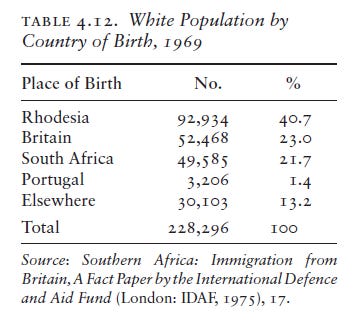
It is a self-evident truth that the colonist is an impostor, but it helps to have demographic statistics that confirm the futility of the Rhodesian impostors’ attempts to establish a population foothold in Zimbabwe. It is revealing that throughout Rhodesia’s history, the foreign-born White population consistently exceeded those born in the country. As late as 1969, 59% of the White population were foreign born. Of these, more than 55% arrived after the Second World War.[22] Roger Howman, a Rhodesian civil servant for 54 years, observed that “the Census of 1956 revealed that less than 15 per cent of white Rhodesians over the age of 20 were born in the country. The great bulk of immigrants – many only moving in after World War II – identified themselves as British.”[23]
At the height of White Rhodesian stupidity in 1975, statistics showed that of the 277,000 Whites ruling over 6 million Africans, fully 40% of the total (111,272) had arrived in the previous 10 years, after 1965.[24] The White population more than tripled in the post-war period from 69,000 in 1941 to 218,000 in 1960.[25] This is how foreign the White minority were to the land. The Rhodesian government had to keep importing White foreigners to buttress their little White island. It is thus fair to say White Rhodesians collectively weren’t really Rhodesian. They were Europeans coming to Africa on a power trip – no different than Rhodes’ founding brigands in 1890.
This White migration would have been entirely unproblematic and unworthy of mention were it not for the fact that this White minority had succeeded in driving the indigenous people off their land, exploited them as a pool of cheap labour, and excluded them from voting to change the government. That was the problem; not the migration itself.
Carole Klein, a Lessing biographer, remarks on a particular type of English émigré to Rhodesia with whom Lessing was familiar. These young, idealistic Englishmen would arrive in Rhodesia, but:
“… most never stayed for more than a year – and were shocked by their first view of overt racism. They would dash around for a while, condemning what they observed, then would either leave or adopt the repellent values, often becoming more rigid than the people who had lived there for a lifetime.”
The reason for the conversion to racism was that unless progressive convictions were “deeply and genuinely rooted, they seldom win out over self-interest.”[27]
As surprising as the turnover of White immigrants in Rhodesia is, it is heartening testimony to basic human decency that most of them simply couldn’t remain in Rhodesia. Those who couldn’t adjust to treating the African as an impostor in the land of his birth simply went back. It seems that most could not adapt to a social and political set-up that represented an unnatural state of affairs. Ian Smith, who took office in 1964, was the first Rhodesian Prime Minister to have been born there.
A 1976 CIA report[28] on “The Economic Aspects of White Resettlement” of Rhodesians infuriatingly described Rhodesia as “a nation of immigrants”. The parasitic ruling class were certainly immigrants but they made up less than 5% of the total nation. It was therefore a CIA racist slip of the tongue to exclude 95% of the population from the rubric of “nation”, and to describe the whole nation as a “nation of immigrants” simply because those who occupied all the positions of power were immigrants.
One of the many idiotic claims made in Unbekoming’s defence of colonial Rhodesia relates to the reason for White emigration from the country after independence: “The white population in Zimbabwe dramatically declined from nearly 300,000 to nearly 50,000 by the year 2000… fleeing increasing persecution and violence”. It is clear from the numbers I quoted on White migration to Rhodesia that, after independence, White Rhodesian foreigners returned home, leaving White Zimbabweans.
Providing evidence for political persecution in Zimbabwe not being race based would be easy but is beyond the scope of this essay since this is an examination of claims about colonial Rhodesia, not post-independence Zimbabwe. For what it’s worth I will say that when I, as a Black Zimbabwean, left Zimbabwe in 2000, the firm I worked for had more White partners than Black, and they were no more ‘persecuted’ than anyone else. They were White Zimbabweans, not Rhodesians. I can also categorically state that I have, since 2020, suffered more political persecution in the UK than I ever suffered in Zimbabwe. There is no place in the world today free from political persecution, and the days of singling out African countries as the perpetrators of persecution are long gone. In keeping with Lord Rea’s observations in 1965, those who cling to their identity as Rhodesians today continue to display their unique brand of backwardness in failing to keep up with world trends.
Given the demographic statistics of White Rhodesians and their origins, the steep decline in the number of White Rhodesians is simply a case of foreigners taking their leave.
Lord Rea was certainly not the only one to take note of Rhodesian backwardness. It was in fact impossible to ignore, unless you were a backward Rhodesian. John Parker’s book, Rhodesia – Little White Island, provides hilarious insights into just how barmy those foreigners had become in the last days of the their final UDI stand. UDI – the illegal Unilateral Declaration of Independence – sounds like a venereal disease, but was much more lethal for Africans, who suffered by far the most deaths in the ensuing bloody civil war. Below, Parker describes one of many instances in which he encountered Rhodesian backwardness during his flirtation with trying to become Rhodesian as an English émigré during the post-war White immigration flood:
“All communities are to some extent bound by their past; after all, the present is founded on it. White Rhodesians, Old and New, are swathed to the eyebrows with their history, perhaps because there is not much of it. In 1967, two years after UDI, a television executive in Rhodesia who had left in disgust to live in London received a letter from his former boss in Salisbury. It offered him a job better than his old one, at vastly enhanced salary, and went on: ‘What we are trying to do here now is to re-create the Rhodesia of the 1920s and ’30s. I am sure we will succeed, and I am sure you are the man to help us do so.’ Apart from the attitude of facing what is to come with your eyes firmly fixed on what may have happened forty years ago, the remarkable thing about this letter is that it was written by a man who himself became a Rhodesian only in 1960! There is no reason to doubt his sincerity. I am sure he meant every word he wrote from the bottom of his heart. But the fact remains that in 1970, three years after writing the letter, its author himself was back in London, looking for a job. Perhaps he found the task of re-creating the past beyond him.”
When one scrapes the surface of the settler psyche, one is less surprised by the initial refusal of White Rhodesians in 1965 to let go, although as we can see from the above, even the more barmy ones had to let go. That left the most unhinged hanging on for dear life until 1980. Most of this barmy army had just arrived after the war, having sold up in the UK to get their easy life of cheap servants, sunshine and a guaranteed managerial status in the economy based on colour, not competence. Bolstered by those who had been there before the war, they too learnt quickly not to let go of what they regarded as ‘theirs’ – a piece of land, more than one and half times the size of the United Kingdom, stolen by a handful of brigands in occupations and wars between 1890 and 1897, and handed down to them by succeeding generations of colonists.
This then is what the Rhodesian, @davemorkel, quoted by Unbekoming, refers to as his ‘legacy’. The majority of Rhodesians at any given time were not even born in Rhodesia, and given that the Rhodesian legacy begins in 1890 with occupation, land theft and conquest, Morkel needs to be reminded that pirates also have ‘legacies’.
Having examined how the land was stolen, we will go on in Part V to examine how the African was squeezed off the best land, and how it was divided into ‘European’ and ‘African’. Land was the first core pillar of Rhodesian segregation.
If you liked this article but don’t want to commit to a paid subscription, please consider rewarding my writing using the BuyMeACoffee link below. Thank you!
[2] Arthur Keppel-Jones, Rhodes and Rhodesia: The White Conquest of Zimbabwe 1884-1902, Kingston and Montreal, McGill-Queens University Press, 1983, Ch. 9, pg. 362.
[13] Edited by Robin Palmer and Neil Parsons, The Roots of Rural Poverty in Central and Southern Africa, Berkeley: University of California Press, 1978, Ch. 9, pg. 225.
[21] Institute of Contemporary British History, Britain and Rhodesia: The Route to Settlement, 2008, https://www.kcl.ac.uk/sspp/assets/icbh-witness/rhodesia2.pdf
[22] Alois S. Mlambo, A History of Zimbabwe, New York, Cambridge University Press, 2014, Ch. 4, pg. 80.
[23] H.R.G. Howman, Provincialisation in Rhodesia 1969-1969: https://www.african.cam.ac.uk/system/files/documents/rhodesia.pdf
[24] International Commission of Jurists, Racial discrimination and repression in Southern Rhodesia – ICJ report: https://www.icj.org/wp-content/uploads/1976/01/Southern-Rhodesia-Racial-discrimination-and-repression-report-1976-eng.pdf


Comments are closed.